The cost of a quiet title action typically runs $1,500 to $5,000 in attorney fees for a straightforward, uncontested case, plus $250–$500 in court filing fees, $100–$400 for a title search, and $125–$300 for newspaper publication if any heirs or lienholders can't be located. Contested cases with real opposition can run well past $5,000–$8,000 once hearings or discovery enter the picture. If you've been told you need to “quiet title” before you can sell, it usually means a title company or an attorney found something in the property's history that they won't insure around without a court order. That's a specific, fixable problem — but it costs real money and takes real time, and the price tag depends heavily on how many people (or how few) show up to contest it. A quiet title action is, formally, “a special legal proceeding to determine ownership of real property” (<a href="https://www.law.cornell.edu/wex/quiet_title_action">Cornell Legal Information Institute</a>) — a lawsuit against anyone who might have a competing claim, resolved by a court judgment that establishes clear ownership going forward. This guide breaks down where the money actually goes, how long the process realistically takes, and what alternatives exist if a lawsuit isn't the only path forward.
Takes about two minutes. Or call
(313) 710-6129 — we answer.
Educational only. This explains how these situations generally work. It is not legal, tax or financial advice, and the rules differ by state — talk to an attorney or CPA about your own situation before you act on any of it.
How Much Does a Quiet Title Action Cost?
For an uncontested quiet title action — no one shows up to fight it — total cost including attorney fees, the court filing fee, a title search, and publication typically falls in the $1,500–$5,000 range, according to figures commonly cited by real estate attorneys who handle these cases.
Attorney fees are the largest piece, usually billed either as a flat fee or hourly at roughly $200–$400 per hour depending on the market. Court filing fees generally run $250–$500 depending on the county and state. Contested cases cost more because attorney time is the main cost driver and a contest means more of it: responding to an answer, attending hearings, possibly taking depositions, and potentially going to trial. Fees in a contested matter can exceed $5,000 and, in more complex disputes with multiple defendants or an appeal, run into five figures. Costs also vary by state — cited examples put Florida's typical range around $1,500–$4,000, while more procedurally involved states can run $3,000–$9,000 for straightforward matters.
What Actually Triggers the Need for a Quiet Title Action?
Sellers usually end up here for one of a handful of reasons: an inherited property with heirs who are missing, deceased, or simply unlocatable; an old lien or mortgage that was paid off but never formally released from the record; a deed with a legal description error, missing signature, or other defect; a boundary or easement dispute with a neighbor; a gap in the chain of title going back several owners; or the need to clear title after buying a property at a tax deed sale.
In each of these situations, the public record shows a “cloud” — a claim, an ambiguity, or a missing link — that keeps a title company from certifying the title as clean. A quiet title action asks a court to review the evidence and issue a judgment that formally resolves the cloud, so the record matches reality.
How Long Does a Quiet Title Action Take?
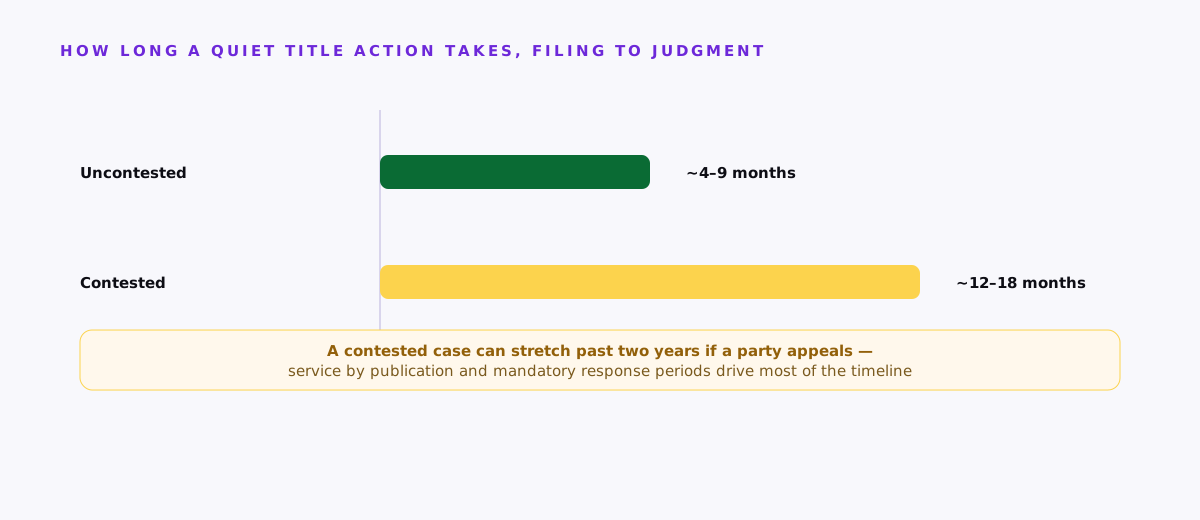
Uncontested quiet title actions commonly take roughly four to nine months from filing to judgment, while contested cases typically run twelve to eighteen months and can stretch past two years if a party appeals.
The timeline is driven less by the legal argument itself and more by procedural steps: locating and formally serving every possible claimant, waiting out the response period the law gives defendants, and getting a hearing date on a court's calendar. Three things extend the clock in particular. First, unknown or unlocatable defendants require “service by publication” — running a legal notice in a newspaper of general circulation, usually once a week for three to four consecutive weeks, before the court will treat them as served. Second, most jurisdictions require a waiting period (often 30 days or more) after service before a default judgment can be entered against a non-responding party. Third, even an uncontested case still needs a judge's time — quiet title generally isn't a rubber-stamp process, since the court typically has to review the plaintiff's evidence of title before entering judgment, regardless of whether anyone objects.
Service by publication and mandatory response periods drive most of the timelineRestar Acquisitions · general process, not a specific case
Why Won't Title Insurance Just Cover the Defect?
Title insurance underwriters price policies against risks they can quantify from the public record — they aren't in the business of insuring over a known, specific, unresolved claim. Mortgage investors reinforce this from the other side: Fannie Mae's own guidelines require “a title insurance policy in place… that meets Fannie Mae's requirements” before it will purchase a loan (Fannie Mae Selling Guide, B7-2-01), which is exactly why a buyer's lender won't fund a purchase without one.
When a title search turns up a real defect (a missing heir's potential interest, an unreleased lien, a break in the chain of title), the underwriter's usual answer is to require either curative work that fixes the record directly, or a quiet title judgment that legally extinguishes the competing claim. Only then will they issue a clean policy. This is the mechanism that actually pushes sellers into a quiet title lawsuit: it's rarely the seller's decision in isolation. A buyer's lender requires an insurable title to fund the loan, the title company won't insure around the defect, and a quiet title judgment (or a cheaper curative fix, where one is available) is what converts an uninsurable title into an insurable one.
A Worked Example: Illustrative Cost Breakdown
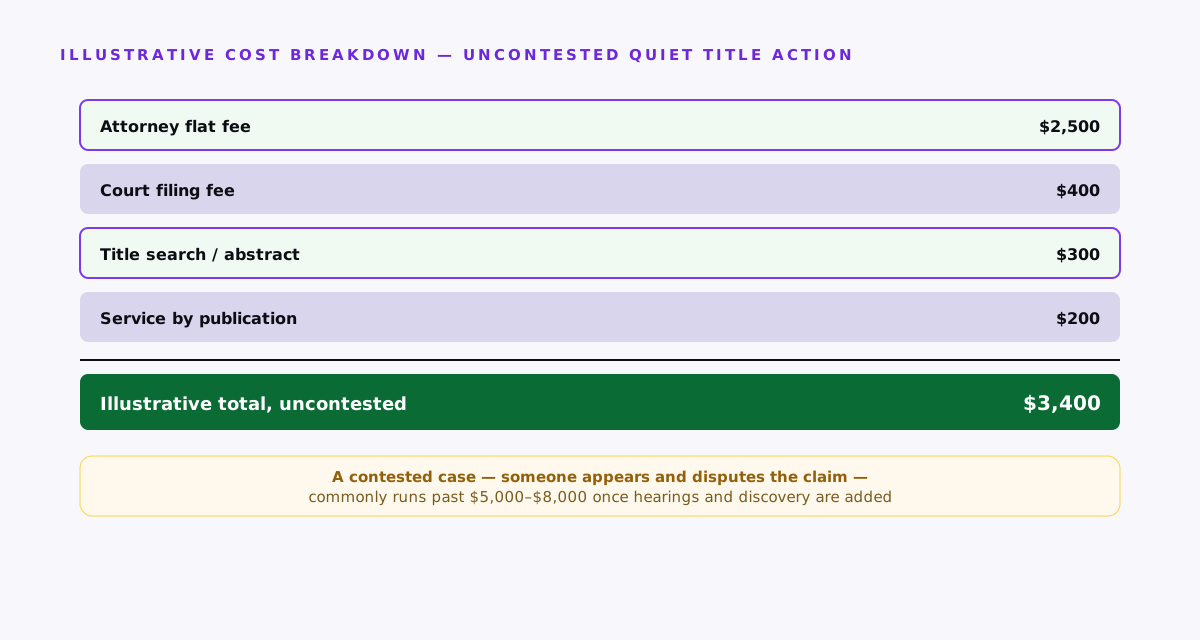
The figures below are a hypothetical, illustrative example only — not a quote, and not what any specific case will cost. It models an uncontested case involving one heir who could not be located and required publication.
A contested case commonly runs past $5,000–$8,000 once hearings and discovery are addedRestar Acquisitions · worked example from this page
Cost item
Illustrative amount
Notes
Attorney flat fee
$2,500
Mid-range for an uncontested case, within the commonly cited $1,500–$5,000 range
Court filing fee
$400
Varies by county/state, commonly $250–$500
Title search / abstract
$300
Confirms the chain of title and identifies all potential claimants
Service by publication
$200
3–4 weekly notices in a local newspaper, commonly cited around $125–$300
Illustrative total
$3,400
Uncontested scenario; excludes any contested litigation costs
If this same case were contested — say a distant heir appeared and disputed the claim — added attorney time for a response, discovery, and a hearing could push total cost past $5,000–$8,000, and the timeline from filing to judgment could stretch from months to well over a year.
Alternatives
A lawsuit isn't always the only way to clear a title problem. Depending on the defect, curative work can resolve it for far less money and time:
Obtaining a lien release. If an old mortgage or judgment was actually paid off but the release was never recorded, tracking down the lienholder (or their successor) for a payoff letter or release can clear the record without ever going to court. See our guide on selling a house with a lien on it.
A corrective deed. Simple errors — a misspelled name, a wrong legal description, a missing signature — can sometimes be fixed with a corrective deed signed by the original parties, rather than a lawsuit.
An affidavit of heirship, where state law allows it, can establish who inherited a property without formal probate or litigation, which matters if you're selling an inherited house with unclear ownership.
The other real alternative is the buyer, not the process. A retail buyer's lender will almost always require clean, insurable title before funding a loan — so a retail sale typically cannot close until a defect is either cured or quieted. A cash buyer without a lender in the loop has more flexibility: they can sometimes purchase subject to a known, disclosed title issue, or agree to wait through a curative process on a timeline that doesn't hold up the seller. That flexibility doesn't eliminate the defect — it changes who's positioned to deal with it and when. For background on how insurability drives this whole conversation, see our guide on title insurance cost, explained.
A Note on How We Fit In
Restar Acquisitions buys houses directly, as-is, for cash, across 45 markets in 12 states: Alabama, Arizona, Florida, Georgia, Indiana, Maryland, Michigan, Missouri, North Carolina, New York, Ohio, and Texas. We give a written offer within 24 hours of seeing a property, we don't require repairs, and we don't charge commissions. We are not real estate agents or brokers, and we don't represent sellers in a transaction.
We are also not a law firm, and nothing here is a substitute for advice from a real estate attorney who has actually looked at your title report. If you're dealing with a title defect, the right first call is an attorney or title company who can tell you whether curative work is enough or whether a quiet title action is genuinely necessary in your situation.
This article is for general educational purposes only and is not legal or tax advice. Quiet title procedures, fees, and timelines vary by state and county. Talk to a licensed real estate attorney about your specific title issue before deciding how to proceed.
Common questions
Do I have to hire an attorney to file a quiet title action?
Most states don't legally require an attorney for a quiet title action, but the procedural requirements — proper service, publication notices, proving title to the court's satisfaction — are technical enough that self-representation carries real risk of delay or a dismissed case. Most sellers use an attorney for this reason.
Can I sell my house while a quiet title action is pending?
Generally not to a retail buyer with a lender, since the title is not yet insurable. Some cash buyers will consider purchasing subject to a pending or resolved title issue; talk to both a real estate attorney and any prospective buyer about what's realistic in your specific case.
What is service by publication, and why does it cost extra?
When a defendant in a quiet title case (like a missing heir) can't be located after a diligent search, the law allows notifying them through a newspaper legal notice instead of personal service. It typically runs once a week for several consecutive weeks in a newspaper of general circulation, which adds a real, billable cost and adds time to the case while the publication period runs.
Will title insurance ever cover a known defect without a quiet title judgment?
Sometimes, if the defect can be resolved through curative work alone — like recording a missing lien release or fixing a deed error — an underwriter may insure around it once that paperwork is in order. But for defects involving competing ownership claims, unlocatable heirs, or a real break in the chain of title, underwriters typically require either curative work or a completed quiet title judgment before issuing a policy.
How much does an uncontested quiet title action typically cost compared to a contested one?
Uncontested cases are commonly cited in the $1,500–$5,000 total range for attorney fees, filing fees, a title search, and publication. Contested cases, where attorney time expands for hearings, discovery, or trial, are commonly cited well above $5,000 and can run into five figures depending on complexity.
What happens if I just try to sell without addressing the title defect?
A title company will typically flag the defect during its search and decline to issue a clean policy, which means a retail buyer's lender will not fund the loan. The sale usually cannot close on the buyer's terms until the defect is cured or quieted — which is why sellers often end up looking at this process, or at a cash buyer who can work with the timeline.
Have a title issue and want an honest read on your options?
We sometimes can work with a known, disclosed title issue on a timeline a retail buyer's lender can't — but we're not a law firm, and if you need a quiet title judgment first, we'll tell you that plainly.
Every offer on this site is underwritten by a person, not a form. If the
numbers do not work for you, say so and I will tell you what would.
Also from Restar
Want the data behind all of this?
Restar Acquisitions is the acquisitions arm of Restar — a housing-market analytics
platform tracking 180+ metrics across every U.S. market, with composite scores and 12-month
price forecasts. The numbers on this page come from the same work.