Selling a house during a will contest is usually on hold, not impossible. Once someone files a formal challenge — a caveat, a notice of contest, or a lis pendens — title insurers generally won't insure a sale until the dispute resolves, because a buyer's clear title depends on which version of events a probate court ultimately accepts. The house can often still be sold once the contest resolves, or an heir can sell their own contingent inheritance interest in the meantime, at a real discount.

Step 1 of 5
Tell us where the contest stands and whether a caveat or lis pendens has been recorded. We'll give you a straight answer, including when waiting it out nets more than selling now.
You’ll talk to Trevor McAmis, Owner & Acquisitions Lead
(313) 710-6129
Takes about two minutes. Or call (313) 710-6129 — we answer.
Educational only. This explains how these situations generally work. It is not legal, tax or financial advice, and the rules differ by state — talk to an attorney or CPA about your own situation before you act on any of it.
A will contest is a formal legal challenge to a will's validity, filed in probate court (or, in some states, the circuit or superior court that oversees probate appeals) by someone with a financial stake in the outcome — typically a beneficiary under the will being challenged, or an heir or beneficiary under a prior will who would inherit more if this one were thrown out. Someone with no financial stake in the estate generally doesn't have standing to contest it at all.
The grounds that actually show up in these cases: the testator lacked the mental capacity to understand what they owned or who their natural heirs were when they signed; someone exerted undue influence strong enough to override the testator's own free will; the will was procured by fraud; it wasn't executed properly (missing witnesses, improper signing, no notarization where required); or it was validly revoked by a later document.
Lawyers who handle these cases commonly describe contests that settle early resolving in well under a year, and contests that go to trial running considerably longer — sometimes several years — though there's no single authoritative dataset nailing down an average. One of the only real empirical studies of this, a 2022 University of Illinois Law Review analysis by David Horton and Reid Weisbord that tracked 443 California probate administrations from filing to final distribution, found that contests which do settle tend to settle for a meaningful share of the claim's value rather than getting dismissed outright — one reason these disputes often don't resolve quickly.
Technically, an executor or personal representative often retains legal authority to sell estate property even with a contest pending — nothing in most probate codes automatically freezes every transaction the moment someone files a caveat. In practice, selling mid-contest is treated as risky enough that most executors seek court approval first, and a probate court can authorize a sale during an active dispute if the executor shows it's in the estate's best interest.
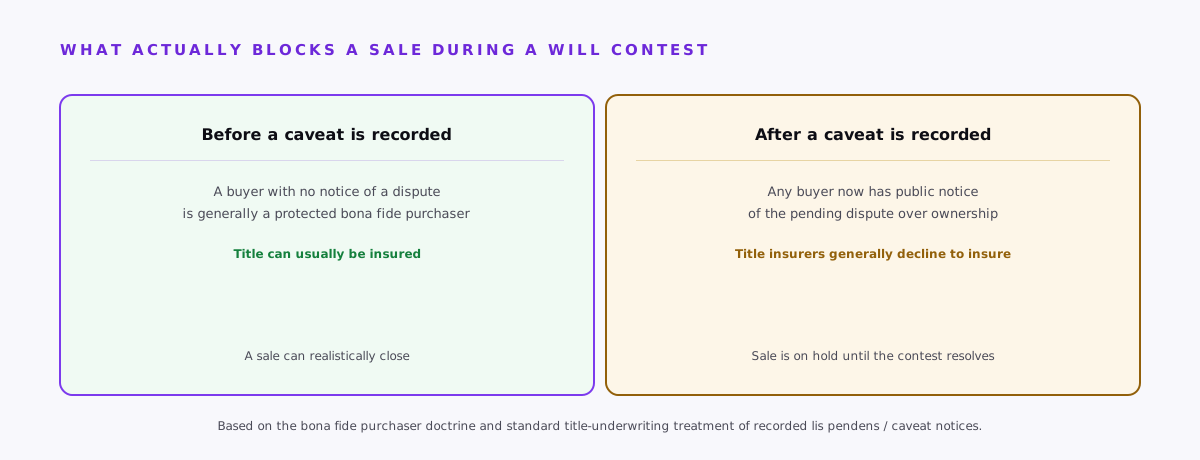
A deteriorating property or mounting carrying costs are the usual justification for an interim sale like this. When a court does authorize one, proceeds are typically held in trust rather than distributed, pending the contest's outcome. The practical blocker isn't usually the executor's authority — it's the title company. Once a caveat, notice of contest, or lis pendens is on record, it puts the world on notice that ownership is disputed, and title insurers routinely decline to insure over an open dispute like that: if the probate court later rules against the party who sold, the buyer's claim to clear title is clouded by a notice that existed before they ever closed. Once a court resolves the dispute and clarifies who actually owns the property, title companies will typically insure based on that ruling.
This is educational information, not legal advice. Whether your specific court will authorize an interim sale, and what a title company will accept, depends on your state's probate code and the facts of your case — talk to a probate attorney before assuming either way.
A lis pendens — Latin for "suit pending" — is a public notice recorded against a property's title, warning that anyone who buys takes the property subject to whatever the lawsuit ultimately decides. Once it's recorded, prudent lenders won't lend against the property and title insurers won't insure it, and it stays in effect until the underlying suit is resolved. (Lis pendens, general doctrine)
Many states use a specifically-named "caveat" filing for will contests instead of a generic lis pendens, but it functions the same way for underwriting purposes: it signals that ownership is contested, which is exactly the kind of risk a title policy is built to avoid insuring over. Importantly, a recorded notice doesn't legally void a sale that happens anyway — a seller can still sign a deed over to a buyer. What it does is strip away the buyer's ability to claim they had no notice of the dispute, which is the thing that normally protects an innocent purchaser if a will contest later succeeds.
An heir who doesn't want to wait out a contest has another option the executor doesn't: assigning their own expected inheritance interest to someone else, rather than selling the house itself. An assignment like this is executed in writing and filed with the probate court before the transfer takes effect.
It's a real, usable tool, but it comes with sharp edges: the assignment is irrevocable once made, there's no fixed deadline for doing it (unlike the much shorter window to formally disclaim an inheritance), and it can create real tax complications for both sides that a CPA, not a real estate agent, needs to sort out. Because the buyer in this scenario is only acquiring a contingent claim — not clean title to a specific house — pricing on these deals is individually negotiated and reflects the real uncertainty the buyer is absorbing; there's no public benchmark rate to quote.
Contest deadlines are set by state probate codes and range from a few months to several years, measured from different trigger events (the date the will is admitted to probate, the date formal notice is served, or the date a personal representative is first appointed). Here's what's confirmed directly from the statute text in states where Restar buys houses:
| State | Deadline to contest | Measured from |
|---|---|---|
| Missouri | 6 months | Probate order or first publication of notice, whichever is later (RSMo §473.083) |
| Indiana | 3 months | Order admitting the will to probate (IC §29-1-7-17) |
| Ohio | 3 months | Certificate of notice filed under the probate code (ORC §2107.76) |
| Florida | 3 months (outer limit 1 year) | Service of the Notice of Administration (Fla. Stat. §733.212) |
| Maryland | 6 months | First appointment of a personal representative (Md. Est. & Trusts §5-207) |
| Arizona | 12 months (or 2 years from death for informal probate) | Informal probate order (A.R.S. §14-3108) |
| Texas | 2 years | Date the will was admitted to probate (Tex. Estates Code §256.204) |
| North Carolina | 3 years (36 months) | Application for probate (N.C.G.S. §31-32) |
North Carolina's 3-year window (36 months from the application for probate) got narrower in one respect via a 2024 amendment, which added a bar preventing a later caveat from anyone who was properly served notice during a solemn-form probate proceeding.
Alabama is widely described as allowing a contest in probate court before admission, then requiring it be refiled in circuit court within 6 months after admission — but that figure comes from secondary legal sources rather than statute text we could independently verify, so treat it as a starting point for a conversation with a local attorney, not a hard deadline. Georgia and Michigan's exact numeric deadlines likewise could not be confirmed against primary statute text as of this writing. New York doesn't use a simple fixed months-or-years deadline at all — its objection window is tied to the citation and return-day process of the specific probate proceeding, not a flat statute of limitations. (N.Y. SCPA §1410) If your house is in any of these four states, the honest answer is: get the deadline confirmed by a probate attorney reading your state's current code, not from an article.
The doctrine that generally protects a buyer here is the "bona fide purchaser" rule: someone who pays fair value for a property without notice of a competing claim is usually protected even if a will is later successfully contested — provided no caveat, lis pendens, or similar notice was on record at the time they bought. If the will is thrown out after a clean sale like that, the contest winner's remedy typically shifts to money damages against the estate or the executor personally, not unwinding the sale and taking the house back from the buyer.
This is precisely why a recorded caveat or lis pendens changes the picture so completely: once that notice exists, a buyer can't credibly claim they had no idea anything was disputed, so the bona fide purchaser protection doesn't apply to them — which is exactly the exposure a title company is pricing in when it declines to insure.
Here's a worked comparison for a $240,000 house with a will contest pending, where the heir doesn't want to assign away their interest and instead waits for the title to clear before selling:
| Route | Gross price | Carrying costs while waiting | Commission | Net to seller | Timeline |
|---|---|---|---|---|---|
| Wait ~14 months for the contest to resolve, then list with an agent | $240,000 | ~$9,800 (taxes, insurance, upkeep on a vacant house for 14 months) | ~6% (−$14,400) | ~$215,800 | 14+ months waiting, then 60–90 days to sell |
| Wait ~14 months for the contest to resolve, then sell as-is for cash | ~$211,200 | ~$9,800 (same holding period) | $0 | ~$201,400 | 14+ months waiting, then 2–3 weeks to close |
Waiting it out and listing normally nets the most in this example, because nothing about the math changes once title is clear — the house is worth what it's worth, and a conventional buyer pool pays retail. A cash sale makes sense here specifically when the heir can't carry 14 months of property taxes, insurance, and upkeep on a house sitting vacant during the dispute, or simply wants the whole thing over with the moment title clears rather than adding another 60 to 90 days of listing and showings on top of a drawn-out legal fight they've likely already been dealing with for over a year.
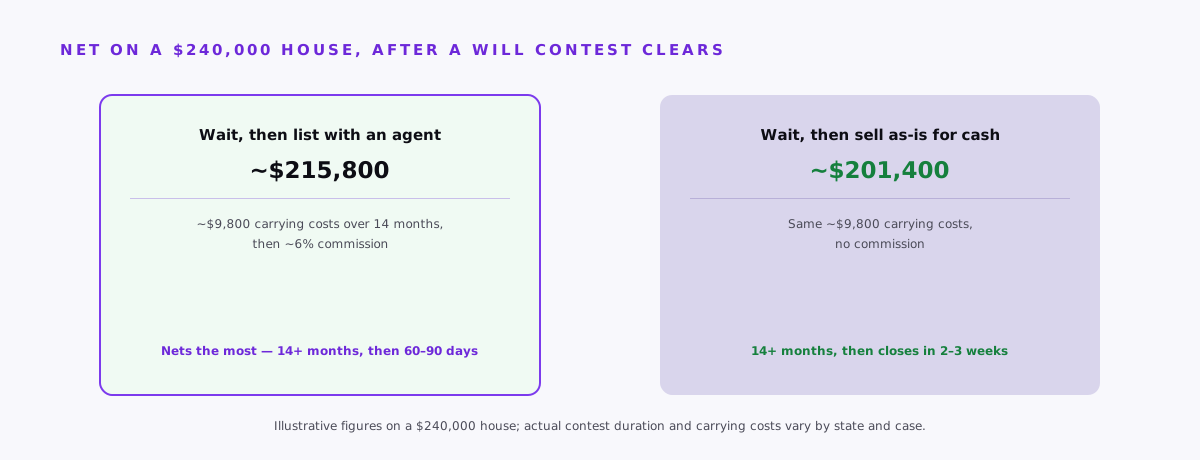
If a caveat or lis pendens is already recorded, we can't close until the dispute resolves — no buyer can. But the moment title clears, a cash sale can close in 2 to 3 weeks instead of the 60 to 90 days a normal listing adds on top of whatever you've already been through.
Send us the address and where things stand in probate, and we'll tell you honestly whether listing or a cash sale nets you more once you're clear to sell. No cost, no obligation.
All guides · Selling an inherited house · When heirs cannot agree to sell · Selling a house held in a trust
Step 1 of 5
No obligation, no fees, no repairs. We respond the same day.
You’ll talk to Trevor McAmis, Owner & Acquisitions Lead
(313) 710-6129
Takes about two minutes. Or call (313) 710-6129 — we answer.