A right of redemption lets a former owner reclaim a foreclosed house after the sale by paying the full sale price plus interest and costs, but only in states that grant it, and only for a set window. Roughly half the states have no post-sale redemption at all. Where it exists, most owners can't raise the cash in time.
Step 1 of 5
Tell us where things stand with your foreclosure. We'll put a written offer in front of you instead of asking you to race a redemption clock later.
You’ll talk to Trevor McAmis, Owner & Acquisitions Lead
(313) 710-6129
Takes about two minutes. Your address is never shared.
Educational only. This explains how these situations generally work. It is not legal, tax or financial advice, and the rules differ by state. Talk to an attorney or CPA about your own situation before you act on any of it.
The right of redemption after a foreclosure sale is a state law that lets the former owner buy the house back from whoever won it at auction, for a fixed period after the sale closes. It is separate from the "equity of redemption," which is the right to stop a foreclosure before the sale by paying off the full debt. Once the gavel falls, equity of redemption ends. Statutory redemption, if your state has it, starts the clock running in the other direction.
Whether you get one, and for how long, depends entirely on two things: which state the house is in, and whether the lender foreclosed judicially (through a court) or non-judicially (through a power-of-sale clause in the deed of trust, no judge involved). Both of those vary by state, and the two interact in ways that surprise most sellers.
There's no national rule here. Four real examples from markets we buy in show how differently this plays out.
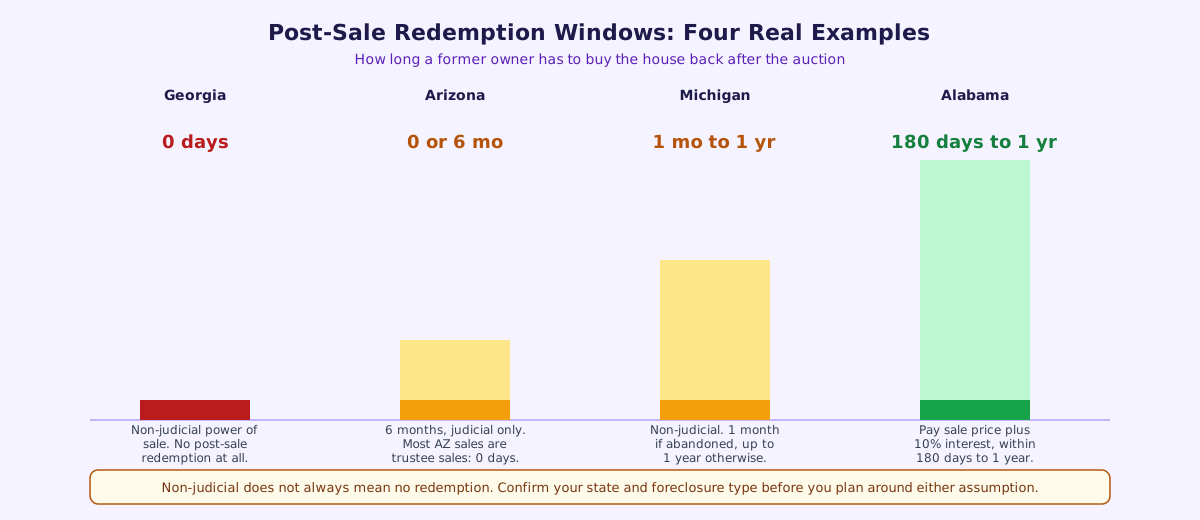
Alabama gives one of the longest windows in the country. Under Alabama Code Section 6-5-248, a former owner generally has one full year after the sale to redeem a non-homestead property. For a homestead mortgage originated on or after January 1, 2016, the window shortens to 180 days if the lender gave proper redemption notice at least 30 days before the sale. To redeem, you pay the purchaser the sale price, plus 10% interest, plus any taxes and lawful charges the purchaser paid in the meantime.
Arizona's right of redemption depends entirely on which kind of foreclosure happened. A judicial foreclosure carries a 6-month redemption period (30 days if the property was abandoned). But the large majority of Arizona foreclosures are non-judicial trustee sales under a deed of trust, and Arizona law gives no post-sale redemption right at all for those. If your lender used a trustee sale, which is the default in Arizona, there's nothing to redeem once it's done.
Georgia gives none, full stop. Georgia is a non-judicial, power-of-sale state, and the equity of redemption simply ends when the auction concludes on the courthouse steps. There is no statutory window afterward. The only redemption right under Georgia law applies to tax sales, a separate process entirely, so don't let anyone conflate the two.
Michigan is the counterexample that breaks the "non-judicial means no redemption" assumption. Michigan forecloses mortgages by advertisement, a non-judicial process, yet still grants a real post-sale redemption window under MCL 600.3240: 6 months from the sale date in most cases, 1 year if less than two-thirds of the original loan balance had been paid down (or if the property is agricultural), and just 1 month if the property was abandoned.
That range, zero days in Georgia, up to a year in parts of Michigan and Alabama, is why you cannot assume anything about your own timeline from a general article, including this one. Confirm your state's rule and which kind of foreclosure your lender used before you plan around a redemption date.
Redemption is not a discount. In every state that offers it, you generally owe the full price the property sold for at auction, not what you originally owed on the mortgage, plus statutory interest (10% in Alabama) and whatever taxes, insurance, or repairs the purchaser paid while they held it. If the house sold at auction for less than market value, which is common, redeeming it still means coming up with that full sale amount in cash or new financing, inside a window measured in months.
That's the practical catch. Getting a new mortgage approved while you have a foreclosure sale on record, inside a 30-, 180-, or 365-day clock, is difficult even for borrowers with otherwise strong credit. Most people who qualify for a right of redemption never use it, not because the law doesn't exist, but because the money isn't there.
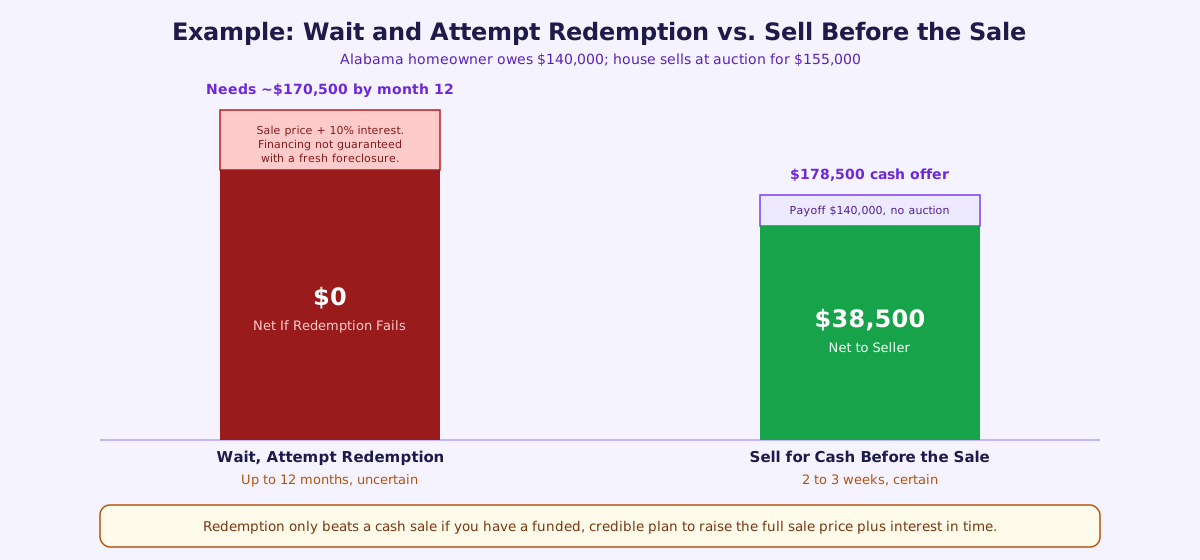
Example: a homeowner in Birmingham, Alabama owes $140,000 on a mortgage on a house worth $210,000 as-is. The lender forecloses and the house sells at auction for $155,000, well under market value, which is typical at a foreclosure sale. To redeem under Alabama's one-year window, the owner would need $155,000 plus 10% interest, roughly $170,500 by month 12, in cash or new financing, with a foreclosure already on their credit file making that financing harder to get. Selling the house before the auction, instead of waiting to see if redemption is even possible, changes the math entirely.
| Wait, Then Attempt Redemption | Sell for Cash Before the Sale | |
|---|---|---|
| As-is value | $210,000 | $210,000 |
| Cash offer (reflects as-is condition, speed) | n/a | $178,500 |
| Mortgage payoff | -$140,000 | -$140,000 |
| Auction sale price (if it proceeds) | $155,000 | avoided |
| Redemption cost needed by month 12 (price + 10%) | ~$170,500 | $0 |
| Realistic access to that cash or financing | Uncertain | n/a |
| Net to seller if redemption fails (typical outcome) | $0, house lost | ~$38,500 |
| Timeline | Up to 12 months, outcome uncertain | 2 to 3 weeks, certain |
If this owner could actually raise $170,500 in cash within a year, redemption gets the house back outright, which beats any cash offer. That's the real tradeoff: redemption is only worth pursuing if you have a credible, funded plan to come up with the full sale price plus interest, not a hope that something will work out. Most owners don't have that plan, which is why selling before the sale, while you still control the price and the timeline, is usually the stronger move.
Loan modification or reinstatement, if you can catch up what's owed or get new terms before the sale date, stops the foreclosure before redemption ever becomes relevant. Your servicer is required to discuss loss mitigation options; see the Consumer Financial Protection Bureau's loss mitigation guide for what to ask for.
A deed in lieu of foreclosure, negotiated with the lender before the sale, avoids the auction and the credit hit of a completed foreclosure, though it still ends in losing the house.
Listing the house for sale, right up until the scheduled auction date in most states, puts you in control of the price instead of letting an auction set it.
Selling to a cash buyer before the sale, which is what the table above compares, converts an uncertain, time-boxed legal right into a certain number on a certain date.
An attorney licensed in your state can confirm your exact redemption rights, the type of foreclosure your lender used, and the real deadline, before you make a plan around any of it. See our foreclosure situation guide for the earlier decision points, our guide on deed in lieu of foreclosure for an alternative to letting it reach auction, and our guide on how long you have to sell before the auction for the window that matters most. Send us the property if you want a written offer before any of these deadlines arrive.
We buy houses facing foreclosure, as-is, with a written offer in 24 hours. No repairs, no commissions, and you pick the closing date. Selling before the sale skips the auction, the credit hit, and any question of whether you could ever afford to redeem the house afterward.
Send us the property here and we'll give you a number before your redemption rights, if you even have any, are the only option left.
All guides · Foreclosure situation guide · Deed in lieu of foreclosure explained · How long you have to sell before the auction
Step 1 of 5
No obligation, no fees, no repairs. We respond the same day.
You’ll talk to Trevor McAmis, Owner & Acquisitions Lead
(313) 710-6129
Takes about two minutes. Your address is never shared.
