A quitclaim deed hands over whatever ownership interest you have, with no promise the title is clear. A warranty deed guarantees clear title and makes the signer liable if a defect turns up later. Neither one, by itself, removes anyone's name from a mortgage.
Step 1 of 5
Send the address. We'll run our own title check and put a written cash offer in front of you within 24 hours, whether the deed in your chain is a quitclaim, a warranty deed, or both.
You’ll talk to Trevor McAmis, Owner & Acquisitions Lead
(313) 710-6129
Takes about two minutes. Your address is never shared.
Educational only. This explains how these situations generally work. It is not legal, tax or financial advice, and the rules differ by state. Talk to an attorney or CPA about your own situation before you act on any of it.
A quitclaim deed moves a specific thing: whatever interest the person signing it holds in the property, on that day, as it stands. It makes no claim about whether that interest is any good. If the signer's ownership is clean, the receiving party gets a clean interest. If there's a lien, a boundary problem, or a co-owner nobody accounted for, the quitclaim deed passes that along too, silently.
That's why quitclaim deeds are fast and cheap to prepare. There's nothing to research or warrant, so a form, a notary, and a trip to the county recorder's office is often all it takes. It's also why a title company treats a quitclaim deed differently when it shows up in a property's history: it tells them nothing about whether the chain of title is clean, so they run their own search regardless of which deed type conveyed the property last.
A general warranty deed is a legal promise. The person signing it is stating they hold clear title, free of undisclosed liens or competing claims, and that they will defend that claim if a problem surfaces later, even one that predates their own ownership. That's the deed type used in most arm's-length home sales, between a buyer and seller who don't know each other and are relying on a title company and legal protections instead of trust.
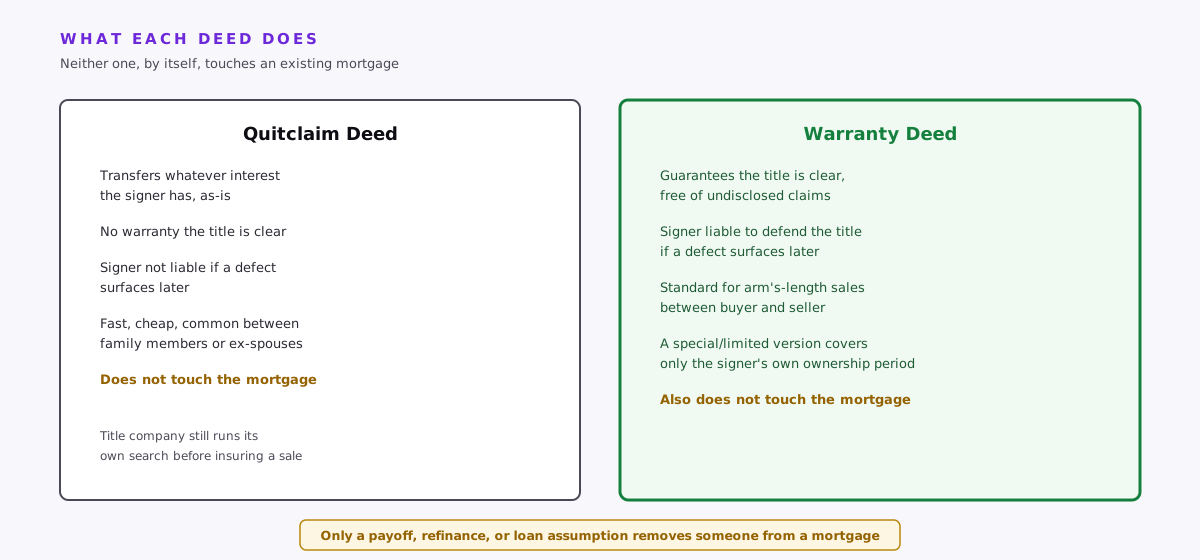
There's a middle version worth knowing: a special (or limited) warranty deed, which only warrants against defects that happened during the signer's own ownership, not anything before. Banks selling foreclosed properties and estates selling inherited houses often use a special warranty deed instead of a general one, since neither can honestly promise what happened to the title before they owned it.
This is the mistake that costs people real money, most often in a divorce. One spouse signs a quitclaim deed giving up their interest in the house. Everyone involved treats that as the end of it. It isn't.
A deed changes who owns the property. A mortgage is a separate contract between the borrowers and the lender. Signing a quitclaim deed doesn't touch that contract at all. The spouse who quitclaimed away their ownership interest is still just as responsible for the monthly payment as the day before, and a late payment still shows up on both credit reports, regardless of who the county records say owns the house now. The Consumer Financial Protection Bureau has documented this exact problem as a recurring source of complaints: people who sign over a house in a divorce, then find out months or years later they're still on the hook for a loan on a house they no longer have any claim to.
Sending the lender a copy of the divorce decree doesn't fix it either. A divorce court can order one spouse to take over the mortgage, but that order only binds the two spouses to each other. It has no power over the lender, who isn't a party to the divorce. The loan stays joint until one of three things happens: it's paid off (commonly through a sale), the remaining spouse refinances it solely in their own name, or the lender formally approves a loan assumption releasing the other party. Nothing else ends the shared liability.
Quitclaim deeds show up constantly, just not usually between strangers. The common situations:
Say a divorce settlement quitclaims the house to one spouse, who stays on the mortgage jointly with their ex because a refinance wasn't approved or wasn't pursued. Every month that house doesn't sell is another month of shared liability hanging over both credit files.
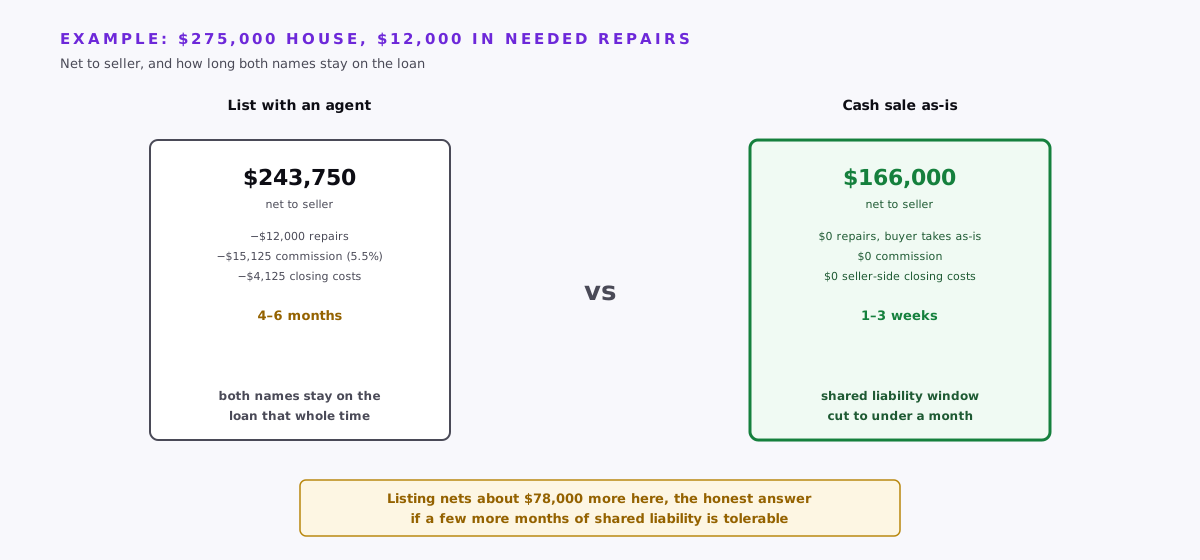
Example: the house is worth $275,000 fixed up, needs about $12,000 in repairs and updates to list at that price, and carries a $165,000 mortgage balance still in both names. Listing it: repairs first, then roughly 60 to 90 days to find a buyer, then 30 to 45 days to close, call it 4 to 6 months from decision to payoff. A cash sale as-is, no repairs, typically closes in 1 to 3 weeks once an offer is accepted.
| List with an agent | Cash sale as-is | |
| Sale price | $275,000 (post-repair) | $166,000 (as-is) |
| Repairs/updates | −$12,000 | $0 |
| Agent commission (about 5.5%) | −$15,125 | $0 |
| Closing costs (about 1.5%) | −$4,125 | $0 |
| Net to seller | $243,750, in 4–6 months | $166,000, in 1–3 weeks |
| Months both names stay exposed on the loan | 4–6 | 0.5–1 |
In this example, listing nets roughly $78,000 more. If the house doesn't need much work and both former spouses can tolerate a few more months of shared liability, listing is very likely the better move, and that's the honest answer. The math changes fast on a house that needs real repair money, where the gap narrows, or in a situation where neither party can qualify to refinance alone and getting both names off the loan quickly matters more than maximizing the last dollar. Run your own numbers before picking a path.
If a quitclaim deed from a divorce, a family transfer, or an estate has left your title looking less than clean, we buy houses as-is for cash, cover standard closing costs, and let you pick the closing date. A written offer in 24 hours means you get a real number while you sort out the deed and the mortgage, not after.
All guides · Buying out a spouse vs selling in a divorce · Due-on-sale clause risk · How a mortgage payoff statement works
Step 1 of 5
No obligation, no fees, no repairs. We respond the same day.
You’ll talk to Trevor McAmis, Owner & Acquisitions Lead
(313) 710-6129
Takes about two minutes. Your address is never shared.
