Every market page publishes the numbers behind its offer. See the math
Home › Guides › What Happens When Your Mortgage Forbearance Ends
Guide
What Happens When Your Mortgage Forbearance Ends
Forbearance pauses your payments — it doesn't erase them, and it doesn't decide for you what happens next. When the plan ends, your missed payments are still owed, and there's no single default outcome. You have to actively work with your servicer to land on one of a handful of real paths, and the earlier you start that conversation, the more of them are still open to you.
Forbearance running out and not sure the math works?
Tell us where you're at with your servicer and what you owe. We'll tell you honestly whether a sale gets you out clean, or whether one of the repayment options is genuinely the better move.
Takes about two minutes. Or call
(313) 710-6129 — we answer.
Educational only. This explains how these situations generally work. It is not legal, tax or financial advice, and the rules differ by state — talk to an attorney or CPA about your own situation before you act on any of it.
What happens when forbearance ends: the short answer
When forbearance ends, your servicer is expected to reach out about loss mitigation options before your final payment pause runs out, and you generally have four real paths: pay the missed amount in one lump sum (reinstatement), add a bit extra to your payment for a while (repayment plan), push the missed amount to the end of the loan (deferral), or permanently change your loan terms (modification). If none of those work, selling before foreclosure keeps you in control of the outcome.
This is educational information, not legal or financial advice. Forbearance terms, servicer obligations, and loss mitigation options vary by loan type (conventional, FHA, VA, USDA) and by investor — confirm your specific options directly with your servicer or a HUD-approved housing counselor.
Forbearance pauses payments — it doesn't cancel them
A forbearance plan is a temporary agreement where your servicer lets you pause or reduce mortgage payments during a hardship. What it is not is forgiveness: every payment you skip is still owed, and it doesn't disappear when the hardship period ends. Standard hardship forbearance plans commonly run in increments, often up to six months at a time, and may be extended depending on your loan type and investor — but most have a cumulative cap, so it's worth confirming your specific limit with your servicer rather than assuming you can keep extending indefinitely.
The single biggest mistake homeowners make with forbearance is treating the end date as someone else's problem to solve. It isn't. You have to initiate the conversation about what comes next, ideally well before your plan's scheduled end.
Your servicer is expected to bring you options before the plan ends
Under the Consumer Financial Protection Bureau's mortgage servicing rules (Regulation X, Section 1024.39), servicers generally must make good-faith efforts to reach delinquent borrowers and discuss available loss mitigation options. The CFPB has proposed strengthening this specifically around forbearance end dates, with a final rule expected sometime in 2026 — as of this writing it isn't finalized, so don't assume a specific notice window applies to your loan until you confirm directly with your servicer. What's already true today: your servicer has an obligation to work with you on options, and Fannie Mae, Freddie Mac, FHA, and VA all publish their own investor-specific loss mitigation waterfalls that most servicers follow.
Don't wait for that outreach to be the reason you start planning. Call your servicer's loss mitigation department directly at least 30 days before your forbearance is scheduled to end and ask, in writing if possible, what options you qualify for.
The four options you'll actually be offered
Reinstatement — pay the full missed amount in one lump sum and your loan goes back to normal. Works if you have savings, an inheritance, or another source of cash, but the amount owed can be substantial after several months of pause.
Repayment plan — your normal payment goes up by a set amount for a period of months until the missed total is caught up. Works if your income has recovered enough to absorb a temporarily higher payment.
Payment deferral — the missed principal and interest gets moved to the back of the loan as a non-interest-bearing balance, due when you sell, refinance, or pay off the loan. Your regular payment and rate don't change. FHA calls its version a partial claim.
Loan modification — a permanent change to your loan terms (rate, term, or both) that folds the missed amount into a new payment structure, generally used when your income has changed and a temporary fix won't hold.
Which of these you qualify for depends on your loan type, investor, and current financial situation — your servicer determines eligibility, not you. Ask about all four rather than accepting the first one offered.
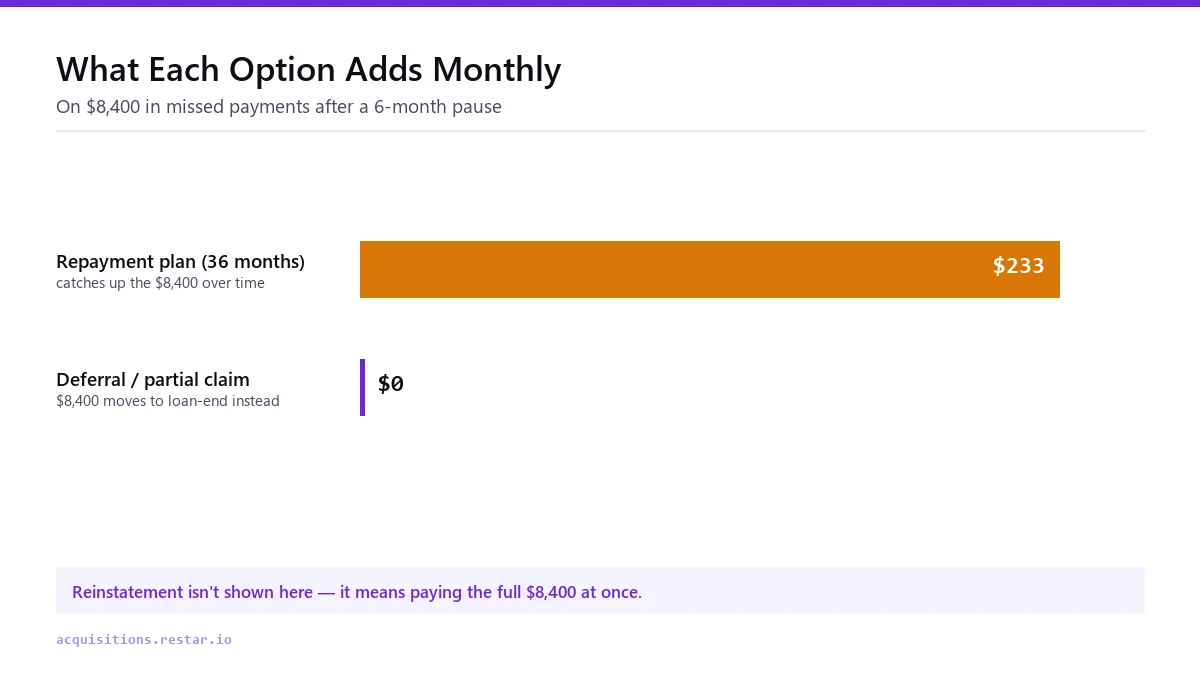
A worked illustration: on a $1,400 monthly payment paused for six months, you'd owe $8,400 in missed payments when forbearance ends. Reinstatement means paying that $8,400 in one lump sum. A repayment plan spread over 36 months adds roughly $233 to your regular payment each month until it's caught up. A deferral adds $0 to your monthly payment — the $8,400 becomes a separate balance due when you sell, refinance, or pay off the loan.
What each option adds to your monthly paymentRestar Acquisitions · worked example from this page. Reinstatement isn't shown — it means paying the full $8,400 at once instead.
A worked illustration on one hypothetical loan. Not a quote, not a prediction about your loan, and not a fixed formula we apply — your servicer determines your actual options and terms.
The honest math: when none of the four options work
Every one of those paths assumes your income can support some version of your mortgage payment going forward. If it genuinely can't — job loss that isn't coming back, a permanent income drop, a health situation that changes your finances long-term — reinstatement, a repayment plan, and a deferral just delay the same problem, and even a modification only works if the new payment is one you can actually sustain.
In that situation, waiting for foreclosure to run its course is close to the worst financial outcome available: it damages your credit far more severely and for longer than a sale, and if there's equity in the house, foreclosure can consume much of it in fees and a below-market forced sale price. Selling on your own timeline, before a foreclosure referral, keeps whatever equity exists in your pocket instead. A HUD-approved housing counselor can help you run this math honestly before you decide — that conversation is free and it isn't a sales pitch from anyone trying to buy your house.
What if you're already past the forbearance end date?
Missing your first post-forbearance payment isn't the same as being in foreclosure. Federal servicing rules generally require your loan to be delinquent 120 days before a servicer can refer it to foreclosure, and that window still gives you time to pursue reinstatement, a repayment plan, a deferral, a modification, or a sale. HUD's foreclosure-avoidance resources walk through this timeline and your rights at each stage. Don't let a missed post-forbearance payment convince you the decision has already been made — it hasn't, but the clock is real, so the faster you engage with your servicer or a housing counselor, the more of these options stay open.
Common questions
How long can mortgage forbearance last?
Standard hardship forbearance plans are commonly granted in increments up to six months and can sometimes be extended, but most loan types have a cumulative cap. Confirm your specific limit with your servicer rather than assuming.
Do I have to pay back everything at once when forbearance ends?
Not necessarily. Reinstatement is a lump-sum option, but a repayment plan, a payment deferral, or a loan modification can spread or postpone the missed amount instead. Ask your servicer about all of them.
What is a partial claim?
It's FHA's version of a payment deferral: the missed principal and interest becomes a separate, interest-free lien that's due when you sell, refinance, or pay off the loan, and your regular monthly payment stays the same.
Will forbearance hurt my credit?
If your servicer reports the account as current under the forbearance agreement, entering forbearance itself typically doesn't hurt your score, but any payments missed outside the agreed plan, or after it ends without a resolution, generally will.
Can I sell my house while it's in forbearance?
Yes. Being in forbearance doesn't prevent a sale; your payoff amount at closing will include the paused payments that were deferred or still owed under your specific plan, so confirm the exact payoff figure with your servicer before you price anything.
What happens if I do nothing when forbearance ends?
Your loan generally reverts to being delinquent for the missed amount, and continued non-payment moves you toward the 120-day mark where a servicer can refer the loan to foreclosure. Doing nothing is the one option that closes off your choices instead of opening them.
If none of the servicer's options work, a sale still has to beat foreclosure
Reinstatement, a repayment plan, a deferral, or a modification only work if your income actually supports the new payment. If it doesn't, waiting to find out the hard way costs you equity, not just time — foreclosure typically returns sellers far less than a sale they control. Send us the address and we'll give you a plain answer on timeline and numbers, including whether we can close before your servicer's next deadline.
If reinstatement or a modification genuinely works for your budget, that almost always beats selling — we'll tell you that too.
Every offer on this site is underwritten by a person, not a form. If the
numbers do not work for you, say so and I will tell you what would.
Also from Restar
Want the data behind all of this?
Restar Acquisitions is the acquisitions arm of Restar — a housing-market analytics
platform tracking 180+ metrics across every U.S. market, with composite scores and 12-month
price forecasts. The numbers on this page come from the same work.