If your house was damaged by a fire, hurricane, tornado, or flood, the federal casualty loss deduction is the IRS mechanism that might let you write off part of the loss — but only under specific conditions most homeowners don't expect. Here's exactly how it's calculated, with real numbers, so you can see what it's actually worth before you decide whether to repair, sell as-is, or wait.
Step 1 of 5
Tell us about the property. We'll give you a straight cash number for the as-is condition so you can weigh it against repairing and listing retail.
You’ll talk to Trevor McAmis, Owner & Acquisitions Lead
(313) 710-6129
Takes about two minutes. Or call (313) 710-6129 — we answer.
Educational only. This explains how these situations generally work. It is not legal, tax or financial advice, and the rules differ by state — talk to an attorney or CPA about your own situation before you act on any of it.
For 2025 and 2026, a personal casualty loss is deductible only if it's attributable to a federally declared disaster — most isolated house fires don't qualify. When it does qualify, the deduction is the lesser of the FMV drop or your adjusted basis, minus insurance, minus a $100 floor, minus 10% of AGI. You must itemize to claim it.
Educational only — this is not tax advice. Talk to a CPA about your own basis, insurance, AGI, and filing status before you rely on anything below.
This is the part almost everyone gets wrong. IRS Publication 547 is explicit: “casualty or theft losses of personal-use property not connected with a trade or business or a transaction entered into for profit are deductible only if the loss is attributable to a federally declared disaster” — a rule that has applied since tax years beginning after 2017, and which the One Big Beautiful Bill Act (P.L. 119-21, enacted July 4, 2025) made permanent going forward rather than letting it expire after 2025 as originally scheduled under the Tax Cuts and Jobs Act.
A “federally declared disaster” has a specific, narrow meaning: a disaster the President has determined warrants federal assistance under the Stafford Act, either through a major disaster declaration or an emergency declaration (IRS Publication 547). That's a formal designation tied to a specific county or region, published and searchable on FEMA's disaster declarations database — it is not the same thing as “a bad thing happened to my house.” A major regional wildfire, hurricane, or tornado outbreak that gets a presidential disaster declaration for the affected counties qualifies. A single house catching fire from a kitchen grease fire, a lightning strike, or faulty wiring — with no broader regional disaster declared — generally does not, no matter how severe the damage.
Publication 547 gives its own example of exactly this gap: a tree fell on a house during a storm and caused $5,000 in damage, but the storm was never declared a federal disaster. Even after the insurance company settled the claim short by $2,000, that $2,000 loss “isn't a federal casualty loss” and “isn't deductible as a casualty loss under the current limitations.” The same logic applies to a house fire with no declared disaster behind it: the loss is real, but the deduction generally isn't available. Before assuming any deduction applies to your situation, check FEMA's declarations database for your county and date, and confirm with a CPA.
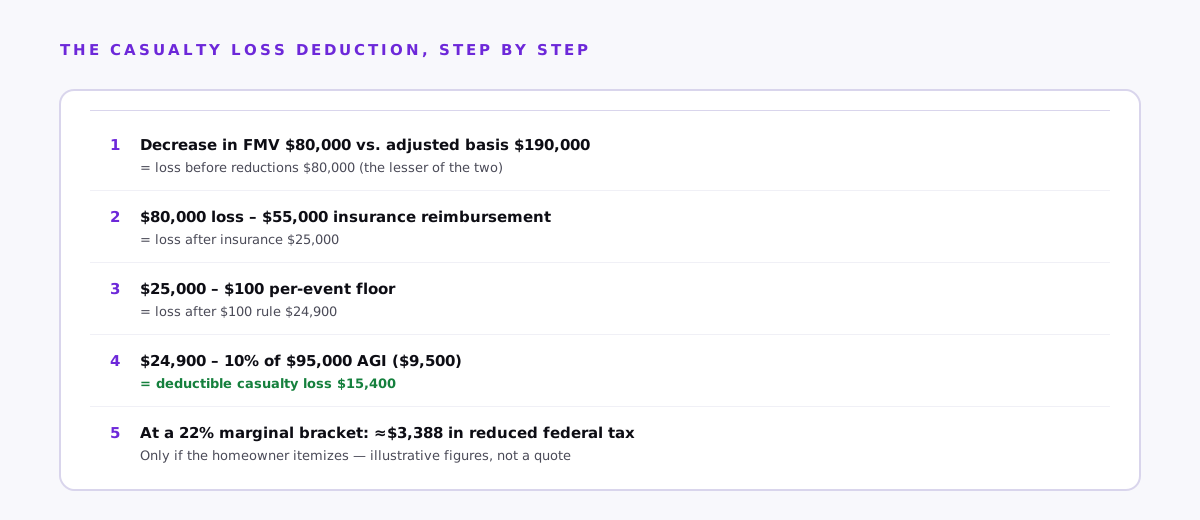
Once a loss does qualify as a federal casualty loss, IRS Publication 547 lays out the formula in four steps, applied to each casualty event:
What's left, if anything, is your deductible casualty loss. Note one important exception: Publication 547 confirms that personal casualty losses tied to certain specifically-named “qualified disaster losses” (a narrower list of major disasters declared between 2018 and February 10, 2025) get a more favorable $500 floor instead of $100, and skip the 10% AGI reduction entirely — check whether your specific disaster is on that list before assuming the ordinary rules apply.
Here's the math on an illustrative property — not a quote for yours.
A single-filer homeowner's house had a fair market value of $310,000 before a hurricane. The storm caused enough damage that the house, as-is, is now worth $230,000 — an $80,000 drop in FMV. The homeowner's adjusted basis (purchase price plus capital improvements over the years) is $190,000. The county received a FEMA major disaster declaration for this storm, so this is a federal casualty loss. The insurance company paid out $55,000 toward the damage. The homeowner's AGI for the year is $95,000.
| Step | Amount |
|---|---|
| Decrease in FMV ($310,000 − $230,000) | $80,000 |
| Adjusted basis (for comparison) | $190,000 |
| Loss before reductions (lesser of the two above) | $80,000 |
| Less: insurance reimbursement | −$55,000 |
| Loss after insurance | $25,000 |
| Less: $100 per-event floor | −$100 |
| Loss after $100 rule | $24,900 |
| Less: 10% of $95,000 AGI | −$9,500 |
| Deductible casualty loss | $15,400 |
At a 22% marginal federal bracket (the bracket a $95,000 single-filer AGI falls into for 2026, per the IRS's own 2026 inflation-adjustment release), that $15,400 deduction is worth roughly $3,388 in reduced federal tax — assuming the homeowner itemizes and this deduction, combined with mortgage interest and other itemized items, exceeds the standard deduction. More on that below.
The “lesser of” rule in step 1 above can quietly shrink a deduction far more than people expect — especially on a house that's been owned for a long time or was inherited with a low basis. Say a different homeowner's adjusted basis is only $90,000, but a wildfire that also received a federal disaster declaration dropped the home's FMV by $120,000 (from $210,000 down to $90,000 of mostly land value). Insurance paid $40,000. AGI is $60,000.
The loss is capped at the lesser of the $120,000 FMV decrease or the $90,000 basis — so it's capped at $90,000, not $120,000, even though $120,000 of real value was destroyed. Subtract the $40,000 insurance payout ($50,000 left), subtract $100 ($49,900 left), subtract 10% of $60,000 AGI ($6,000), and the deductible loss is $43,900. The $30,000 gap between the real value lost and the basis cap is simply gone for tax purposes — a direct consequence of a low basis, not something a CPA can plan around after the fact.
Using the $230,000/$80,000-damage hurricane example above, here's what the three realistic paths actually net, in cash, side by side. These are illustrative figures built on the hypothetical property above, not a quote for any specific house.
Path 1 — Repair with the insurance money, then list retail. Full repair back to the pre-storm $310,000 condition costs roughly $80,000 (the same as the FMV drop, for simplicity): $55,000 from insurance plus $25,000 out of the homeowner's own pocket. Selling at $310,000 after about 8% in commission and closing costs (−$24,800) and roughly $6,000 in holding costs during the repair-and-listing period, minus the $25,000 already spent on repairs, nets $254,200 before tax effects, or ≈$257,588 after the $3,388 casualty-loss tax savings. Typical timeline: five to seven months.
Path 2 — Sell as-is now for cash. The homeowner keeps the full $55,000 insurance payout instead of spending it on repairs, and sells the storm-damaged house as-is to a direct cash buyer who accounts for the unrepaired damage in the offer, with no commission and the buyer covering closing costs. On an illustrative as-is cash offer of $215,000, the total is $215,000 + $55,000 insurance + $3,388 tax savings = ≈$273,388. Typical timeline: two to three weeks.
Path 3 — Do nothing and wait. The homeowner keeps the $55,000 insurance payout unspent but keeps paying roughly $1,200/month in carrying costs — mortgage, taxes, insurance, utilities — on a vacant, unrepaired, unsold house for a year ($14,400). The house, left unrepaired, continues to lose value, dropping further to roughly $220,000. After a year: ≈$43,988 in cash on hand (the leftover insurance money plus the tax savings), plus a still-unsold, still-damaged house worth less than before — and the same selling costs or as-is discount still ahead of them whenever they finally do sell.
| Path | Net cash outcome (illustrative) | Timeline |
|---|---|---|
| Repair with insurance + list retail | ≈$257,588 | 5–7 months |
| Sell as-is now for cash | ≈$273,388 | 2–3 weeks |
| Do nothing / wait a year | ≈$43,988 cash + an illiquid, further-depreciated house still unsold | Open-ended |
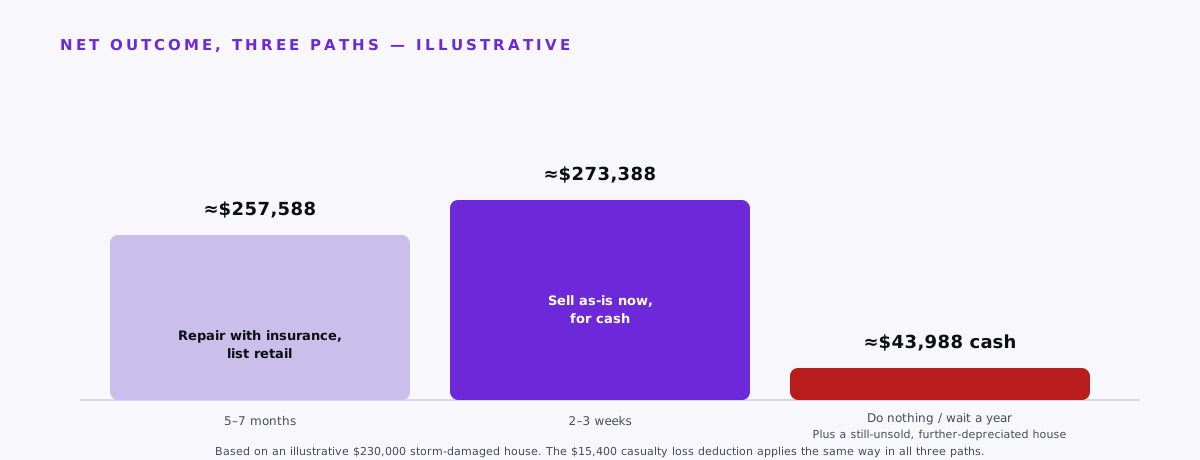
One detail doesn't change across any of the three paths: the $15,400 casualty loss deduction itself. It's based on the drop in value at the time of the casualty, not on what the homeowner does afterward. Repairing the house doesn't erase the loss for tax purposes, and selling as-is doesn't forfeit it — though proving the amount differs: actual repair costs are the cleanest evidence if the home is repaired, while an independent appraisal is generally needed to document the FMV drop if it isn't.
Even a qualifying casualty loss only reduces your tax bill if you itemize deductions on Schedule A instead of taking the standard deduction — and the standard deduction has grown large enough that it rules out many filers entirely. The IRS's own 2026 inflation adjustments set the standard deduction at $16,100 for single filers and $32,200 for married couples filing jointly (up from $15,750 and $31,500 for 2025). If a homeowner's mortgage interest, state and local taxes, and this casualty loss combined don't add up to more than that, itemizing doesn't help, and the deduction is effectively worth $0 — even though the loss and the math behind it are completely real. Qualified disaster losses are a partial exception: some can be added to the standard deduction without itemizing — confirm with a CPA whether your specific disaster qualifies.
The loss is generally deductible in the tax year it's “sustained” — which, once you've filed an insurance claim, usually means the year it becomes clear how much of the loss won't be reimbursed. If your insurer hasn't finished settling by year-end, that can push the deductible amount (and the year you claim it) later than you'd expect. Separately, for losses tied to a federally declared disaster, the IRS allows an election to instead treat the loss as having occurred in the tax year immediately before the disaster year, which can accelerate a refund if that prior year had higher income or tax owed. Whether that election helps depends entirely on your two years' numbers — a question for a CPA, not a rule of thumb.
Selling the house for cash, as-is, doesn't eliminate the casualty loss question — it's a separate calculation from the capital gain or loss on the eventual sale itself, which is its own topic (see our capital gains tax guide). Whichever way the house sells, the casualty loss deduction is figured independently, based on the damage event, your basis, your insurance, and your AGI — not on the sale price or the buyer. If the damage was from a fire specifically, our guide on selling a house with fire damage covers the practical side of that process; if it was wind or storm-related, see selling a house with hurricane damage. Both are about the mechanics of the sale itself — this page is specifically about the tax arithmetic that sits alongside that decision.
This is educational information only, not tax advice. Talk to a CPA about your specific basis, insurance settlement, AGI, and disaster declaration before you file anything or decide how to sell.
The casualty loss deduction is the same math whether you repair, sell as-is, or wait — what changes is your cash position. Send us the address here and we'll give you a straight as-is number to weigh against the repair-and-list path, while you sort out the tax side with a CPA.
All guides · Selling a house with fire damage · Selling a house with hurricane damage · Capital gains tax when you sell your house
Step 1 of 5
No obligation, no fees, no repairs. We respond the same day.
You’ll talk to Trevor McAmis, Owner & Acquisitions Lead
(313) 710-6129
Takes about two minutes. Or call (313) 710-6129 — we answer.