Selling a house with hurricane damage is possible whether your insurance claim is resolved or still open, but the path you choose changes what you net. You can repair with insurance proceeds and stay, repair and list at retail price, sell as-is to a rehabber at a discount, or sell to a cash buyer now — each trades certainty and speed against total dollars received. If your roof is tarped, your drywall is wet, and you're getting calls from contractors you've never heard of, you are not alone, and you don't have to decide anything today. This guide walks through the insurance mechanics, the real timeline, the honest math on what a fast cash sale costs you versus a repaired retail sale, and the alternatives worth considering before you sign anything.
Step 1 of 5
Send the address and we'll tell you honestly how the cash number compares to waiting out a repair.
You’ll talk to Trevor McAmis, Owner & Acquisitions Lead
(313) 710-6129
Takes about two minutes. Or call (313) 710-6129 — we answer.
Educational only. This explains how these situations generally work. It is not legal, tax or financial advice, and the rules differ by state — talk to an attorney or CPA about your own situation before you act on any of it.
This is educational information, not insurance, legal or tax advice. Talk to your insurance agent, a licensed public adjuster, and/or a real estate attorney about your specific policy, claim, and state's disclosure requirements before making a decision.
The single most consequential thing to understand after a hurricane is that “hurricane damage” is not one insurance claim — it's usually two, and they don't come from the same place. A standard homeowners insurance policy generally covers wind damage: a torn-off roof, blown-out windows, wind-driven rain that got in through a wind-created opening. It does not cover flood damage — surface water, storm surge, or a rising body of water — regardless of what caused the water to rise. Flood damage is covered only by a separate flood policy, typically through the National Flood Insurance Program (NFIP) or a private flood carrier.
FEMA's own guidance on this puts it plainly: the cause of damage determines which policy pays, and policyholders are advised to document damage by category (wind vs. water) and loop in their agent immediately so each claim goes to the right place (FEMA/NFIP: Wind vs. Floodwater Damage, March 2023). If your home took on water and you didn't carry separate flood coverage, that portion of the loss may not be covered by your homeowners policy at all — which is a major reason some hurricane-damaged homes end up sold as-is rather than repaired.
Practically, this means your first calls after safety and shelter are: your homeowners insurance agent, and, if water was involved, a check on whether you hold a separate flood policy. Don't assume “hurricane” is a single covered peril — ask your agent to confirm which parts of the damage each policy is expected to cover, and get that in writing where possible. Flood coverage specifically runs through the NFIP, which FEMA's flood-insurance overview (updated January 2026) describes as the nation's largest single-line flood insurer, covering 4.7 million policyholders nationwide (FEMA: Flood Insurance) — a program most hurricane-exposed homeowners only think about after the water is already inside.
FEMA Individual Assistance (IA) — sometimes called the Individuals and Households Program — is federal aid for people with uninsured or underinsured disaster-related losses, but it only becomes available after a Presidential Major Disaster Declaration covering your county, and it is explicitly not a replacement for insurance. If you have a homeowners or flood policy, FEMA generally requires you to file that claim first; IA is meant to help with the gap that's left over (FEMA: Individual Assistance). It will not make you whole and it will not pay you back for a fully insured loss.
If your home is uninhabitable from covered wind damage, your homeowners policy likely includes Additional Living Expenses (ALE) coverage, sometimes called loss-of-use coverage. ALE reimburses the difference between your normal cost of living and your temporary cost of living while displaced. According to the National Association of Insurance Commissioners, ALE will help cover a hotel or rental stay, but “you will still be responsible for your mortgage payment,” and ALE has its own dollar and time limits separate from the coverage that repairs or rebuilds the structure itself (NAIC: Additional Living Expenses, January 2025). Months of ALE plus a mortgage payment on a house you can't live in is a real, ongoing cost that belongs in any repair-vs-sell math.
After you file a claim, your insurer sends its own adjuster to inspect the damage and recommend a settlement — that adjuster works for and is paid by the insurance company, not you. A public adjuster is a separate, state-licensed professional you can hire directly, who works only for you and is typically paid a percentage of the settlement. Whether hiring one makes sense depends on your claim's size and complexity and your state's rules — a decision to make with your agent or an attorney, not something this guide can tell you to do.
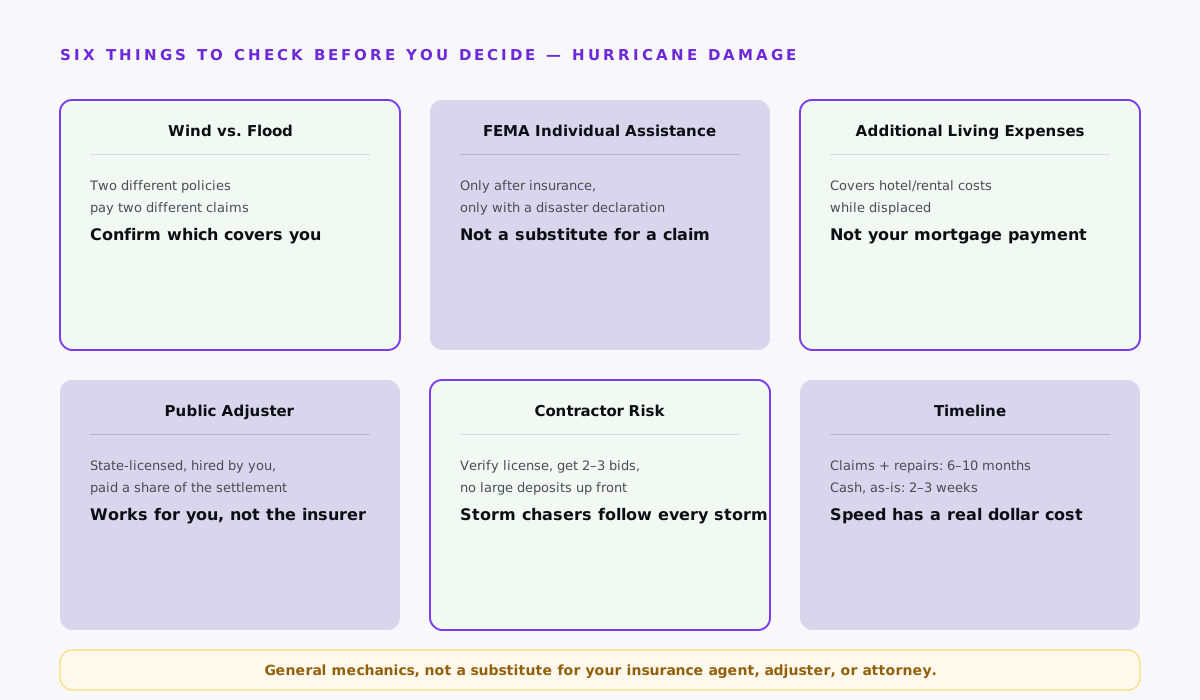
Every major hurricane brings a wave of “storm chaser” contractors — some legitimate, many not. FEMA's guidance on post-disaster contractor fraud recommends getting two or three written bids, confirming a contractor's license, registration, and insurance before any work starts, and never handing over a large deposit or signing over your insurance check up front (FEMA, “Beware of Post-Disaster Contractor Fraud,” fema.gov). Red flags include no local license number, cash-only demands, pressure to sign immediately, and out-of-state plates on the truck — verify the license independently before you pay anyone anything.
This is also the practical reason repairs after a major storm take longer than people expect: licensed, reputable contractors get backed up for months when an entire region needs roofers, drywall crews, and remediation companies at once. If you sell a storm-damaged house — repaired or not — most states require you to disclose known material defects to a buyer, and that generally includes past hurricane damage, water intrusion, or mold, even if it's since been repaired. Disclosure rules vary by state; that's a conversation for a real estate attorney or a licensed agent in your market before you list or sign a contract.
Insurance claims on a major hurricane routinely take months from filing to final payment, especially when wind and flood causation is disputed or a public adjuster is negotiating a supplemental claim. Add a backed-up contractor market on top of that, and a full repair-then-list path can easily run six to ten months from the storm to a closed retail sale. A cash, as-is sale can typically close in two to three weeks because there's no insurance settlement to wait on and no repair to schedule — but that speed has a real cost attached to it, covered next.
This is the part sellers deserve straight numbers on, not adjectives. A cash, as-is sale will net you less than a fully repaired retail sale — that's the tradeoff, and it's worth seeing in real arithmetic rather than taking on faith.
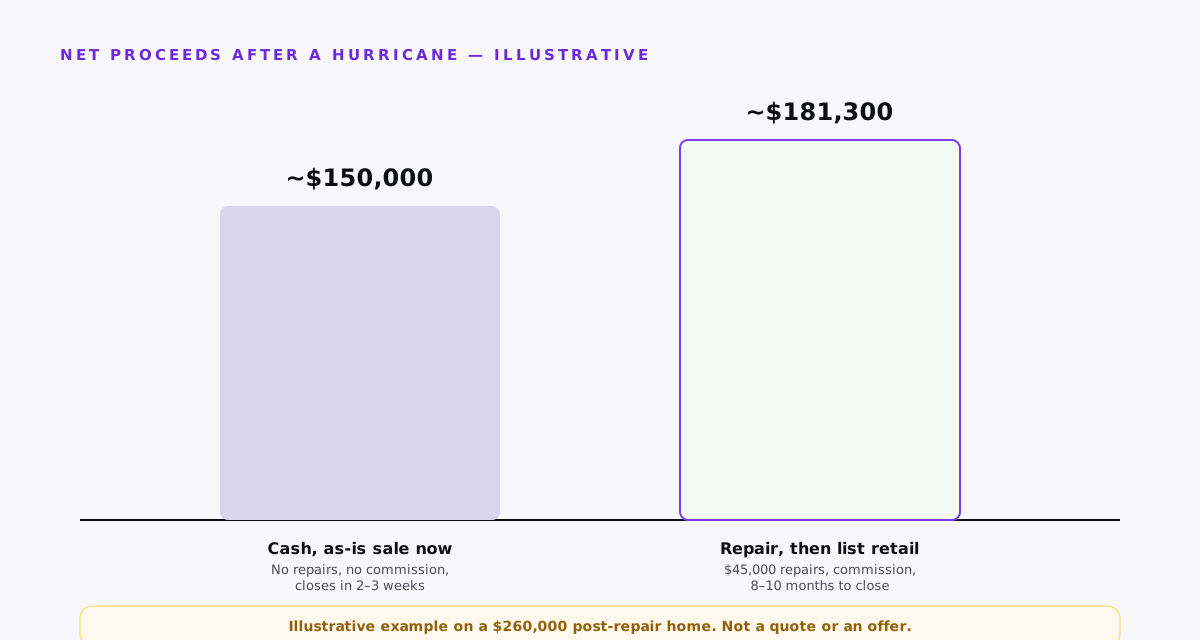
Illustrative example (a $260,000 post-repair home, not a quote or offer). Repair-then-list-retail path: repaired retail sale price $260,000, minus repair costs (roof, drywall, flooring, mold remediation) $45,000, minus agent commissions (~5.5%) $14,300, minus buyer concessions/closing costs $5,000, minus holding costs during an 8-month claims-and-repair timeline $14,400 — net proceeds roughly $181,300, received in 8–10 months. Cash, as-is sale path: cash offer reflecting as-is condition and repair need $150,000, with no repair costs, no commissions, no months of holding costs — net proceeds $150,000, received in 2–3 weeks.
In this example the retail path nets about $31,000 more — but it requires fronting or financing $45,000 in repairs, waiting out an insurance claim, carrying the house for the better part of a year, and hoping the contractor timeline and the sale both go as planned. If your insurance payout is strong, you have the cash or credit to front repairs, and you can carry the house for months, the math often favors repairing and either staying or listing retail. If the claim is stalled, underpaid, or you simply can't carry an empty house for eight months, the math behind a faster, lower, certain sale becomes more reasonable. There is no universally right answer — only the right answer for your specific insurance position, timeline, and cash reserves.
Repair with insurance proceeds and stay. If the payout covers repairs and you want to remain in the home, this avoids selling entirely.
Repair with insurance proceeds, then list retail. Nets the most in the example above, at the cost of time, contractor coordination, and holding costs.
List as-is at retail price, disclosed, to a rehab buyer. You skip the repair but still go through a retail listing, showings, and a buyer pool willing to take on a project — timelines and pricing vary a lot by market.
A cash sale, as-is, now. Fastest and most certain option, at a discount to repaired retail value.
If you want to see the retail-versus-cash math laid out in more general terms beyond this example, our guide on cash offers versus listing net proceeds walks through the same tradeoff independent of storm damage specifically. And if part of your calculation involves how long you might have to carry a vacant, damaged property while a claim or repair drags on, see our breakdown of holding costs of a vacant house. If your situation involves flood damage without a separate flood policy, our guide on selling a damaged house covers the broader mechanics of disclosure and buyer expectations.
We'll give you a written offer within 24 hours and can buy a storm-damaged house as-is, no repairs required — and if repairing first and listing nets you more, we'll say so.
All guides · Cash offer vs listing net proceeds · Holding costs of a vacant house · Selling a damaged house
Step 1 of 5
No obligation, no fees, no repairs. We respond the same day.
You’ll talk to Trevor McAmis, Owner & Acquisitions Lead
(313) 710-6129
Takes about two minutes. Or call (313) 710-6129 — we answer.
