Every market page publishes the numbers behind its offer. See the math
Home › Guides › What an Assumable FHA or VA Mortgage Is Worth When You Sell
Guide
What an Assumable FHA or VA Mortgage Is Worth When You Sell
If your mortgage is FHA or VA and carries a rate from a few years ago, you're sitting on something a lot of sellers don't realize has a dollar value: an assumable mortgage. Figuring out what an assumable mortgage is worth when you sell means running two different numbers — the theoretical value of the rate spread over the life of the loan, and the much smaller, harder-to-pin-down premium it might actually add to a sale price. Both numbers matter, and confusing one for the other is where sellers get overly optimistic or dismiss the whole thing as not worth the hassle.
Takes about two minutes. Or call
(313) 710-6129 — we answer.
Educational only. This explains how these situations generally work. It is not legal, tax or financial advice, and the rules differ by state — talk to an attorney or CPA about your own situation before you act on any of it.
What an assumable mortgage is worth when you sell: the short answer
An assumable FHA or VA mortgage at a legacy rate like 3% can theoretically be worth roughly $69,500 to a buyer who holds it the full 30 years against today's 6.71% rate — but that figure is a rational-buyer ceiling, not a realistic sale-price bump. In practice, the smaller buyer pool and cash-gap requirement usually cap the real premium at a modest, single-digit percentage of price.
This is educational information, not individualized financial, tax, or legal advice. Assumption approval, fees, and timelines vary by servicer — confirm current terms directly with your loan servicer or a qualified professional before relying on any figure here.
Which loans are actually assumable
Not every mortgage can be handed off to a buyer with its rate intact. It comes down to loan type.
FHA loans are assumable. Every FHA-insured loan can be assumed, but the servicer still has to underwrite the buyer's credit, income, and debt-to-income ratio, and must complete that review within 45 days of receiving the buyer's full application package, per HUD Handbook 4000.1. HUD caps the assumption processing fee servicers can charge at $1,800 (raised from $900 in May 2024), though many servicers in practice charge closer to $500.
VA loans are assumable — by anyone, not just veterans. Under 38 U.S.C. §3714, a creditworthy civilian buyer can assume a VA loan using VA Form 26-6381. The buyer pays a 0.5% funding fee on the remaining balance (it can't be rolled into the loan), plus a lender processing fee capped around $300 with automatic lender authority, $250 if prior VA approval is required, plus the actual cost of a credit report.
Conventional loans generally are not assumable. Fannie Mae and Freddie Mac loans carry a due-on-sale clause that lets the lender demand full repayment the moment title transfers, per Fannie Mae's Servicing Guide, section D1-4.2-02. There's no meaningful workaround for a seller here — if your loan is conventional, this whole conversation doesn't apply to you.
One VA-specific detail sellers skip past: if the assuming buyer isn't a veteran who formally substitutes their own entitlement (via that same Form 26-6381 process), your VA entitlement stays tied up in the old loan until it's paid off, which can limit your ability to get a new VA loan on your next house. A Release of Liability is the separate protection that gets you off the hook if the new buyer later defaults — ask your servicer for it explicitly; it isn't automatic.
The math: what a 3% loan is worth against today's rate
Here's the arithmetic, not adjectives. Freddie Mac's Primary Mortgage Market Survey put the average 30-year fixed rate at 6.71% for the week of September 3, 2026 — that's the number a buyer is actually facing on the open market right now, and it's the baseline every assumable-loan comparison runs against.
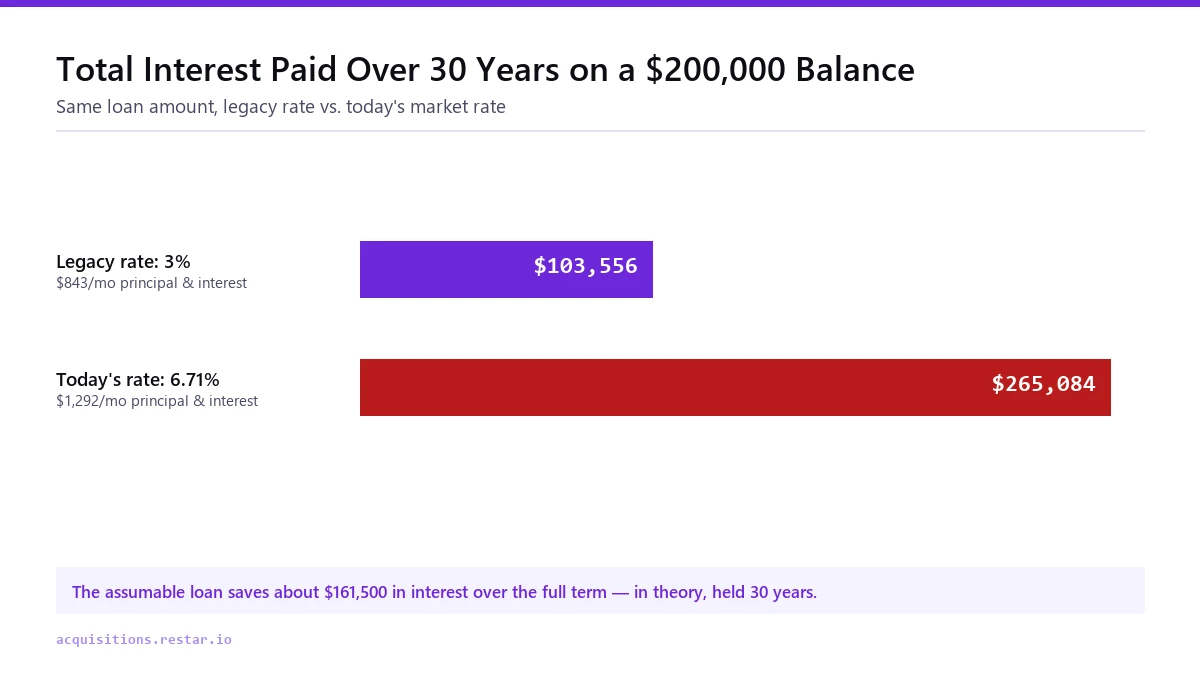
Take a $200,000 remaining balance on a 30-year amortization, compared at a legacy 3% rate versus today's 6.71%:
Legacy rate: 3%
Today's rate: 6.71%
Monthly principal & interest
$843
$1,292
Total interest paid over 30 years
$103,556
$265,084
Total interest paid over 30 years, same $200,000 balanceRestar Acquisitions · illustrative amortization on identical principal — your actual balance and rate will differ.
The monthly gap is $449 — that's what a buyer keeps in their pocket every single month by assuming the 3% loan instead of originating a new one at 6.71%. Over the full 30-year term, the difference in total interest paid is roughly $161,500.
If you take that $449 monthly savings and discount it back to today's dollars over 360 months at the 6.71% rate, the present value comes out to approximately $69,500. Treat that number carefully: it's a theoretical ceiling for a perfectly rational buyer who assumes the loan and holds it for the entire 30-year term without selling, refinancing, or moving. It is not a number you should expect to show up as an extra $69,500 in your sale price — almost no real transaction converts the full theoretical value into cash at closing, for reasons covered below.
The equity gap: the real bottleneck, not the underwriting
The single biggest reason the theoretical value above rarely becomes the actual premium isn't paperwork — it's cash. Assuming a loan only transfers the existing balance. It does not cover the rest of the purchase price.
Say your house is worth $240,000 and your assumable balance is $150,000 at 3%. The buyer assumes that $150,000 note, but the sale price is $240,000 — which means the buyer has to bring the other $90,000 to closing, either in cash or through a separate second loan or gap financing, because FHA and VA assumption rules don't let a buyer finance more than the existing balance under the assumed note.
Line
Amount
Sale price
$240,000
Assumable loan balance (3%)
−$150,000
Cash or gap financing the buyer must bring
$90,000
That $90,000 requirement, far more than servicer underwriting, is what actually narrows the pool of buyers who can use an assumable loan. A buyer has to want the house, qualify with the servicer, and have $90,000 in liquid cash or a second loan lined up — all three, at once. As home equity grows and the gap between sale price and remaining balance widens, that cash requirement gets larger, not smaller, which is part of why the realistic premium tends to shrink the longer a legacy loan has been paid down.
What actually caps the premium in a real sale
A few real-world frictions stand between the $69,500 theoretical number and whatever a buyer will actually pay extra for your loan.
The buyer pool is smaller. Mainstream listing portals like Zillow aren't built to filter for assumable loans, so most buyers browsing a normal search never see that your loan is assumable at all. Dedicated services — Roam (withroam.com) and Assumable.io are two real, live examples — specifically list and filter assumable mortgages by rate, balance, and monthly savings, and one comparison found dramatically more assumable listings surfaced through Roam than through a standard Zillow search in the same market. That's a real gap in market visibility, not a reason to expect a flood of buyers.
The process takes longer and is less certain. Servicer underwriting on an assumption commonly runs 30 to 60-plus days, well past what a conventional purchase or a cash close takes, and there's real risk the buyer doesn't qualify at the end of it.
The 5-8% premium claim is an industry estimate, not a verified fact. Some companies that sell assumption-search or listing services cite a 5% to 8% sale-price premium for assumable listings. That figure comes from commercially-interested sources, not an independent or academic study, and no independently verified study confirming an exact premium percentage could be confirmed. Treat it as a directional industry claim, not a number to plan around.
The honest tradeoff: a fast cash sale vs. marketing the assumable loan
This is where the math has to meet your actual timeline, because the two paths genuinely conflict.
If you need certainty in days — you're facing foreclosure, bleeding holding costs on a vacant rental, or working against a fixed divorce settlement deadline — a 30-to-60-plus day assumption process with a smaller, less certain buyer pool is a real risk you likely can't afford to take. In that situation, a straightforward cash sale is the right call, full stop, even though it means walking away from the loan's theoretical value. Our page on selling your house fast covers how that no-repair, as-is process works if that's where you are, and cash offer vs listing net proceeds walks through how that tradeoff compares in dollars beyond just the loan question.
If instead you have time, a house that's in sellable condition, and a legacy FHA or VA loan under roughly 4%, it's worth specifically asking your agent — or listing somewhere that flags assumability, like Roam or Assumable.io — about marketing the loan itself as a feature, not just the house. The realistic upside there is a real but modest premium, likely a single-digit percentage of price rather than anything close to the full $69,500 theoretical value. On a $250,000 to $400,000 home, though, even a modest premium can mean a genuine $10,000 to $25,000-plus difference over an otherwise-identical sale — separate from the underlying math behind a cash offer itself. That's worth pursuing if your timeline allows for it — it's not worth gambling a time-sensitive sale on.
Common questions
Can I just keep the low rate and pocket the difference in cash?
No. The value of an assumable mortgage only exists at the moment you sell, when a buyer takes over your loan and its rate. If you keep the house, you keep making the same payments you always have — there's no mechanism to "cash out" the rate spread without transferring the loan to a new borrower through a sale.
Is my conventional loan assumable if I ask the lender nicely?
Almost certainly not. Fannie Mae and Freddie Mac conventional loans carry a due-on-sale clause that lets the lender demand the full balance the moment the property transfers, per Fannie Mae's Servicing Guide. There's no standard process for a lender to waive that on a routine sale, so if your loan is conventional, this article's math doesn't apply to your loan.
Does the buyer have to be a veteran to assume my VA loan?
No. Under 38 U.S.C. §3714, any creditworthy buyer can assume a VA loan, veteran or not. The catch is on your side, not the buyer's: unless the assuming buyer is also a veteran who formally substitutes their own entitlement, your VA entitlement stays tied up in the old loan until it's paid off, which can affect your ability to get a new VA loan later.
How long does an FHA or VA loan assumption actually take?
Plan on 30 to 60-plus days in most cases. HUD requires FHA servicers to complete the buyer's credit and income underwriting within 45 days of receiving the full application package, and VA assumptions run on a similar timeline. That's longer and less certain than a typical cash closing, which is the main reason assumption isn't the right tool for a seller who needs to close in days, not weeks.
Is the 5-8% price premium for assumable loans a real, guaranteed number?
No, and it shouldn't be treated as one. That range comes from companies that sell assumable-loan search and listing services, not from an independent or academic study, and no independently verified figure could be confirmed. It's a reasonable directional estimate that a modest premium is realistic, not a number to expect or negotiate around as fact.
A cash offer is one number you can compare against the assumption math
If your timeline can absorb a 30-to-60-plus day assumption process and a smaller buyer pool, marketing your FHA or VA loan's assumability alongside the house is worth asking your agent about — the realistic upside, while well short of the loan's full theoretical value, can still be a genuine five-figure difference on a mid-range home.
If you need certainty sooner — a deadline, holding costs that don't stop, or a buyer pool that's simply too uncertain for your situation — a cash sale skips the assumption underwriting entirely. We buy houses as-is, cover the closing costs we typically cover, and let you pick the closing date. Send us the property here to get a written offer and compare it against the assumption route side by side.
Every offer on this site is underwritten by a person, not a form. If the
numbers do not work for you, say so and I will tell you what would.
Also from Restar
Want the data behind all of this?
Restar Acquisitions is the acquisitions arm of Restar — a housing-market analytics
platform tracking 180+ metrics across every U.S. market, with composite scores and 12-month
price forecasts. The numbers on this page come from the same work.