A deficiency judgment after foreclosure is a court order letting your lender collect the gap between your loan balance and what the foreclosure sale (or short sale) recovered. The amount is loan balance minus recovery, sometimes adjusted by a fair-market-value offset, and some states bar it outright depending on the loan and foreclosure type. If the debt is forgiven instead of collected, the forgiven amount can become taxable income on a Form 1099-C.
Step 1 of 5
Tell us about the property and the loan balance, and we'll give you a written cash offer within 24 hours that accounts for what's actually owed.
You’ll talk to Trevor McAmis, Owner & Acquisitions Lead
(313) 710-6129
Takes about two minutes. Your address is never shared.
Educational only. This explains how these situations generally work. It is not legal, tax or financial advice, and the rules differ by state. Talk to an attorney or CPA about your own situation before you act on any of it.
Start with the loan balance at the time of sale, including unpaid principal and whatever accrued interest, fees, and foreclosure costs the loan documents allow the lender to add. Subtract what the foreclosure sale recovers. Whatever is left is the raw deficiency.
Example: a homeowner owes $300,000 on the mortgage. The house goes to a trustee's or sheriff's sale and the sale nets $230,000 after sale costs. The raw deficiency is $300,000 (loan balance) minus $230,000 (sale proceeds), which equals a $70,000 deficiency.
That $70,000 is what the lender could try to collect from the borrower in a state that allows deficiency judgments and doesn't adjust the number further. But two things can change that figure before any court signs off on it: a fair-market-value offset, and state anti-deficiency law.
Foreclosure sales often sell below what the house would fetch on the open market, especially at a courthouse-steps or trustee auction with few bidders. Some states let the borrower push back on that by asking a court to use the property's fair market value instead of the sale price, if the fair market value is higher.
Texas does this under Texas Property Code § 51.003. The statute gives a lender two years from the foreclosure sale to bring a deficiency action, and it lets the person being sued ask the court to determine the property's fair market value as of the sale date, using expert testimony, comparable sales, and similar evidence. If the court finds the fair market value is higher than the sale price, the borrower gets an offset for the difference (Tex. Prop. Code § 51.003).
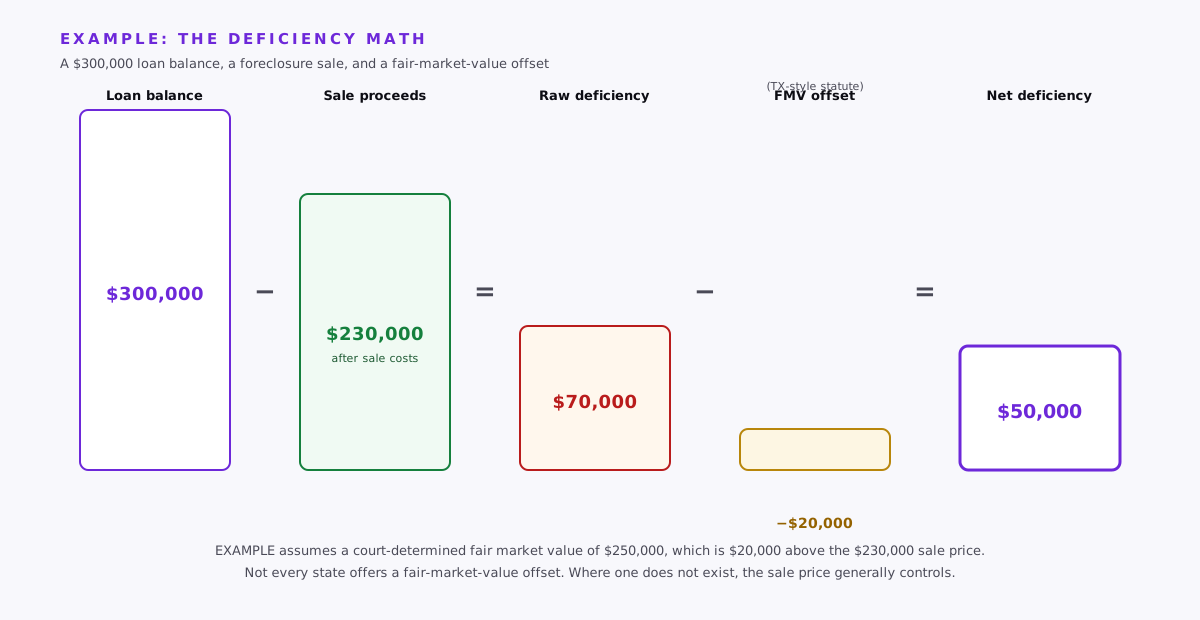
Example, continuing the numbers above: say a court determines the fair market value of that same house was $250,000 on the sale date, even though the trustee's sale only brought in $230,000. The offset is $250,000 (fair market value) minus $230,000 (sale price), which equals a $20,000 offset. Apply that against the raw deficiency: $70,000 (raw deficiency) minus $20,000 (offset) equals a $50,000 net deficiency.
The fair-market-value offset doesn't exist in every state. Where it doesn't, the sale price is usually what counts, even if it was well below market. That's one more reason a foreclosure auction is a worse financial outcome for a seller than a sale negotiated ahead of it.
Some states don't let a lender collect a deficiency at all, at least for certain loans and certain foreclosure methods. California is the clearest example. Under California Code of Civil Procedure § 580b, no deficiency judgment is allowed on a purchase-money loan secured by a mortgage or deed of trust on an owner-occupied dwelling of four units or fewer. Under § 580d, no deficiency judgment is allowed at all after a nonjudicial trustee's sale (the standard foreclosure method in California), regardless of loan type. Put those together and most California homeowners who lose an owner-occupied home to a standard trustee's sale owe nothing beyond the house itself.
Arizona has a narrower version. A.R.S. § 33-814(G) bars a deficiency after a trustee's sale on "trust property of two and one-half acres or less which is limited to and utilized for either a single one-family or a single two-family dwelling." A typical single-family home on a standard lot qualifies. A larger parcel, a property that was never completed or occupied as a dwelling, or a multi-unit building over two units generally does not, and the lender can pursue a deficiency on those.
Florida and Texas, by contrast, generally allow deficiency judgments. Florida narrows the window sharply instead, which brings up the next piece.
The clock on a deficiency action varies by state, and it's often shorter than people expect.
Other states run longer, often matching the general statute of limitations on written contracts, which can stretch several years. If a lender misses its window, it generally can't collect the deficiency through a lawsuit, though the debt may still show up on a credit report or get written off internally, which carries its own tax wrinkle below. Scope your own deadline against your state's actual statute, not a rule of thumb, since the range runs from about one year to several years depending on where the property sits.
A lender approving a short sale is not automatically forgiving the shortfall. The Consumer Financial Protection Bureau tells homeowners directly: if you live in a state where you're responsible for a deficiency, ask your lender to waive it before the short sale closes, and if the lender agrees, get the waiver in writing and keep it. Nothing about an approved short sale implies forgiveness unless the approval letter says so in plain language.
The same is true of a deed in lieu of foreclosure. Handing the keys back to the lender doesn't erase the gap between the loan balance and the home's value unless the deed-in-lieu agreement expressly states the transfer satisfies the debt in full. Some lenders include that language as a matter of course, others don't, and the only way to know is to read the agreement and ask before signing, not assume it.
Example: the same $300,000 loan goes to a short sale instead of foreclosure. The sale closes at $235,000, and the lender's approval letter includes an explicit line waiving the remaining balance. The deficiency owed is $300,000 (loan balance) minus $235,000 (short sale price), a $65,000 shortfall, waived to $0 owed.
No deficiency judgment risk. But that $65,000 didn't just disappear from a tax standpoint, which is the next piece.
When a lender forgives debt instead of collecting it, whether through a short-sale waiver, a deed-in-lieu agreement, or simply letting the statute of limitations run out without suing, the forgiven amount is generally reportable to the IRS and to the borrower on Form 1099-C. The IRS's own guidance (Publication 4681) lists bankruptcy, foreclosure, and the expiration of the collection statute of limitations among the "identifiable events" that trigger a 1099-C, and it states that a borrower must report canceled debt as income even without receiving the form, unless an exception or exclusion applies.
The exclusion that used to cover most foreclosed and short-sold primary residences, for canceled "qualified principal residence indebtedness," expired for discharges completed after December 31, 2025, per the IRS's current Publication 4681. That exclusion had been extended repeatedly since the original Mortgage Forgiveness Debt Relief Act of 2007, but as of 2026 it is not in effect, so a 2026 short-sale or foreclosure waiver doesn't get that specific protection unless Congress revives it again.
The remaining exclusion that still applies broadly is insolvency: if your total liabilities exceeded the fair market value of your total assets immediately before the debt was canceled, you can exclude some or all of the canceled amount using the IRS's insolvency worksheet and Form 982. Whether that applies, and by how much, depends on a full accounting of assets and debts that a CPA or tax preparer needs to run for your actual numbers. This isn't something to estimate from a blog post.
Example, using the short-sale waiver above: the $65,000 forgiven balance is a candidate for 1099-C reporting. At a 22% federal tax rate and no insolvency exclusion, that's roughly $14,300 in additional tax owed for that year. If the homeowner qualifies for the insolvency exclusion instead, some or all of that $65,000 could come off the taxable total. The only way to know which applies is to run the actual numbers with a tax professional before the sale closes, not after the 1099-C shows up.
| Path | Deficiency owed | Collection risk | Tax wrinkle | Rough timeline |
|---|---|---|---|---|
| Foreclosure sale, no offset or anti-deficiency protection | $70,000 | Lender can sue within the state's limitations window (1–2+ years in examples above) | None until forgiven; then becomes 1099-C income | Sale happens on the auction date set by the foreclosure process |
| Foreclosure sale, fair-market-value offset applies (TX-style) | $50,000 | Same collection window, lower balance | Same, on the lower balance if later forgiven | Same as above |
| Foreclosure sale, anti-deficiency state/property (CA purchase-money, AZ qualifying home) | $0 | None, barred by statute | None, nothing forgiven because nothing was owed | Resolved at the sale itself |
| Short sale with explicit written deficiency waiver | $0 | None if the waiver is in writing | $65,000 potential 1099-C income, taxable unless insolvent | 60–120+ days for lender approval, then closes on a negotiated date |
| Cash sale that pays off the loan in full before foreclosure | $0 | None, debt fully satisfied | None | As fast as the buyer and title company can close, often inside a few weeks |
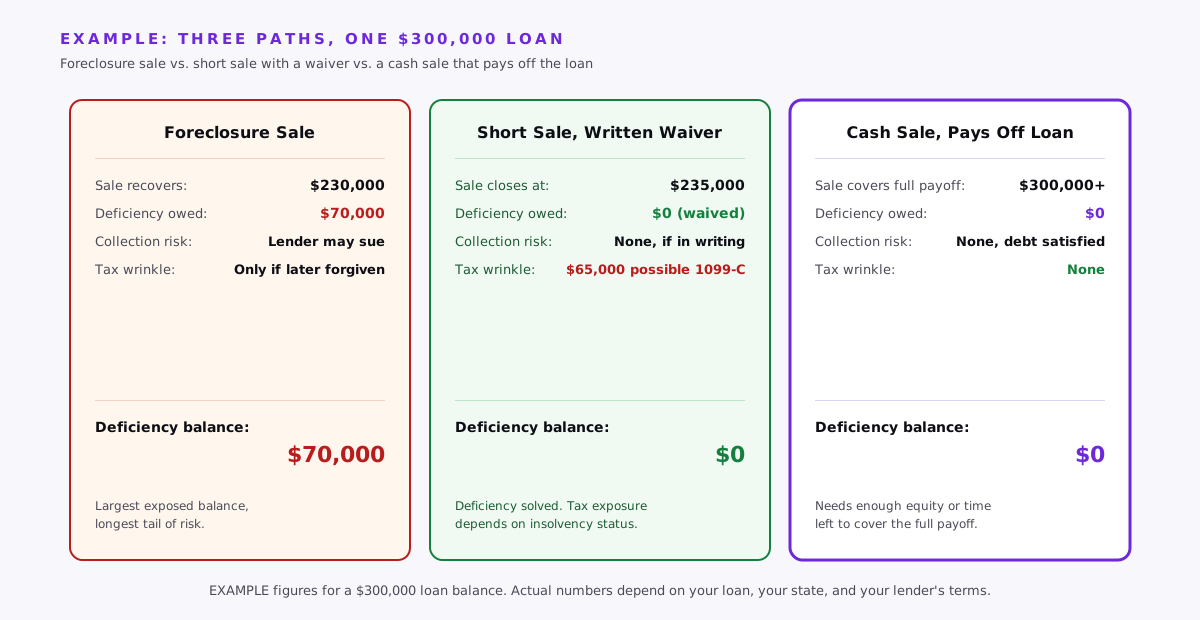
The numbers above make the tradeoff plain. A foreclosure sale with no offset leaves the largest exposed balance and the longest tail of risk, since the lender can pursue it and a later write-off can turn into taxable income years down the line. A fair-market-value offset helps, where it's available, but it still leaves a real balance owed. A short sale with a written waiver gets the deficiency itself to zero, but it can hand the seller a tax bill the same year unless insolvency wipes it out.
The cleanest outcome on this list is a sale, of any kind, that pays off the loan in full before foreclosure. No deficiency, no waiver to negotiate, no 1099-C. That requires either enough equity to cover the payoff at the sale price a buyer will pay, or enough time left before the foreclosure date to list the house on the open market and let it sell for closer to retail value. If a homeowner has that equity or that time, listing the house (even with an agent, even if it takes longer than a cash sale) and paying the loan off in full is very often the better financial move. A fast cash sale is the better move specifically when there isn't enough time left to list, or when the house needs more repair work than a seller can afford to put in before a retail buyer's lender will touch it.
Negotiate a short sale with an explicit deficiency waiver. Ask for the waiver in writing as part of the approval letter, not as a verbal assurance, and keep the letter. See our guide on the full mechanics and cost of a short sale for the approval-timeline details.
Ask about a deed in lieu of foreclosure, and confirm the deficiency language before signing. A deed in lieu isn't automatically a deficiency release. Read the agreement for language stating the transfer satisfies the debt in full, and don't sign without it if that matters to your situation. See our deed in lieu of foreclosure guide.
Sell for cash fast enough to pay the loan off before the foreclosure date. This only fully protects you from a deficiency if the sale price covers the full payoff. If there's a gap, you're back to needing a waiver or an anti-deficiency protection to apply.
If a deficiency judgment has already been entered against you, talk to a bankruptcy or consumer-law attorney about dischargeability. Deficiency judgments are typically unsecured debt once entered, and depending on your overall financial picture, bankruptcy or a negotiated settlement may be able to address a judgment that's already in place. This is a legal strategy question for an attorney, not something to self-diagnose.
A foreclosure sale happens on whatever date the state's foreclosure process sets, often a matter of weeks to a few months after a missed-payment default, depending on whether the state uses judicial or nonjudicial foreclosure. A short sale needs lender approval first, commonly 60 to 120 days or longer before closing. A deficiency lawsuit, where one is filed, generally has to be brought within the state's specific limitations window, which the examples above show runs from about one year (Florida) to two years (Texas) or longer elsewhere. A cash sale fast enough to outrun a foreclosure date can close in a few weeks if the title is clean and the payoff is confirmed early.
This article explains how deficiency judgments and canceled-debt tax rules generally work. It isn't legal or tax advice. Deficiency rules, offset statutes, and limitations periods vary by state, and canceled-debt tax treatment depends on your full financial picture. Talk to a consumer-law attorney about your specific deficiency exposure and a CPA about your specific tax exposure before you decide how to sell.
Restar buys houses as-is, in all 65 of our markets across 14 states. We give a written offer within 24 hours, there are no repairs to make and no commissions to pay, and you pick the closing date. We're not attorneys, accountants, or agents, and we don't represent you in a sale. If running the numbers shows that listing the house on the open market would net you more and there's time to do it, we'll tell you that instead of pushing a sale that doesn't serve you.
All guides · The real cost of a short sale · Deed in lieu of foreclosure, explained · Foreclosure help
Step 1 of 5
No obligation, no fees, no repairs. We respond the same day.
You’ll talk to Trevor McAmis, Owner & Acquisitions Lead
(313) 710-6129
Takes about two minutes. Your address is never shared.
