Unpaid water and sewer usage fees are settled at closing through proration, the same way property taxes are. Your title company gets a final meter reading or payoff estimate, subtracts what you owe from your proceeds, and the buyer takes over with the account current. One-time connection or "tap" fees only apply in specific situations and vary by city. You will not get stuck paying the full amount twice or losing the sale over it.
Step 1 of 5
Tell us about the house and we'll give you a written cash offer within 24 hours. Small items like an unpaid water bill get handled at closing like any other proration.
You’ll talk to Trevor McAmis, Owner & Acquisitions Lead
(313) 710-6129
Takes about two minutes. Your address is never shared.
Educational only. This explains how these situations generally work. It is not legal, tax or financial advice, and the rules differ by state. Talk to an attorney or CPA about your own situation before you act on any of it.
This is a money-math article, not a legal one. If your water or sewer bill is old enough that the municipality has already certified it as a lien against the property, that's a different situation with its own rules and priority issues. See our guide on selling a house with a water or sewer lien for that scenario. Everything below covers the earlier, more common case: a regular unpaid usage bill that hasn't been certified as anything yet.
Most municipalities bill water and sewer usage monthly, quarterly, or semi-annually. If you're behind on a bill or two, that's an unpaid balance sitting on your utility account. It becomes a lien only after the municipality runs its own statutory certification process, and how long a bill has to sit delinquent before that happens is set by each state and city on its own schedule.
This article is about the first stage: the balance before certification. That's the stage almost every seller with a past-due water bill is in. The good news is this stage is simple arithmetic, not a legal process.
Near closing, the title company or the seller contacts the water department and requests a final reading, so the bill reflects usage only through the closing date. If the department can't produce a true final bill on short notice, the title company prorates the most recent bill instead and holds back enough from your proceeds to cover it.
Legacy Title Agency, a Michigan-based title and closing company, lays out how this works on a settlement sheet. The holdback is sometimes called a water escrow: the title company sets aside enough from the seller's proceeds to cover the estimated amount based on days of ownership, and once the real final bill shows up, it pays the bill from the holdback and releases whatever is left to the seller.
This works almost exactly like property tax proration at closing: nobody argues about who technically "owes" the money, the days of ownership get split, and the dollar amount comes out of proceeds before you get your check. If you want the general mechanics of how that proration math works for taxes, see our guide on who pays property taxes when you sell a house.
Example: Prorating a $340 Unpaid Water Bill. Say your last water and sewer bill was $340, covering a 90-day billing cycle, and you owned the home for 46 of those 90 days before closing. Daily rate: $340 ÷ 90 = $3.78 per day. Seller's share: $3.78 × 46 days = $173.78. Buyer's share: $3.78 × 44 days = $166.22.
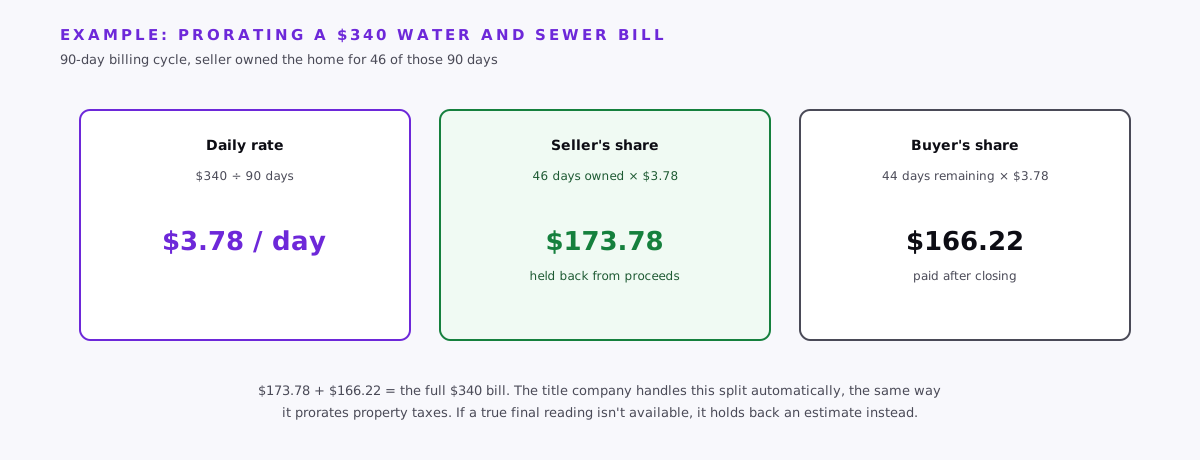
The title company holds back roughly $174 from your proceeds (rounded), pays the water department when the real final bill lands, and you get the rest. If you already owed the full $340 as a straight unpaid balance with no new cycle to prorate, the math is even simpler: the title company pays the $340 directly out of your proceeds at closing and the buyer never sees it. Either way, the number that comes off your check is small. It's a few hundred dollars, not a few thousand, in the overwhelming majority of cases.
Separate from usage bills, some municipalities charge a one-time connection or "tap" fee tied to the water and sewer line serving the property. These fees exist to pay for infrastructure capacity, not usage, and they're usually triggered by new construction, a new or upsized meter, or reconnecting service that was fully disconnected, not by an ordinary resale of an occupied home. There is no national rule here. Whether a tap fee applies at all, and how much it costs, depends entirely on the municipality.
To show what a real fee schedule looks like, here's one example: the City of Circleville, Ohio (one of our operating states) published utility connection charges effective February 1, 2026.
| Charge | Amount |
|---|---|
| Water tap, 3/4" meter | $2,650 |
| Sewer connection, single dwelling | $1,877 |
| Combined | $4,527 |
Those are Circleville's numbers, for Circleville's infrastructure, for a 3/4-inch connection. They are not a national average and not what your city will charge. A city two counties over might charge a few hundred dollars for the same thing, or nothing at all for a standard resale. The only way to know what applies to your specific property is to ask your local water department directly, or have your title company confirm it as part of the closing package.
This is the honest part: a small unpaid water bill isn't a cash-sale-versus-listing decision point. The proration happens the same way, dollar for dollar, no matter who buys the house. What changes between the two paths is everything stacked on top of it.
| Line item | Cash sale (Restar) | Traditional listing |
|---|---|---|
| Unpaid water/sewer bill, prorated | −$174 (example above) | −$174 (same proration) |
| Agent commissions | $0 | Typically 5–6% of sale price |
| Repairs/prep before showing | $0, sold as-is | Varies, often several thousand dollars |
| Time to closing | Days to a couple weeks | Weeks to months, plus showings |
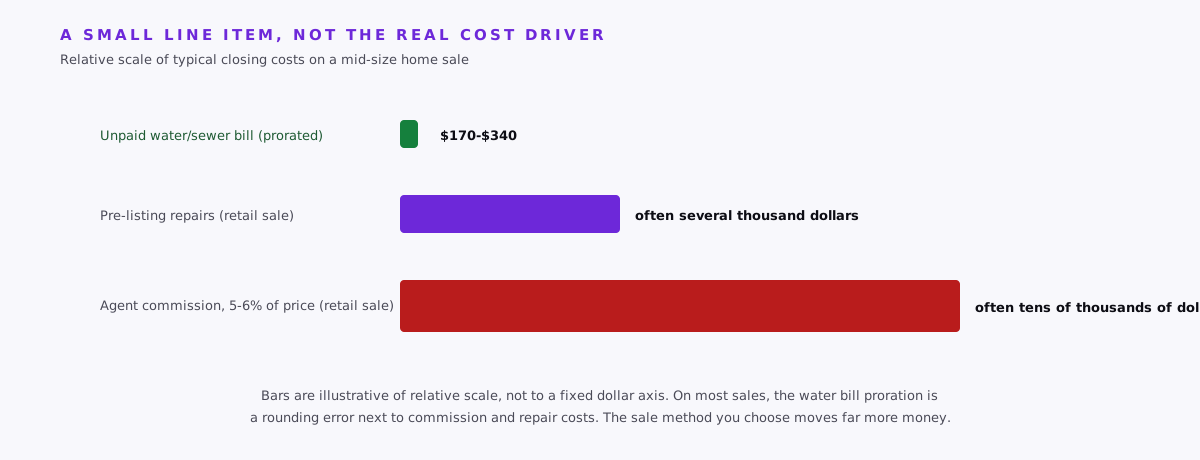
On a $340 unpaid bill, the proration itself nets out to roughly the same $170-$340 reduction in proceeds either way. That's not where the real money moves. The real cost driver in any sale is the method you choose, not a utility bill. A listing adds commissions and repair costs on top of the same proration; a direct cash sale skips those, but a cash, as-is offer is also typically lower than what a fully repaired home might fetch after months on the retail market. Whether that trade is worth it depends on your timeline and the condition of the house, not on a few hundred dollars of unpaid water usage. If your water bill is the only thing you're worried about, it shouldn't be the deciding factor in how you sell.
A few steps keep this simple regardless of how you sell: call the water department early for an estimate, have your title company request a payoff letter, and confirm whether a connection fee applies before you sign anything.
Call your water department early, before you're under contract pressure, and ask for a final-bill estimate or a payoff quote. Most departments can tell you an approximate number even if they can't do a true final reading until closing day.
Ask your title company or closing attorney to request a payoff or clearance letter from the utility directly. This is standard practice and it's what prevents a stale number from showing up as a surprise on the settlement sheet.
If you're in a market where connection or tap fees could apply (new meter, upsized service, a prior disconnection), raise it with your title company before you sign anything. Don't assume it doesn't apply and don't assume it does. Confirm it.
An unpaid water or sewer bill is a small, mechanical line item at closing, not a reason to panic and not a reason to pick one sale method over another on its own. Get a final-bill estimate, confirm whether a connection fee applies, and let your title company handle the proration.
Restar Acquisitions buys houses as-is for cash, sends a written offer within 24 hours, and lets you pick the closing date. An unpaid water or sewer bill doesn't change any of that, it's just a line item your title company prorates at closing like any other.
All guides · Selling a house with a water or sewer lien · Who pays property taxes when you sell · Seller closing costs breakdown
Step 1 of 5
No obligation, no fees, no repairs. We respond the same day.
You’ll talk to Trevor McAmis, Owner & Acquisitions Lead
(313) 710-6129
Takes about two minutes. Your address is never shared.