Every market page publishes the numbers behind its offer. See the math
Home › Guides › Who Pays Property Taxes When You Sell a House?
Guide
Who Pays Property Taxes When You Sell a House?
Who pays property taxes when you sell a house is one of those questions with a simple answer and a complicated bill. The simple answer is that you pay for the days you owned it. The complicated part is that whether that appears on your settlement statement as money leaving your side or money arriving on it depends entirely on whether your state collects tax before the year it covers or long afterwards. Ohio runs about a year behind. Texas bills in the autumn for a year already nearly over. Michigan sends two bills covering periods that are not obvious from either of them. Here is the arithmetic, and a full settlement statement showing where the line actually lands.
Takes about two minutes. Or call
(313) 710-6129 — we answer.
Educational only. This explains how these situations generally work. It is not legal, tax or financial advice, and the rules differ by state — talk to an attorney or CPA about your own situation before you act on any of it.
Who pays property taxes when you sell a house: the short answer
You pay for the days you owned it and the buyer pays for the rest. Closing prorates the year's tax between you, but whether that shows up as a credit to the buyer or a bill to you depends entirely on whether your state bills in advance or in arrears.
General educational information about how tax proration works at closing. This is not tax advice and not legal advice. Billing cycles, due dates and proration customs vary by state, county and even by contract. Confirm your own numbers with your title or settlement agent, and talk to an attorney or a CPA about your situation.
The proration arithmetic, in four lines
The calculation behind who pays property taxes when you sell a house is the same three steps in every state, followed by a decision about which direction the money moves.
Take an annual tax bill of $4,380 and a closing on 12 September.
Step
Calculation
Result
Daily rate
$4,380 ÷ 365
$12.00 per day
Days you owned it
1 Jan to 12 Sep
255 days
Your share
255 × $12.00
$3,060
Buyer's share
110 × $12.00
$1,320
That is the whole calculation. Some settlement agents use a 360-day year and 30-day months, which moves the number by a few dollars and nothing more. What is worth arguing about is not the divisor.
The part worth arguing about is which twelve months the $4,380 is actually for, because that is what decides whether the $3,060 is money you owe or money you are owed.
Arrears or advance: the part that decides who writes the cheque
If your state collects tax after the period it covers, then on closing day you have lived in the house for months whose tax nobody has yet billed. Those months are your responsibility, and the buyer will be the one holding the bill when it finally arrives. So you credit the buyer, and your proceeds go down.
If your state collects in advance, you have already paid for time you will not own. The buyer credits you, and your proceeds go up.
Same arithmetic, opposite direction. Here is how three of the states we buy in behave.
Ohio collects in arrears, roughly a year behind. Under Ohio Revised Code 323.12, a taxpayer pays the full amount on or before 31 December, or half by 31 December with the remaining half on or before the twentieth day of June next ensuing — and those collections relate to a preceding tax year. In practice county treasurers extend the dates into January or February and July or August. The effect for a seller is consistent: you are almost always crediting the buyer at closing for time already lived.
Texas bills in the autumn for the year already running. The Texas Comptroller states that taxing units start mailing bills in October, that taxes are generally due by 31 January, that they become delinquent on 1 February, and — the line that governs proration — that each person who owns taxable property on 1 January is liable for all taxes due on the property for that year. Sell in June and the buyer receives a bill in October covering a year you owned half of, so you credit them for 1 January to closing.
Michigan sends two bills and writes the default rule into statute. Summer taxes become a lien on 1 July and are generally due by 14 September; winter taxes become a lien on 1 December and are generally due by 14 February, subject to a city charter saying otherwise. And MCL 211.2(4) supplies the fallback where the parties have not agreed otherwise: the seller is responsible for that portion of the annual taxes levied during the 12 months immediately preceding, but not including, the day title passes, from the levy date or dates to, but not including, the day title passes, and the buyer is responsible for the remainder. Michigan proration disputes are common enough that the contract usually names a method. Read that clause.
The general lesson is worth more than any of the three specifics: ask your settlement agent, in writing, which period the bill covers and which proration custom your county uses. Do it before you sign a contract, not at the table.
Two lines people expect to see and do not
Your escrow account does not pay the proration. These are separate systems. The proration is a settlement-statement adjustment between you and the buyer; your escrow balance is money your servicer holds and returns to you afterwards, on its own schedule. Our guide to the mortgage payoff statement covers exactly how and when that balance comes back, and it is the single most common reason a seller thinks the tax line was double-counted when it was not.
Delinquent taxes are not prorated. Proration splits the current period. Anything already overdue is a lien against the property that has to be cleared for title to pass, and it comes off the top of your proceeds in full, with penalty and interest attached. If that is your situation, selling a house with delinquent property taxes is the page you want, not this one.
A full settlement statement, with the tax line in it
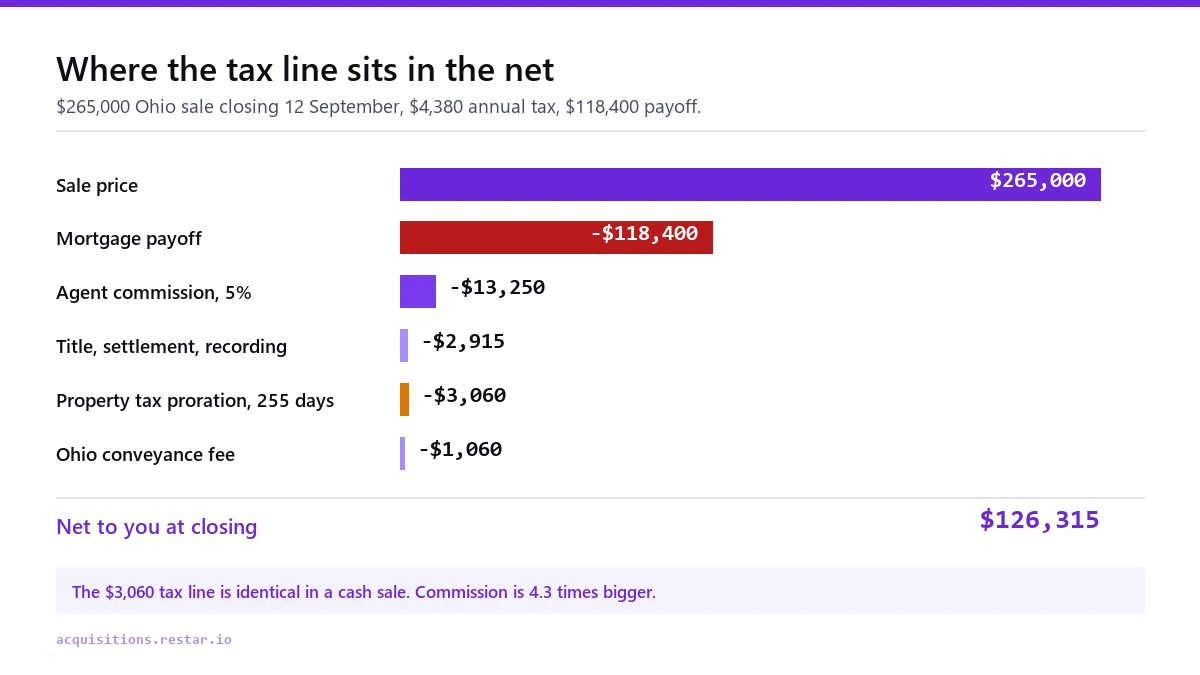
Numbers in isolation are hard to feel. Here is the whole thing on a $265,000 Ohio sale closing 12 September, with a $118,400 mortgage payoff and the $4,380 annual tax from above.
Where the tax line sits in the netRestar Acquisitions · worked example from this page
Line
Amount
What it is
Sale price
$265,000
Contract price
Mortgage payoff
−$118,400
Principal, per diem interest and release fees
Agent commission at 5%
−$13,250
The largest line you can actually negotiate
Title, settlement and recording
−$2,915
About 1.1% of price here
Property tax proration
−$3,060
255 days at $12.00, credited to the buyer
Ohio conveyance fee
−$1,060
$1 per $1,000 state plus county permissive, county-dependent
Net to you at closing
$126,315
Two observations that matter more than the total. The tax proration is $3,060, which is 1.2% of the price and about 2.4% of what you actually walk away with — small enough that sellers wave it through, large enough to be worth checking rather than accepting. And the commission line is 4.3 times bigger. If you are going to spend an hour negotiating one number on this statement, it is not the tax line.
The honest part: this line is identical in a cash sale
We buy houses for cash, so it would suit us to imply that selling to us saves you something on the tax proration. It does not. The proration is an adjustment between the seller and the buyer for time owned. It does not care who the buyer is, and it is the same number either way.
What actually differs is elsewhere on the statement, and the honest comparison looks like this on the same house. Assume it needs no repairs and would take about three months to sell conventionally, carrying at $980 a month.
Line
List with an agent
Sell as-is for cash
Price
$265,000
$236,000
Mortgage payoff
−$118,400
−$118,400
Commission
−$13,250
—
Title, settlement, recording
−$2,915
—
Property tax proration
−$3,060
−$3,060
Conveyance fee
−$1,060
−$1,060
Carrying costs
−$2,940 (3 mo)
—
Net to you
$123,375
$113,480
Listing nets $9,895 more. On a house in this condition, with no deadline pressing on you, that is the right answer and you should list it. Our cash offer versus listing net proceeds guide runs that comparison across a wider range of conditions, and seller closing costs breaks down the settlement lines in detail.
The cash column earns its keep only when the house needs work you cannot fund, when it will not finance, or when a date matters more than $9,895. That is a genuine set of circumstances, and it is a much narrower one than the industry usually admits.
What to actually do before you close
Ask for the preliminary settlement statement at least three days early. Errors in the tax line are common and they are much easier to fix before disbursement than after.
Check which tax year the proration is based on. In an arrears state, the number should reflect the period you actually occupied, not simply the last bill issued.
Read the tax clause in your purchase contract. In Michigan especially, the contract's proration method overrides the statutory default, and the two produce different numbers.
Confirm there is nothing delinquent. A prior year unpaid does not get split; it gets paid in full out of your proceeds.
Budget for the escrow refund separately. It arrives after closing and by post, and it is not part of the number on the settlement statement.
Common questions
Who pays the property taxes when a house is sold?
Both parties, split by the calendar. The seller is responsible for the portion of the tax period during which they owned the house, and the buyer for the remainder. The settlement agent calculates a daily rate from the annual bill and applies it to the days each party owned the property.
Do I get money back for property taxes I already paid?
Only if your state or locality collects in advance. If you have paid tax covering a period that runs past the closing date, the buyer credits you for the unused portion at closing and your proceeds go up. In an arrears state such as Ohio, the opposite happens and you credit the buyer instead.
How is property tax proration calculated at closing?
Divide the annual tax by 365 to get a daily rate, then multiply by the number of days each party owns the property in the tax period. On a $4,380 annual bill closing on 12 September, the daily rate is $12.00, the seller's 255 days come to $3,060, and the buyer's 110 days come to $1,320. Some agents use a 360-day convention, which changes the figure slightly.
Does selling to a cash buyer save me the property tax proration?
No. The proration is an adjustment between seller and buyer for time owned, and it is the same figure regardless of who is buying or how they are paying. What differs in a cash sale is commission, repairs and holding costs, not the tax line.
What happens to unpaid property taxes when I sell?
They are not prorated. Delinquent taxes are a lien against the property that must be cleared before title can pass, so they are paid in full out of your proceeds at closing, along with any accrued penalty and interest.
Are property taxes taken from my escrow account at closing?
No. Your escrow balance is held by your mortgage servicer and returned to you separately after the loan is paid off, usually by post some weeks later. The proration on the settlement statement is a completely separate adjustment between you and the buyer.
Send us the address and we will tell you within 24 hours what we would pay as-is — alongside an honest estimate of what listing it would net after commission, settlement costs, the tax proration and the months of carrying. As on this page, listing often wins, and we will say so when it does.
Every offer on this site is underwritten by a person, not a form. If the
numbers do not work for you, say so and I will tell you what would.
Also from Restar
Want the data behind all of this?
Restar Acquisitions is the acquisitions arm of Restar — a housing-market analytics
platform tracking 180+ metrics across every U.S. market, with composite scores and 12-month
price forecasts. The numbers on this page come from the same work.