Every market page publishes the numbers behind its offer. See the math
Home › Guides › Selling a House With a Water or Sewer Lien
Guide
Selling a House With a Water or Sewer Lien
If your city or water authority has certified an unpaid water, sewer, or trash bill against your property, you're dealing with a different animal than a tax lien, an HOA lien, or a judgment from a lawsuit. A municipal utility lien attaches automatically once a bill goes delinquent long enough, it's usually collected the same way your property taxes are, and in some states it can sit ahead of a mortgage that was recorded years earlier.
Tell us about the property and the certified balance. We'll send a written offer within 24 hours and walk you through how the lien gets cleared at closing.
Takes about two minutes. Or call
(313) 710-6129 — we answer.
Educational only. This explains how these situations generally work. It is not legal, tax or financial advice, and the rules differ by state — talk to an attorney or CPA about your own situation before you act on any of it.
Selling a House With a Water or Sewer Lien: The Short Answer
A municipal water or sewer lien is created automatically when a utility bill goes unpaid long enough for the city or utility authority to certify it against the property — no lawsuit required. In most states it must be paid off at closing like a tax lien, and in some states it can even sit ahead of your mortgage.
This is educational information about how municipal utility liens generally work, not legal or financial advice about your specific bill or municipality. Certification rules, priority, and payment-plan options vary by state and by city ordinance. Confirm your exact balance and payoff process with your water/sewer authority and a title company or real estate attorney before you rely on anything here.
Almost every state gives cities and water/sewer authorities the power to turn an unpaid utility bill into a lien against the property that received the service, not just a debt against the person who signed up for the account. That's the detail that surprises sellers: you can sell the house, hand over the keys, and the lien stays behind on the property — it doesn't follow you, and it doesn't disappear because you moved out or stopped getting bills at that address.
How a Utility Bill Turns Into a Lien
The mechanism is closer to a tax lien than to a lawsuit-based judgment lien. No court case, no judge, no process server — the utility or municipality follows a statutory certification procedure instead.
Michigan is a clean, concrete example, and one of the states Restar buys in directly. Under the Municipal Water Lien Act (MCL 123.161–167), a municipality that has adopted the right ordinance can certify any water or sewer charge delinquent six months or more to the local tax assessor, who enters it as a lien on the next tax roll. From that point, it's collected and enforced exactly like a property tax lien — same roll, same penalties, same foreclosure exposure if it's never paid. See Michigan Compiled Laws § 123.162.
Other states run the same idea through different statutes and timelines — some certify after 90 days, some after a year; some require a formal notice-and-hearing step before certification, others don't. Washington State law is explicit that a water/sewer district's lien for an unpaid balance attaches to the property and, per RCW 57.08.081, sits senior to everything except the general property tax lien — meaning it can outrank a first mortgage recorded years before the bill ever went unpaid. The specific mechanics differ by state and city, but the pattern is consistent: unpaid utility service becomes a real lien on real property, on a timeline the property owner rarely tracks closely.
Why a Utility Lien Can Jump Ahead of Your Mortgage
Ordinary unsecured debt — a credit card, a personal loan — only becomes a lien on your house if a creditor sues you, wins, and records a judgment. A utility lien skips that entire process because state legislatures have decided that charges for services delivered to the property itself (water, sewer, and in many places trash pickup) deserve the same collection teeth as property taxes.
That's also why priority runs differently than it does for a judgment. A judgment lien is typically junior to an earlier-recorded mortgage. A certified water or sewer lien, in states that treat it like a tax lien, is often senior — which is exactly why a title company treats it with the same urgency as an unpaid tax bill rather than filing it away as an ordinary junior lien to negotiate down. Whether your state grants that senior status is a specific, checkable fact, not something to assume either way; your title company will know for your county.
How It Gets Resolved at Closing
A title search turns up the certified lien (or the tax-roll entry it rides on) the same way it turns up an unpaid tax bill. Fannie Mae's Selling Guide is explicit that outstanding liens and other title impediments have to be resolved before a loan the agency will purchase can close — see Fannie Mae Selling Guide B7-2-05, Title Exceptions and Impediments. In practice that means the closing agent pays the certified balance out of your proceeds at or before closing, the same as they would a property tax bill, before your buyer's title insurer will issue a clean policy.
If you paid off your mortgage a while back and never confirmed the release was recorded, the same logic applies in reverse — an old lien of any kind can sit on record long after you think it's resolved. The Consumer Financial Protection Bureau's guidance on checking lien releases is a useful gut-check for any lien you believe is already handled.
The Honest Tradeoff: What a Utility Lien Does to Your Net Proceeds
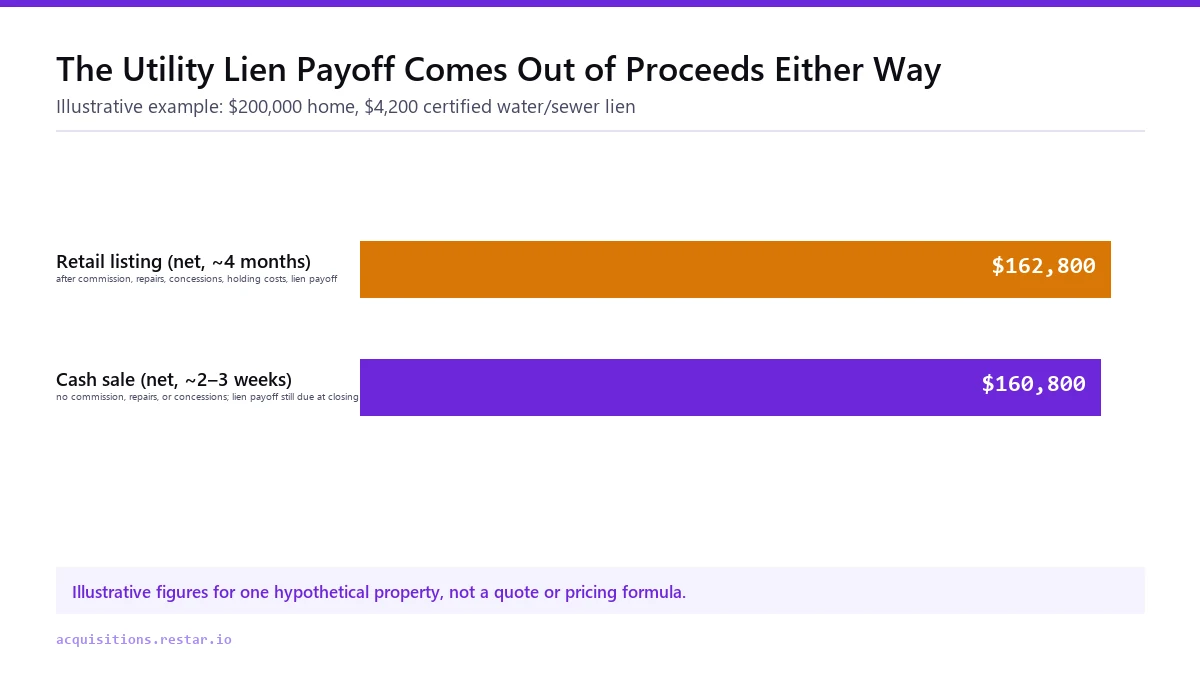
The certified balance comes out of your proceeds either way you sell. Here's an illustrative example, not a quote: a house worth $200,000 once it's market-ready, needing about $13,000 in repairs and updates to compete with nearby listings, carrying a $4,200 certified water/sewer lien balance.
The utility lien payoff comes out of proceeds either wayRestar Acquisitions · illustrative example, $200,000 home with a $4,200 certified lien
In this example, listing nets roughly $2,000 more than the cash sale — but it takes about four months instead of two to three weeks, and every retail line item carries its own risk of running long or falling through. If you have the equity to cover the repair list and the lien, and the runway to carry the house for months, listing with an agent is very likely the better financial outcome. A cash sale is the trade you make for speed and certainty, not for a higher number — and these are illustrative, rounded figures for one hypothetical property, not a quote or a formula we apply to offers.
Your Real Options
Confirm the balance and dispute it if it's wrong. Billing errors happen. If the charge is disputed before it's certified, you may be able to resolve it directly with the utility rather than through a title-company payoff.
Ask about a payment plan or hardship program. Many municipalities offer one, especially for owner-occupants, though it typically has to be arranged before the balance is certified and rolled into the tax collection process.
Pay it off from your proceeds and list normally. The most common path once you have enough equity — your title company or closing attorney handles the payoff like any other lien.
Sell for cash. A cash buyer isn't relying on an institutional lender's underwriting file, so the sale isn't held up by a lender weighing whether the title exception is acceptable. The balance still comes out of your proceeds at closing to convey clear title — see selling a house with a lien on it for how that works across lien types, and cash offer vs listing net proceeds to run your own numbers against the example above.
Where This Comes Up Most
Certified utility liens aren't limited to one state — any municipality with the right ordinance can use them, and they turn up most often on inherited houses, long-vacant rentals, and properties where a tenant's account went unpaid before a landlord noticed. Michigan cities are a documented, direct example under the statute above, which is relevant if you're selling in Detroit, Grand Rapids, Lansing, or Kalamazoo. The underlying pattern — unpaid utility service certified onto the tax roll — shows up in some form in most of the states Restar buys in, so it's worth a title check regardless of where the house sits.
Sources
Michigan Compiled Laws § 123.162, Municipal Water Lien Act — legislature.mi.gov
Revised Code of Washington § 57.08.081, water-sewer district lien priority — app.leg.wa.gov
Consumer Financial Protection Bureau, checking whether a lien was released — consumerfinance.gov
Common questions
What is a water or sewer lien?
It's a lien a city or water/sewer authority places against a property for an unpaid utility bill, once the bill has been delinquent long enough to be certified under state or local law. It attaches to the property itself, not just to whoever owed the bill.
Can you sell a house with a water or sewer lien on it?
Yes. Selling isn't blocked, but the certified balance almost always has to be paid off at closing, the same way an unpaid property tax bill would be, because a title insurer won't issue a clean policy over an unresolved lien.
Does a utility lien come before the mortgage?
It depends on the state. Some states, like Washington, give a water/sewer district's lien priority over everything except the general property tax lien, which can put it ahead of a mortgage recorded years earlier. Other states treat it as a more ordinary junior lien. Your title company can confirm which applies to your property.
How do you find out if a house has a utility lien?
A title search will typically surface it, since certified liens are usually recorded or entered on the county tax roll. If you're not yet under contract, your local water/sewer authority or city treasurer's office can confirm any certified balance directly.
Do all cities do this?
No. A municipality generally has to adopt a specific ordinance authorizing it to certify unpaid utility charges as a lien, and the delinquency period and process vary by city and state. It's common enough, especially on inherited or long-vacant properties, that it's worth checking regardless of where the house is.
A cash sale doesn't erase a certified water or sewer lien — it still comes out of your proceeds at closing, same as a financed sale. What it removes is the lender's underwriting file: no appraisal contingency, no loan committee deciding whether the title exception is acceptable, no financing that falls through three weeks before your closing date.
We buy houses as-is across 30 markets in Alabama, Arizona, Florida, Georgia, Indiana, Maryland, Michigan, New York, North Carolina, Ohio, and Texas, utility lien or not, and we'll tell you plainly what the balance does to your number before you decide anything.
Every offer on this site is underwritten by a person, not a form. If the
numbers do not work for you, say so and I will tell you what would.
Also from Restar
Want the data behind all of this?
Restar Acquisitions is the acquisitions arm of Restar — a housing-market analytics
platform tracking 180+ metrics across every U.S. market, with composite scores and 12-month
price forecasts. The numbers on this page come from the same work.