It costs whatever your loan servicer's current payoff quote says, not the balance shown on your last statement. For a financed system, that is typically ten to thirty-five thousand dollars depending on system size and years left, and it is due at closing because the loan is secured by a UCC-1 fixture filing recorded against your house, not just a personal loan you can carry past the sale.

Step 1 of 5
Tell us about the solar loan along with the property. We'll build the payoff into the offer instead of asking you to sort it out first.
You’ll talk to Trevor McAmis, Owner & Acquisitions Lead
(313) 710-6129
Takes about two minutes. Your address is never shared.
Educational only. This explains how these situations generally work. It is not legal, tax or financial advice, and the rules differ by state. Talk to an attorney or CPA about your own situation before you act on any of it.
These three are not the same problem at closing.
A solar loan means you own the panels, financed with debt that is specifically secured by the system itself through a UCC-1 fixture filing. You owe a payoff balance, and that balance has to be resolved before or at closing.
A solar lease or power purchase agreement (PPA) means a third party owns the panels and you pay them for the power. There is no loan balance to pay off, but the lease itself has to be transferred to the buyer, with the solar company's approval, or bought out. We cover that case separately in our guide on selling a house with leased solar panels.
Owning the system outright, paid in cash or with a loan that is already paid off, means there is no lien, no transfer approval, and no payoff math. This guide is about the loan case specifically.
When you finance solar panels, the lender almost always files a UCC-1 financing statement against the panels as personal property attached to your home. It is not a mortgage and it is not, strictly speaking, a lien on the real estate. In practice, it shows up in a title search anyway, and a title company closing your sale will generally treat it the way they treat a lien: it has to be released, satisfied, or formally subordinated before they will issue clean title to the buyer. The Consumer Financial Protection Bureau's research on solar financing notes the same practical problem: these UCC filings on the panels can still muddy the title, because some jurisdictions and title examiners treat the filing as reaching the property itself, not just the equipment.
If your buyer is getting a conventional mortgage, their lender's appraisal rules matter too. Fannie Mae's Selling Guide, Section B4-1.3-05, draws a direct line: solar panels that are leased, financed through a PPA, or otherwise serving as collateral for a debt separate from the mortgage generally cannot be credited toward the home's appraised value, specifically because they are collateral for someone else's loan, not an owned feature of the house. Only panels that are fully owned, free of a separate financing lien, get treated as part of the home's value in a standard appraisal.
That rule has a direct consequence for sellers: you cannot count on a buyer's appraisal coming in higher because of the solar system if your loan on it is still outstanding. The payoff is on you, or built into the price you accept, not absorbed by a higher appraised value.
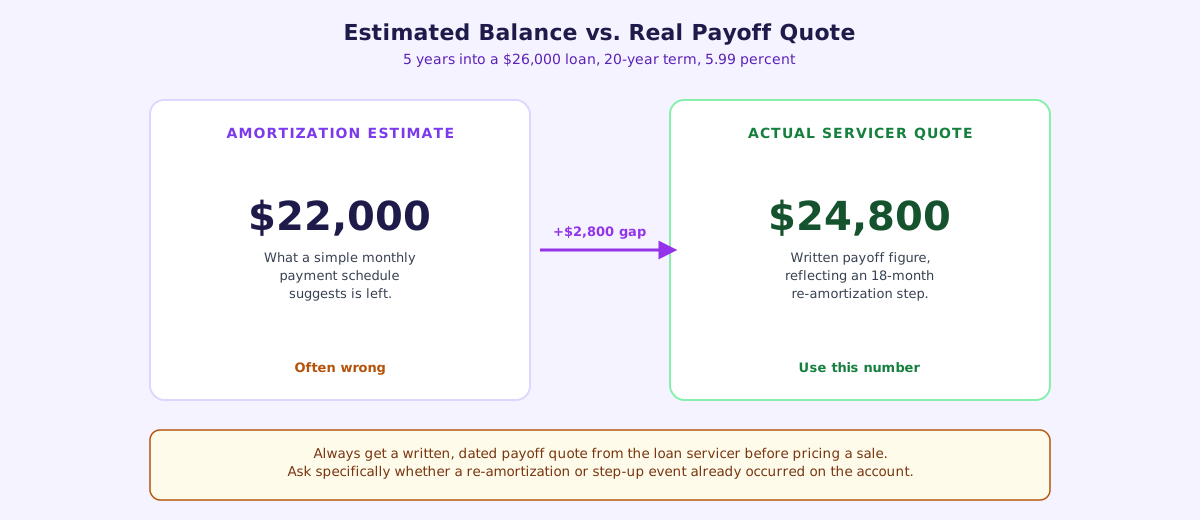
Example: a seller financed a solar system five years ago with a $26,000 loan on a 20-year term at 5.99%. Looking at a basic amortization schedule, the seller assumes the remaining balance is around $22,000. The actual payoff quote from the servicer comes back at $24,800, almost $3,000 higher.
The gap is common, not a mistake. Many solar loans are structured to re-amortize around the 18-month mark, assuming the borrower applies a lump sum, often the federal solar tax credit, to pay down roughly 30 percent of the principal early. If that lump sum was never applied, the loan recalculates over the remaining term on the original, higher principal, which is why a payoff quote this many years in can run well above what a simple monthly-payment schedule would suggest. That federal credit, the Residential Clean Energy Credit, covered 30 percent of system cost for systems placed in service from 2022 through December 31, 2025 under current law, so this is specifically worth checking if your system was installed anywhere in that window and you are not sure whether that early paydown ever happened.
| Pay Off at Closing (List Normally) | Sell As-Is, Cash | |
|---|---|---|
| Sale price | $240,000 | $200,000 |
| Solar loan payoff (from proceeds) | -$24,800 | -$24,800 |
| Agent commission (6%) | -$14,400 | $0 |
| Closing costs / concessions (2%) | -$4,800 | $0 |
| Net to seller | $196,000 | $175,200 |
| Timeline | 30 to 60 days, plus appraisal/financing risk | 2 to 3 weeks, no financing contingency |
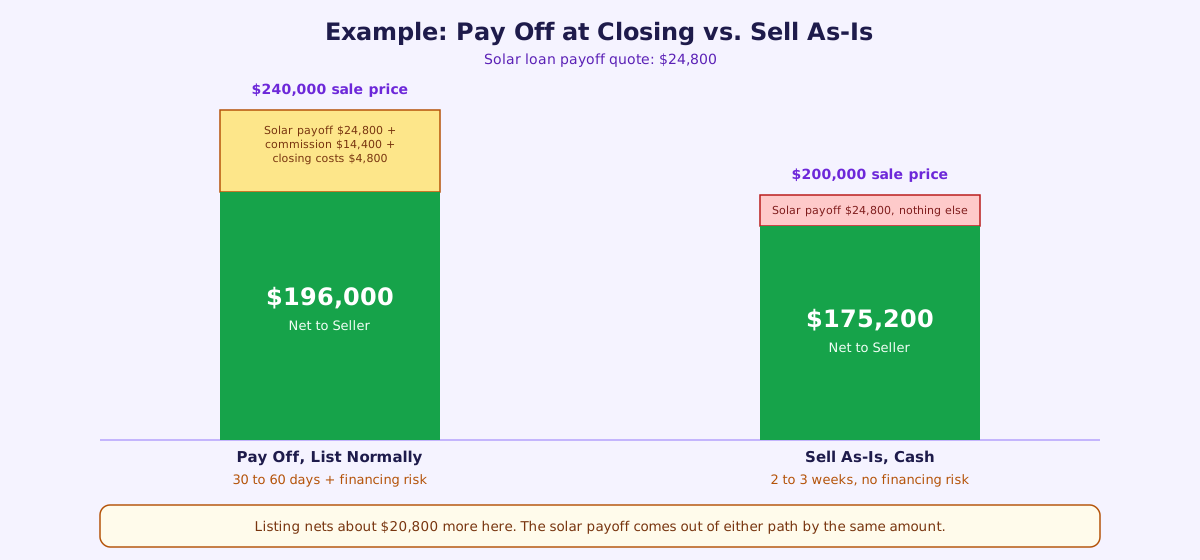
The solar loan payoff comes out of the proceeds the same way on either path, the same way a mortgage or lien payoff would. What changes between the two columns is the sale price itself and whether a commission and closing costs apply. Listing nets about $20,800 more in this example, if the appraisal comes in at value, the buyer's financing closes on schedule, and the payoff doesn't climb between now and closing. Get your real payoff quote before comparing anything, since that number moves both columns by the same amount and changes how wide the gap actually is.
A buyer assuming your loan is a fourth option and the one most sellers hope for. It is rarely simple: the solar lender has to approve the new buyer, re-underwrite them, and agree to the transfer, and not every servicer allows it. Ask your loan servicer directly, in writing, whether assumption is available before you build a listing price around it.
Removing the system instead of paying it off is usually the most expensive option on paper once you add removal, remounting hardware, and roof patching, commonly a few thousand dollars, on top of still owing the loan balance to the lender regardless of whether the panels stay on the roof. It rarely pencils out compared to simply paying off the loan at closing.
Call your solar loan servicer now for a written, dated payoff quote. Do not rely on the amortization schedule from your loan documents or a balance estimate from an app. Ask specifically whether a step-up or re-amortization event already happened on your account.
Ask about assumption in writing, even if you expect to be told no. Some servicers will approve it for a qualified buyer, which avoids the payoff question entirely.
Tell your title company about the solar loan before you're under contract, not during closing week. UCC fixture filings are a common source of last-minute closing delays specifically because sellers do not realize they need to be cleared the same way a lien does.
See our guide on what an assumable mortgage is worth when you sell for the same assumption question applied to a primary mortgage, and our guide on the cost of a HELOC or second mortgage when you sell for how a second lien payoff compares.
Tell us about the solar loan along with the property and we'll build the payoff into a written offer within twenty-four hours. No repairs, no commissions, and you pick the closing date. If paying it off yourself and listing nets you more once you have your real payoff quote, this guide shows you how to run that math.
Send us the property here and we'll factor the solar loan into the numbers before you decide anything.
All guides · Selling a house with leased solar panels · What an assumable mortgage is worth when you sell · The cost of a HELOC or second mortgage when you sell
Step 1 of 5
No obligation, no fees, no repairs. We respond the same day.
You’ll talk to Trevor McAmis, Owner & Acquisitions Lead
(313) 710-6129
Takes about two minutes. Your address is never shared.
