Every market page publishes the numbers behind its offer. See the math
Home › Guides › Selling a House With Leased Solar Panels: The Real Math
Guide
Selling a House With Leased Solar Panels: The Real Math
Selling a house with leased solar panels is not the disaster the internet says it is, and it is not the non-issue your solar salesperson said it would be either. It is a contract problem with a specific dollar value, and you can calculate it. The mistake most sellers make is paying a five-figure buyout to make the problem go away without ever checking whether the contract is actually costing them five figures. Usually it is not. Here is how to work out your own number.
Takes about two minutes. Or call
(313) 710-6129 — we answer.
Educational only. This explains how these situations generally work. It is not legal, tax or financial advice, and the rules differ by state — talk to an attorney or CPA about your own situation before you act on any of it.
Selling a house with leased solar panels: the short answer
You do not own the panels, so they add nothing to your appraised value, and the lease must either transfer to the buyer with the solar company's approval or be bought out at closing. Which of those is cheaper depends entirely on whether the remaining payments exceed the value of the power the system produces.
This is educational information about how these contracts generally work — it is not legal, tax or financial advice about your agreement. Solar lease and power purchase agreement terms vary enormously between companies and contract vintages. Read your own contract, and have an attorney read it if real money turns on the answer.
First, work out which of five things you actually have
Sellers routinely describe all of these as “my solar panels,” and they behave completely differently in a sale. Before anything else, dig out the paperwork and identify which one you signed.
Owned outright — you paid cash, or the system was rolled into the purchase price of the house. The panels are yours, they convey with the property, and there is nothing to transfer. This is the easy case.
Financed with a solar loan — you own the panels but owe a lender. The debt is usually secured by a UCC-1 fixture filing recorded against the property, and it is paid off at closing out of your proceeds like any other lien.
Leased — a third party owns the system and you pay monthly rent to use it. Terms typically run 20 to 25 years.
Power purchase agreement (PPA) — a third party owns the system and you buy the electricity it generates at a set per-kilowatt-hour price. Also typically 20 to 25 years.
PACE-financed — the cost was added to your property tax bill as an assessment. This one is different in kind, and worse. See below.
The Federal Trade Commission's plain-English rundown in Solar Power for Your Home puts the core distinction bluntly: with a lease or a PPA, “you don't own the system.” That is also why the tax credits and renewable energy certificates went to the company rather than to you.
PACE deserves the separate warning. A PACE assessment is a property tax lien, and it generally takes priority over your mortgage — the FTC notes that some mortgage contracts do not even permit adding one. Fannie Mae is explicit that properties with energy improvements financed through PACE “are not eligible for delivery to Fannie Mae if the PACE loan is not paid in full prior to or at closing.” If your solar shows up on your tax bill rather than as a separate monthly payment, that is what you have, and it has to be cleared at closing before a financed buyer can purchase.
Why the panels add nothing to your appraisal
This is the part sellers find hardest to accept, and it is not a matter of opinion — it is written into the rules the buyer's lender has to follow. Fannie Mae's special property eligibility requirements state that where panels are leased or covered by a power purchase agreement, “the value of the solar panels cannot be included in the appraised value.”
The logic is straightforward once you see it. An appraiser values what conveys with the real estate. Leased panels do not convey — they remain the property of the solar company, and what the buyer inherits is an obligation, not an asset. A financed system that is properly affixed and documented as a fixture is treated differently: there, the lender instructs the appraiser to consider the panels in the value of the property, and the remaining debt goes into the buyer's ratios.
So if you were told at the kitchen table that the system would add $20,000 to your home's value, and you leased it, that was not accurate. Plan around the rules as they actually are.
The only calculation that matters: is the contract underwater?
Here is the question almost nobody asks. A lease is not automatically a liability. You are paying for something real — electricity you would otherwise buy from the utility. The contract only costs you money to the extent the payments exceed the value of the power.
Take a realistically shaped example. Fourteen years into a 25-year lease, eleven years left to run:
Input
Value
Lease payment today
$148 per month
Annual escalator written into the contract
2.9%
System production today
9,200 kWh per year
Panel degradation
0.5% per year
Local retail electricity rate
$0.16 per kWh
Assumed utility rate inflation
2.2% per year
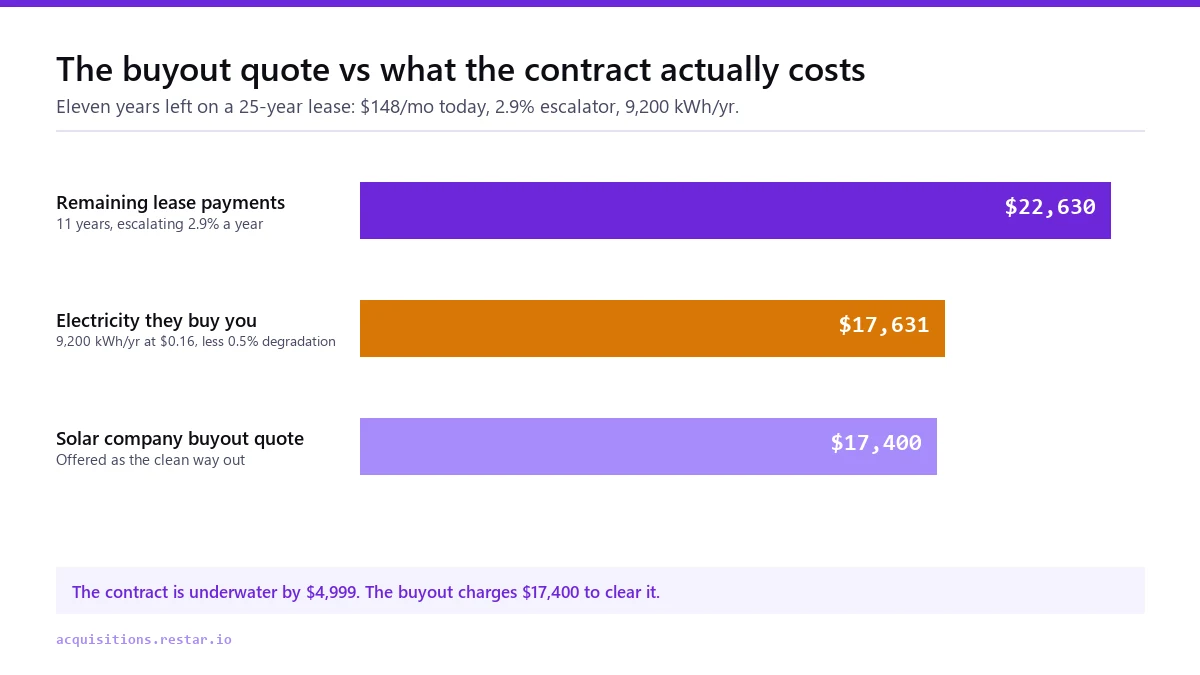
Run those eleven years out. The lease payments total $22,630. The electricity the system produces over the same period is worth $17,631 at the utility rate it displaces. So the contract is underwater — but only by $4,999 spread across eleven years, which is roughly $38 a month. Today the gap is smaller still: $148 of rent against about $123 of power, a shortfall of $25 a month.
The buyout quote versus what the contract actually costsRestar Acquisitions · worked example from this page
A worked illustration on one hypothetical contract. Not a quote, not a prediction about your agreement, and not a formula we apply to offers.
Now compare that shortfall to what the solar company quotes to buy the system out: $17,400. Paying it to clear a $4,999 problem means overpaying by $12,401 for the privilege of a tidier closing. That is the single most expensive mistake sellers make in this situation, and it gets made because the buyout is presented as the responsible, grown-up option.
Run your own version before you agree to anything. You need four numbers: your current payment, your escalator rate, your system's annual production (it is in your monitoring app or on your last annual statement), and your utility's real per-kWh rate including delivery charges. The Department of Energy's Homeowner's Guide to Going Solar is a reasonable primer if the production figures are unfamiliar territory.
How the transfer actually works, and where it goes wrong
Assuming your numbers say transfer rather than buy out, here is the sequence — and the two places these deals die.
Notify the solar company early. Most contracts require written notice before a transfer, and transfer departments are slow. Start this the week you decide to sell, not the week you go under contract.
The buyer applies and is credit-checked. This is failure point one. The solar company decides whether to accept your buyer using its own criteria, and there is no mechanism to make it say yes.
The UCC-1 fixture filing has to be dealt with. This is failure point two. A filing recorded against your property surfaces in the title search, and the title company generally will not insure over it without a release or subordination. Fannie Mae requires any fixture filing senior to the mortgage to be subordinated to it.
Transfer fees get paid. Usually modest — a few hundred dollars — and negotiable between the parties like any other closing item.
The FTC's own list of contract questions is the right checklist here: whether you are permitted to transfer the contract at all, whether you must give written notice first, and “will the buyer have to meet credit requirements or pay any fees before taking over the contract?” Those answers are in your agreement, and you should know them before a buyer thinks to ask.
If the solar company rejects your buyer's credit, you have three moves and none of them are free: pay the buyout yourself, cut the price enough that the buyer absorbs the cost, or find a different buyer. Knowing your shortfall number in advance is what tells you which of those you can afford. Almost every horror story about selling a house with leased solar panels traces back to this moment arriving unprepared, three weeks before a closing date.
Disclose it in writing, early, and in dollars
The escalator is the disclosure that gets sellers sued. A buyer told “the solar payment is $148” who works out at year eight that it is climbing toward $200 has a genuine grievance, and depending on your state's disclosure law, potentially a claim.
Give buyers the contract itself, the current payment, the escalator rate, the remaining term, and a year-by-year schedule of what the payment becomes. It costs you nothing, it removes the single biggest objection, and it means the number cannot come back at you after closing. Buyers walk away from leases that surprise them far more often than from leases they understand.
What this means for your decision
Strip away the noise and selling a house with leased solar panels is a contract with a calculable price attached, not a catastrophe. For most sellers with a leased system and an otherwise saleable house, the honest answer is: disclose it properly and list it with an agent. The lease is a nuisance, not a value destroyer, and the retail market will pay you more than a cash buyer will — ours included. Do not let a buyout quote frighten you into treating a $5,000 problem as a $17,000 one.
A cash sale earns its place in a narrower set of cases: the house needs work you cannot fund on top of the solar complication, your contract genuinely is deeply underwater, the system was PACE-financed and carries a priority tax lien that has to be cleared, or you are on a deadline that will not survive a solar company's transfer department. Our breakdown of how cash offers are calculated shows the size of the discount you would be trading for that certainty, and the net-proceeds comparison works it both ways on two houses.
Alternatives to consider
Disclose and transfer — the default, and the right call whenever the contract's shortfall is smaller than the buyout quote.
Negotiate a partial credit — offer the buyer a closing credit worth a few years of the shortfall instead of the whole buyout. Far cheaper, and it addresses the actual objection.
Buy out the contract — genuinely correct when the shortfall approaches or exceeds the quote, or when a transfer has already failed and you have a buyer worth keeping.
Ask about relocation — some contracts allow moving the system to your next home. Usually expensive, occasionally worth it.
Sell as-is for cash — worth it when the lease sits on top of repairs, a deadline, or a lien you cannot clear, not as a general answer to solar.
Common questions
Can you sell a house with leased solar panels?
Yes. The lease either transfers to the buyer with the solar company's approval, or it is bought out at closing. Neither prevents a sale, but both take time, so notify the solar company as early as possible rather than after you are already under contract.
Do leased solar panels increase my home's value?
No. Fannie Mae's rules state that where panels are leased or covered by a power purchase agreement, their value cannot be included in the appraised value, because they do not convey with the property. Owned systems, and properly documented financed ones, are treated differently.
Should I buy out my solar lease before selling?
Only if the buyout costs less than what the remaining contract actually costs you. Total the remaining payments including the escalator, subtract the value of the electricity the system produces, and compare that shortfall to the quote. In the example on this page, the buyout was $12,401 more than the shortfall it would have cleared.
What is a UCC-1 fixture filing and why does it matter when I sell?
It is a security interest the solar company records against your property in the land records. It surfaces in the title search, and the title company generally will not insure the sale until it is released or subordinated, so it has to be handled well before closing rather than at the table.
What happens if the buyer is not approved to take over the lease?
There is no way to compel the solar company to accept a buyer. Your options are to pay the buyout yourself, reduce the price so the buyer absorbs the cost, or find another buyer who does qualify. This is exactly why knowing your own shortfall number in advance matters.
Is PACE-financed solar treated the same as a lease?
No, and it is more serious. PACE is repaid through an assessment on your property tax bill and generally takes priority over the mortgage. Fannie Mae will not accept a loan on a property where a PACE obligation has not been paid in full by closing, so it must be cleared out of the sale proceeds.
If you want a second opinion on what the remaining contract is actually worth — and whether a buyout quote is worth paying — send us the property and the solar paperwork. We will tell you within 24 hours what we would pay and how we would handle the lease.
Send us the property here. If the math says disclose the lease and list it, we will say so, and this page shows a case where that is exactly the right answer.
Every offer on this site is underwritten by a person, not a form. If the
numbers do not work for you, say so and I will tell you what would.
Also from Restar
Want the data behind all of this?
Restar Acquisitions is the acquisitions arm of Restar — a housing-market analytics
platform tracking 180+ metrics across every U.S. market, with composite scores and 12-month
price forecasts. The numbers on this page come from the same work.