<b>A PACE loan payoff is remaining principal plus interest accrued since your last tax installment plus an administrator processing fee — commonly $50 to $70, per Florida's PACE administrators. That part is small. The real question is whether your sale price, after that payoff and everything else coming out of proceeds, still clears what you owe.</b> PACE is only active in a narrow slice of our footprint: Florida has meaningful residential PACE activity, and Missouri carries legacy-only assessments since new residential contracts were barred there after August 28, 2024.

Step 1 of 5
Tell us about the property and the remaining PACE balance. We'll send a written cash offer within 24 hours that factors the payoff in, not around it.
You’ll talk to Trevor McAmis, Owner & Acquisitions Lead
(313) 710-6129
Takes about two minutes. Or call (313) 710-6129 — we answer.
Educational only. This explains how these situations generally work. It is not legal, tax or financial advice, and the rules differ by state — talk to an attorney or CPA about your own situation before you act on any of it.
If your property tax bill carries a PACE loan, selling means settling that balance, and the cost of paying off a PACE loan before you sell is more than just the remaining principal. Our companion guide on selling a house with a PACE loan covers the mechanics and why lenders require it cleared; this guide does the arithmetic — what a real payoff quote actually contains, and how it changes net proceeds depending on how you sell.
One honesty check before any of that: PACE is not available everywhere. In Restar's 12-state footprint, Florida is the one state with meaningfully active residential PACE programs. Missouri authorized PACE, but a 2024 state law barred new residential PACE contracts after August 28, 2024, so what's left there is legacy assessments on properties that signed up before that date. If you're outside Florida or don't have a pre-2024 Missouri assessment, this specific cost almost certainly doesn't apply to your sale.
This is educational information about how PACE assessment payoffs generally work, not legal, tax, or financial advice about your specific balance or contract. PACE administrator fees, interest accrual, and prepayment terms vary by program and by state. Confirm your exact payoff amount and any subordination options directly with your PACE program administrator, your title company, and a real estate attorney before you rely on anything here.
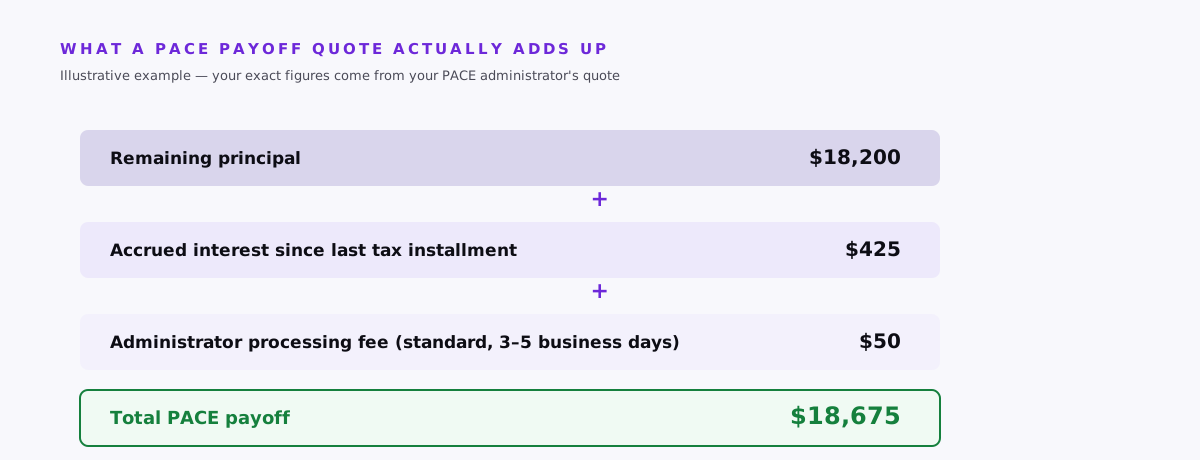
A PACE balance isn't a loan statement you can eyeball from memory, because it isn't billed like a loan. It's a special assessment riding on your property tax bill, so the number you owe today depends on where you are between semi-annual installments. Three pieces make up the total: remaining principal — the unpaid portion of the original assessment, amortizing over a term that averages close to 20 years (240 months), per the CFPB's 2023 analysis of PACE transactions; accrued interest since your last paid installment, because interest keeps running between tax bills, not just on an annual due date; and an administrator processing fee for preparing the quote itself.
Florida's Resiliency and Energy District, a real PACE administrator operating in the state, publishes its own fee schedule: a standard payoff request costs $50 and takes 3 to 5 business days, an expedited request costs $70 and takes 2 business days, and a simple paydown (reducing, not eliminating, the balance) runs a $25 fee. Those are real, current figures from the administrator's own payoff page, not an estimate.
What's notably absent from that list, at least at one major administrator: a prepayment penalty. Ygrene, one of the larger residential PACE administrators, states directly in its own FAQ that there is no prepayment penalty for residential property when paying off financing early — interest simply keeps accruing until the payoff date. Penalty terms can vary by program and contract, so don't assume every administrator matches that, but it means the “it'll cost you extra to pay it off early” assumption some sellers carry isn't a safe default without checking your own contract.
The practical lesson: request your payoff quote early, not the week before closing. A standard request alone can take 3 to 5 business days, and on a tight closing timeline, that delay matters more than the $20 difference between standard and expedited processing.
Take a hypothetical Florida house worth $345,000 in market-ready condition, needing roughly $15,000 in repairs and updates to compete with nearby listings, carrying a PACE assessment with $18,200 in remaining principal. The payoff quote comes back at $18,200 principal, plus $425 in interest accrued since the last tax installment, plus the $50 standard processing fee — a total payoff of $18,675.
| Line item | Retail listing | Cash sale |
|---|---|---|
| Sale price | $345,000 | $292,000 (illustrative) |
| Agent commission (~5.5%) | −$18,975 | $0 |
| Repairs/updates to list competitively | −$15,000 | $0 |
| Buyer closing-cost concessions | −$4,500 | $0 |
| Holding costs (~3–4 months) | −$5,500 | $0 (closes in ~2–3 weeks) |
| PACE payoff | −$18,675 | −$18,675 |
| Net proceeds | $282,350 | $273,325 |
The PACE balance comes out of both columns identically, because it has to be cleared to convey title either way. What it doesn't do is change which route pays more — listing still nets roughly $9,025 more in this example, the same relationship that would exist with no PACE lien at all. What the lien actually tests is whether a seller has enough equity cushion to absorb an $18,675 line item on top of commission, repairs, and holding costs and still come out ahead. In this example, there's plenty of room either way. That won't always be true.
Now take a thinner-equity scenario: a house realistically worth $228,000 after $9,000 in repairs, with a $150,000 first-mortgage balance and an older, larger PACE assessment — $34,200 in remaining principal, $800 in accrued interest, plus a $70 expedited processing fee for a total payoff of $35,070.
| Line item | Retail listing (repaired) | Cash sale (as-is) |
|---|---|---|
| Sale price | $228,000 | $179,000 (illustrative) |
| Agent commission (~5.5%) | −$12,540 | $0 |
| Seller closing costs (~1.5%) | −$3,420 | $0 |
| Repairs to list competitively | −$9,000 | $0 |
| Holding costs (~3 months) | −$4,200 | $0 (closes in ~2–3 weeks) |
| First-mortgage payoff | −$150,000 | −$150,000 |
| PACE payoff | −$35,070 | −$35,070 |
| Net to seller | $13,770 | −$6,070 |
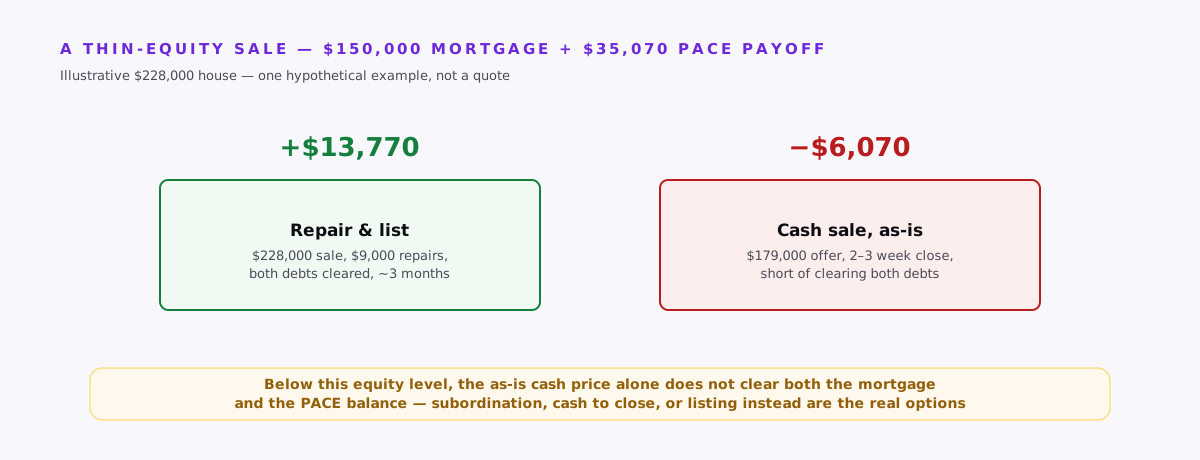
This is the honest version of a thin-equity sale. The retail path, after fronting $9,000 in repairs and carrying the house roughly three months, clears both the mortgage and the PACE balance with about $13,770 left over. The cash path, priced for as-is condition and a two-to-three-week close, doesn't clear both debts at this price — it comes up about $6,070 short.
That gap isn't a reason to assume the cash number is simply wrong. It's the real tradeoff: the cash price reflects no repair spend and a much shorter timeline, and in this example that price isn't high enough to also absorb $185,070 combined in mortgage and PACE debt. A seller in this position has three honest paths forward on a sale that doesn't fully clear what's owed: ask the PACE administrator about subordination (uncommon, and dependent on whether a program's terms even allow it), bring cash to the closing table to cover the shortfall, or choose the slower listing route instead, if there's the cash on hand to fund $9,000 in repairs and the time to carry the house for a few months first.
A few of these come up regardless of which path you're leaning toward:
It's also worth being clear about what a PACE loan is not. It's not a leased solar contract — see selling a house with leased solar panels if that's actually your situation — and it's not a conventional second mortgage. It's a tax-roll assessment with its own payoff process, which is exactly why the arithmetic above treats it as a line item pulled from the tax bill, not a loan payoff letter.
A cash sale doesn't make the PACE balance disappear — it still comes out of your proceeds at closing, the same as with a financed buyer. What it removes is the lender's underwriting timeline and the appraisal-driven deadline pressure that can come with a financed closing.
We buy as-is across Restar's 12-state footprint, PACE balance or not, and we'll tell you plainly what the payoff does to your number before you decide anything. This is educational information, not financial, tax, or legal advice — confirm your exact payoff amount with your PACE administrator.
All guides · Selling a house with a PACE loan · Cash offer vs. listing: net proceeds · Selling a house with a lien on it
Step 1 of 5
No obligation, no fees, no repairs. We respond the same day.
You’ll talk to Trevor McAmis, Owner & Acquisitions Lead
(313) 710-6129
Takes about two minutes. Or call (313) 710-6129 — we answer.