If your house has a PACE loan attached to it — financing for solar, a new roof, windows, or water-efficiency upgrades that gets repaid through your property tax bill instead of a separate monthly payment — selling isn't blocked, but the lien doesn't disappear on its own at closing. It generally has to be paid off, or in rare cases subordinated, before a conventional, FHA, or VA lender will fund your buyer's purchase, because PACE assessments typically sit ahead of the mortgage in payoff priority.
Tell us about the property and the remaining balance. We'll send a written offer within 24 hours and walk you through how the lien gets cleared at closing.
Takes about two minutes. Or call
(313) 710-6129 — we answer.
Educational only. This explains how these situations generally work. It is not legal, tax or financial advice, and the rules differ by state — talk to an attorney or CPA about your own situation before you act on any of it.
Selling a House With a PACE Loan: The Short Answer
A PACE loan is a lien attached to your property tax bill, not a personal loan — it stays with the property and must generally be paid off or subordinated at sale. Conventional, FHA, and VA lenders won't fund a purchase behind a senior PACE lien, so the balance is typically settled from sale proceeds at closing.
This is educational information about how PACE financing generally works, not legal, tax, or financial advice about your specific lien or contract. PACE program terms vary by administrator and by state. Confirm your payoff amount and any subordination or assumption options with your PACE program administrator, your title company, and a real estate attorney before you rely on anything here.
PACE stands for Property Assessed Clean Energy. It's a financing tool offered through local governments in a small number of states to help homeowners pay for solar panels, energy-efficient HVAC, insulation, storm-resistant windows, or water-conservation upgrades without a traditional loan application or credit-score-driven underwriting. Instead of a bill from a lender, the cost is added as a special assessment on the property's tax bill and repaid over a term that can run 10 to 25 years. That structure — a tax assessment rather than a loan — is exactly what makes selling a house with a PACE loan different from selling a house with an ordinary second mortgage or personal loan.
How a PACE Lien Actually Works
A few mechanics explain almost everything that follows for a seller:
It's a lien, not a personal loan. The obligation runs with the property, not with you as a borrower. If you sell without paying it off, it doesn't vanish — it transfers to whoever holds title next, the same way an unpaid tax bill would.
It's typically senior to your mortgage. Fannie Mae's Selling Guide states plainly that a PACE-encumbered property is not eligible for delivery to Fannie Mae unless the PACE program's terms do not provide for lien priority over first mortgage liens — in practice, most residential PACE programs do carry that priority, which is the whole reason agency lenders treat it as a payoff condition. See Fannie Mae Selling Guide B5-3.4-01.
It's repaid through your property tax bill, as a line-item special assessment, typically on a semi-annual schedule alongside your regular property taxes — not a separate loan statement.
New federal consumer protections apply to PACE originations as of March 1, 2026. The CFPB's final rule brings residential PACE financing under Truth in Lending Act ability-to-repay standards and requires PACE-style Loan Estimate and Closing Disclosure documents going forward. That rule governs how new PACE loans get originated — it doesn't change how an existing balance gets handled when you sell. See CFPB: Residential PACE Financing Final Rule.
PACE vs a Leased Solar System: Not the Same Obligation
Sellers conflate these constantly, and it's worth being precise, because the two problems are solved differently at closing. A leased solar system (or a power-purchase agreement) is a contract with a solar company: they own the panels, you pay them monthly for the power or the use of the equipment, and if there's any lien at all, it's usually a UCC-1 fixture filing against the equipment itself — not a tax assessment. Our guide on selling a house with leased solar panels covers how those transfer or get bought out.
A PACE loan is different in kind. There's no separate contract to transfer with a solar company or lender — the obligation is baked into the property's tax bill by the local government's PACE program, it generally holds automatic priority ahead of the mortgage, and it follows the deed rather than a credit check. A leased-solar transfer can fail because a buyer doesn't qualify with the solar company; a PACE balance doesn't have an approval step like that — it simply has to be paid off, or in rarer cases formally subordinated, before an agency-backed loan can close on the property.
Why Mortgage Lenders Require a PACE Payoff at Closing
This is the part that actually controls your timeline and your buyer pool. Fannie Mae and Freddie Mac both require a mortgage they purchase to be in first-lien position, and a PACE assessment's senior priority conflicts with that directly. Fannie Mae's guidance is explicit: lenders must generally have the borrower pay off the existing PACE obligation as a condition of the new mortgage, and a property may only avoid that requirement if the PACE program's own terms don't grant it lien priority over the mortgage in the first place (see Fannie Mae Selling Guide B5-3.4-01). Freddie Mac applies the same first-lien-position requirement.
FHA financing is affected even more directly. HUD's Mortgagee Letter 2017-18 ended FHA's earlier, narrower policy of allowing FHA-insured financing on PACE-encumbered properties after a lender due-diligence review, effective for case numbers assigned on or after January 7, 2018 — in practice, FHA lenders now require the PACE obligation to be resolved before closing on that property (see HUD Mortgagee Letter 2017-18). VA and USDA buyers run into a similar practical wall: those programs also require the insured mortgage to sit in first-lien position, so a lender originating either loan type is very unlikely to close behind an unresolved senior PACE assessment.
In practice: almost any financed buyer is going to need the PACE balance cleared, paid off from your proceeds, or in the uncommon case where your specific program doesn't carry lien priority, left in place. Ask your title company to confirm which situation applies before you price or market the house.
The Honest Tradeoff: What a PACE Balance Does to Your Net Proceeds
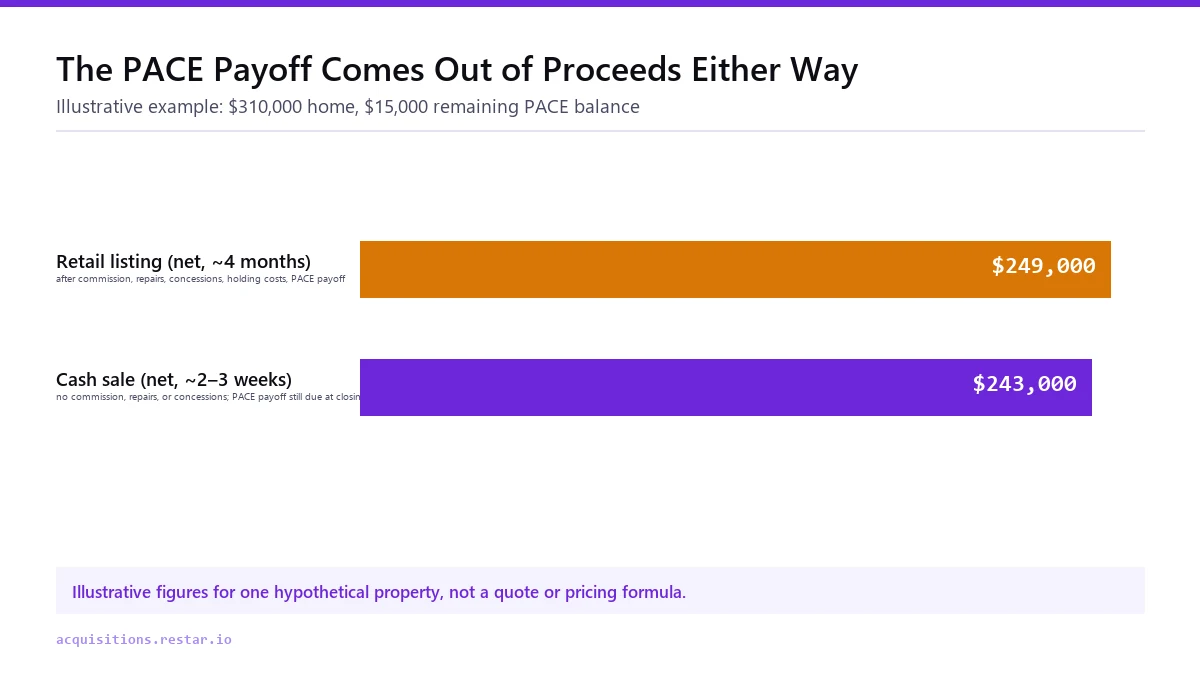
A PACE balance is a real dollar amount coming out of your proceeds either way you sell — the question is what else comes out alongside it, and how long that takes. Here's an illustrative example, not a quote: a house realistically worth $310,000 in market-ready condition, needing about $16,000 in repairs and updates to compete with nearby listings, carrying a $15,000 remaining PACE balance.
The PACE payoff comes out of proceeds either wayRestar Acquisitions · illustrative example, $310,000 home with a $15,000 PACE balance
In this example, listing nets roughly $6,000 more than the cash sale — but it takes about four months instead of two to three weeks, and every retail line item (repair cost, commission, concessions, holding costs, whether the appraisal supports the contract price) carries its own risk of running over budget or falling through. If you have the equity to absorb the PACE payoff, the time to carry the house, and the tolerance for that uncertainty, listing with an agent is very likely the better financial outcome. A cash sale is the trade you make for speed and certainty on the closing date, not for a higher number — and these are illustrative, rounded figures for one hypothetical property, not a quote or a formula we apply to offers.
Your Real Options When Selling With a PACE Lien
Pay off the PACE balance from your proceeds and list normally. The most common path if you have enough equity. Your title company handles the payoff at closing like any other lien, and the sale proceeds normally.
Ask your PACE program administrator about subordination. Some administrators will subordinate the assessment behind a new first mortgage on request; whether that helps depends entirely on whether your buyer's lender is willing to accept a subordinated PACE lien in second position, which agency lenders generally are not.
Ask about assumption by the buyer. A PACE assessment is designed to run with the property, so in theory a new owner can simply keep paying it. In practice this only works cleanly for an all-cash buyer or a portfolio lender comfortable closing behind the lien — it does not solve the problem for a buyer using an agency-backed conventional, FHA, VA, or USDA loan.
Refinance to pay off the PACE balance before you list. If you're not ready to sell yet but want the lien gone, Fannie Mae and Freddie Mac both allow a no-cash-out refinance where the payoff is rolled into the new first mortgage, which clears the lien and simplifies a future sale.
Sell for cash. A cash buyer isn't relying on an institutional lender's underwriting file, so the sale isn't held up by a lender's PACE payoff condition the way a financed deal can be. The balance still typically comes out of your proceeds at closing to convey clear title — see selling a house with a lien on it for how that works with other lien types, and cash offer vs listing net proceeds for how to run your own numbers against the example above.
Where PACE Programs Are Actually Active
Residential PACE isn't available everywhere — it exists only where a state has authorized it and a local government has opted in. The three states with meaningful residential PACE activity are California, Florida, and Missouri. California is by far the largest market: the state's Department of Financial Protection and Innovation licenses PACE program administrators, and the California Alternative Energy and Advanced Transportation Financing Authority runs a loss-reserve program that, as of a March 2026 program update, covered tens of thousands of active PACE financings statewide (see California State Treasurer: PACE FAQ). Missouri authorized residential PACE but a 2024 state law barred new residential PACE contracts after August 28, 2024, so activity there is now limited to existing, legacy assessments in areas that previously participated.
Florida is the one that matters most directly for our footprint, since Restar buys in Florida but not in California or Missouri. Florida's PACE statute, Fla. Stat. § 163.08, doesn't just authorize the assessment — it requires the seller to give the buyer a specific written disclosure statement, at or before contract signing, whenever the property carries an unpaid PACE assessment (see Florida Statutes § 163.08). If you're selling a Florida property with a PACE balance, that disclosure isn't optional paperwork — confirm the required language and timing with your title company or closing attorney before you go under contract.
Outside these three states, a PACE lien is unusual but not impossible — a handful of other states have authorized smaller pilot programs over the years. The mechanics above apply regardless of which state issued it.
Consumer Financial Protection Bureau, Residential Property Assessed Clean Energy Financing (Regulation Z), final rule — consumerfinance.gov
U.S. Department of Housing and Urban Development, Mortgagee Letter 2017-18 — hud.gov
Florida Statutes § 163.08, seller disclosure requirement for PACE assessments — flsenate.gov
California State Treasurer, PACE Loss Reserve Program FAQ — treasurer.ca.gov
Common questions
What is a PACE loan?
PACE stands for Property Assessed Clean Energy. It's financing for solar, energy-efficient, or water-efficiency home improvements that's repaid as a special assessment on your property tax bill rather than through a separate loan payment. It's a lien attached to the property, not a personal loan attached to you.
Can you sell a house with a PACE loan on it?
Yes. Selling isn't blocked, but the PACE balance generally has to be paid off, or in rare cases subordinated, at closing, because Fannie Mae, Freddie Mac, FHA, VA, and USDA lenders all require their mortgage to sit in first-lien position ahead of the PACE assessment.
Is a PACE loan the same as leased solar panels?
No. Leased solar is a contract with a solar company, paid monthly, sometimes secured by a UCC-1 fixture filing against the equipment. A PACE loan is a tax assessment added to your property tax bill by a local government program, and it typically carries senior lien priority over your mortgage in a way a solar lease generally does not.
Does a PACE balance have to be paid off before closing?
In almost every financed sale, yes. Fannie Mae and Freddie Mac require payoff as a condition of the new mortgage unless the specific PACE program doesn't grant lien priority over the mortgage, and FHA has required PACE payoff since HUD Mortgagee Letter 2017-18. A cash sale isn't held up by a lender's underwriting condition, but the balance still typically comes out of the sale proceeds to convey clear title.
Which states have active residential PACE programs?
California and Florida currently have active residential PACE programs. Missouri authorized PACE but barred new residential contracts after August 28, 2024, so only legacy assessments remain active there. Of the states Restar buys in, Florida is the one where a PACE lien is most likely to come up, and Florida law requires a specific written seller disclosure under Fla. Stat. § 163.08.
A cash sale doesn't remove the PACE lien — it still has to be paid off out of the proceeds at closing, same as with a financed buyer. What it removes is the financing contingency: there's no lender underwriting file that stalls or falls apart because of the lien's position, and no repair list to clear before closing.
We buy houses as-is across 30 markets in Alabama, Arizona, Florida, Georgia, Indiana, Maryland, Michigan, New York, North Carolina, Ohio, and Texas, PACE lien or not, and we'll tell you plainly what the balance does to your number before you decide anything.
Every offer on this site is underwritten by a person, not a form. If the
numbers do not work for you, say so and I will tell you what would.
Also from Restar
Want the data behind all of this?
Restar Acquisitions is the acquisitions arm of Restar — a housing-market analytics
platform tracking 180+ metrics across every U.S. market, with composite scores and 12-month
price forecasts. The numbers on this page come from the same work.