An unpaid water or sewer bill doesn't stay a personal debt. In most states it can become a lien against the house itself, and in several of the states Restar buys in, that lien has the same legal priority as a property tax lien, which means it can outrank a mortgage that's been in place for years. A $900 unpaid balance can realistically grow into well over $1,200 after a year or two of penalties and interest, and it's the kind of thing a standard title search frequently misses. Here's how the math works, state by state, and what to do about it before you sell.
Step 1 of 5
Send the address and we'll help you get the real payoff figure and a written offer that already accounts for it.
You’ll talk to Trevor McAmis, Owner & Acquisitions Lead
(313) 710-6129
Takes about two minutes. Your address is never shared.
Educational only. This explains how these situations generally work. It is not legal, tax or financial advice, and the rules differ by state. Talk to an attorney or CPA about your own situation before you act on any of it.
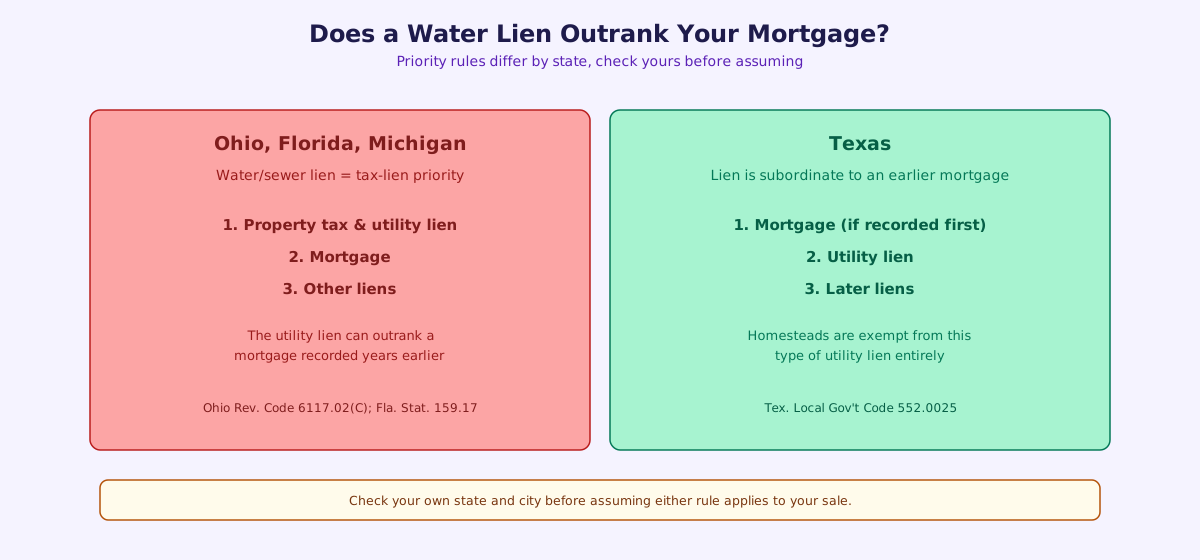
This surprises a lot of sellers: utility departments generally bill the account holder, but the authority to collect unpaid charges usually attaches to the property, not just the person who ran up the bill. Several states spell this out directly in statute:
The pattern to remember: in Ohio and Florida specifically, a water or sewer lien behaves like a tax lien and can outrank your mortgage. In Texas, it generally can't, as long as your mortgage was recorded first. Check your own state and municipality rather than assuming either rule applies.
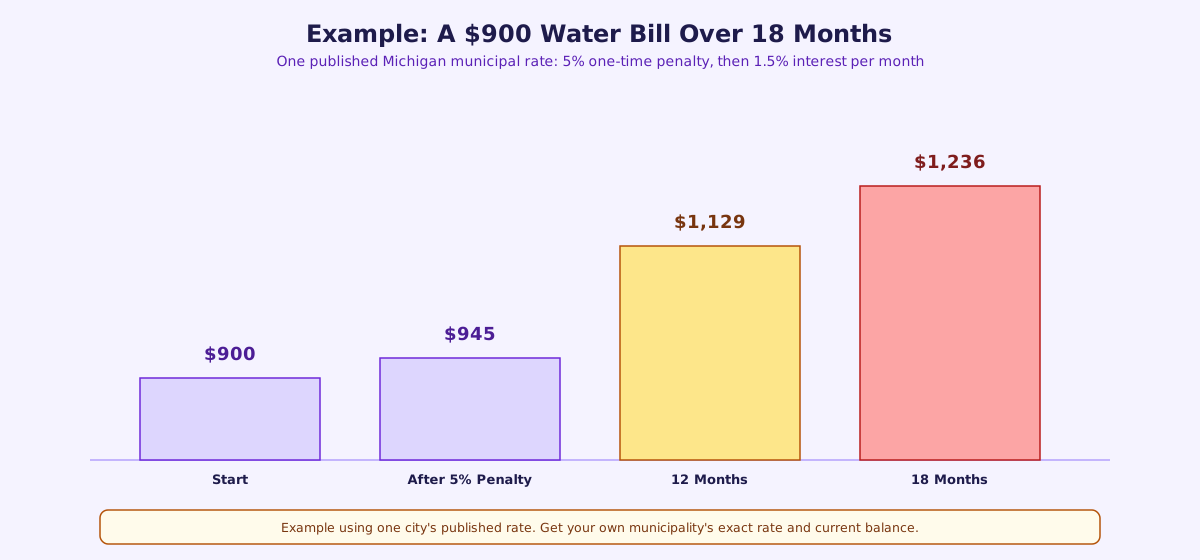
Interest and penalty rates on delinquent utility accounts vary by city, and there's no single number that applies everywhere. One published, real example: as of its current 2026 published rate schedule, Iron Mountain, Michigan charges a one-time 5% penalty on a delinquent water bill, followed by 1.5% interest per month after that until it's paid (City of Iron Mountain).
Applying that one city's published rate to a representative balance shows how fast this compounds:
| Month | Running balance |
|---|---|
| Start: unpaid water/sewer bill | $900 |
| After 5% one-time penalty | $945 |
| After 12 months at 1.5%/month | $1,129 |
| After 18 months at 1.5%/month | $1,236 |
Example: using one published Michigan municipality's rate, not a prediction for your city. Your own water department can tell you the exact rate and current balance.
An $800 to $1,200 swing is a real number, but it's not the scary part. The scary part is that this account can sit quietly accruing for well over a year before anyone connected to a sale notices it, because of how it's discovered.
A standard title search pulls recorded documents from the county recorder's office, like deeds and mortgages. Municipal utility balances are tracked at the city or utility department level, a completely separate system, and in some states a utility lien doesn't even have to be recorded to be valid against a buyer.
Florida's statute exempts these utility liens from the state's normal recording requirement entirely, meaning the lien can legally bind a new owner even though it never shows up at the county recorder's office. That's why title companies and real estate attorneys in affected states recommend a separate municipal lien search or a direct payoff letter from the utility department, not just a standard title search, before closing.
Whether a title insurance policy covers an unpaid utility lien that surfaces after closing depends heavily on the policy and the state. Ask your title company directly whether their search and policy include a municipal lien check, since this is not handled uniformly the way a mortgage payoff is.
Documented cases show just how far this can run: a Rhode Island homeowner lost her house over a $474 unpaid sewer bill before the state passed reform legislation, and a Baltimore, Maryland homeowner's $362 water bill ballooned into a tax sale before Maryland tightened its own rules. Maryland is one of the states Restar buys in, which makes that second case worth taking seriously rather than treating it as a story from somewhere else.
Rhode Island is not a state Restar buys in, and both cases are extreme, now-reformed examples, not the typical case. Within Restar's footprint, Michigan reporting on Detroit-area water debt shows balances more commonly running into the thousands of dollars, not hundreds, before a tax foreclosure becomes a real risk, with Michigan's broader tax foreclosure process generally running on a multi-year statutory cycle rather than months. The lesson isn't that a small bill will definitely take your house. It's that the dollar amount alone doesn't tell you how serious the lien is. The state law governing priority and enforcement does.
Get the real payoff figure before you price the house, not after a buyer is already under contract, since a lien that surfaces mid-deal is a common reason financed sales fall apart late. Here's the order that keeps it from derailing your closing.
A cash sale handles a lien like this the same way it handles any other: it comes out of closing proceeds before you receive your share, and you don't have to front the payoff yourself. Whether a cash sale or a listed sale nets you more after that payoff still depends on your house's condition and your local market, the same as our guide to selling a house with a lien on it explains for liens generally. Run both numbers once you have the real payoff figure in hand, and see how cash home buyers calculate offers if you want to understand that side of the comparison.
This article is educational, not legal or tax advice. Lien priority, interest rates, and enforcement timelines for unpaid water and sewer charges vary significantly by state and even by city. Confirm the exact balance and your state's lien priority rules with your local utility department and a real estate attorney if the amount is significant.
A water or sewer lien, like any other lien, gets paid out of closing proceeds in a cash sale, not fronted by you. We'll help you confirm the balance and give you a written offer within 24 hours.
All guides · Selling a house with a lien on it · How cash home buyers calculate offers · Holding costs of a vacant house
Step 1 of 5
No obligation, no fees, no repairs. We respond the same day.
You’ll talk to Trevor McAmis, Owner & Acquisitions Lead
(313) 710-6129
Takes about two minutes. Your address is never shared.