Selling with an open FHA 203(k) loan means paying off the full loan balance, not just what you've spent on the rehab. Money still sitting in the rehab escrow account isn't paid out to you. It goes toward the payoff instead. And if the work is unfinished, unpermitted or uninspected, a retail buyer's lender may want it done before they'll close.
Step 1 of 5
Tell us about the property and we'll send a written cash offer within 24 hours. We buy it with the rehab unfinished. No repairs, no commissions.
You’ll talk to Trevor McAmis, Owner & Acquisitions Lead
(313) 710-6129
Takes about two minutes. Your address is never shared.
Educational only. This explains how these situations generally work. It is not legal, tax or financial advice, and the rules differ by state. Talk to an attorney or CPA about your own situation before you act on any of it.
An FHA 203(k) loan rolls the purchase (or refinance) of a house and the cost of fixing it up into one mortgage. HUD describes it this way: part of the loan pays the seller or the old mortgage, and “the remaining funds are placed in an escrow account and released when the rehabilitation is completed” (HUD, 203(k) Rehabilitation Mortgage Insurance Program). That account is the Rehabilitation Escrow Account, and the rules for it are in the Rehabilitation Loan Agreement you signed at closing.
There are two versions. The Standard 203(k) covers major work, requires a HUD-approved 203(k) Consultant, and gives you up to 12 months to finish. The Limited 203(k) covers minor, nonstructural repairs up to $75,000 and gives you up to 9 months (HUD Mortgagee Letter 2024-13). Your own Rehabilitation Loan Agreement sets your actual deadline, so check it before you plan around these numbers.
This is the part sellers most often get wrong. The escrow isn't a savings account in your name. HUD's model Rehabilitation Loan Agreement says the lender releases the money “by check, payable to the Borrower and/or the contractor, upon satisfactory completion of the rehabilitation… as evidenced by a compliance inspection,” and only once the work meets “all federal, state and local laws, codes and ordinances, including required permits and inspections” (HUD Rehabilitation Loan Agreement, Form Model Document). In other words, it comes out in draws as inspected work gets finished. Deciding to sell doesn't release it.
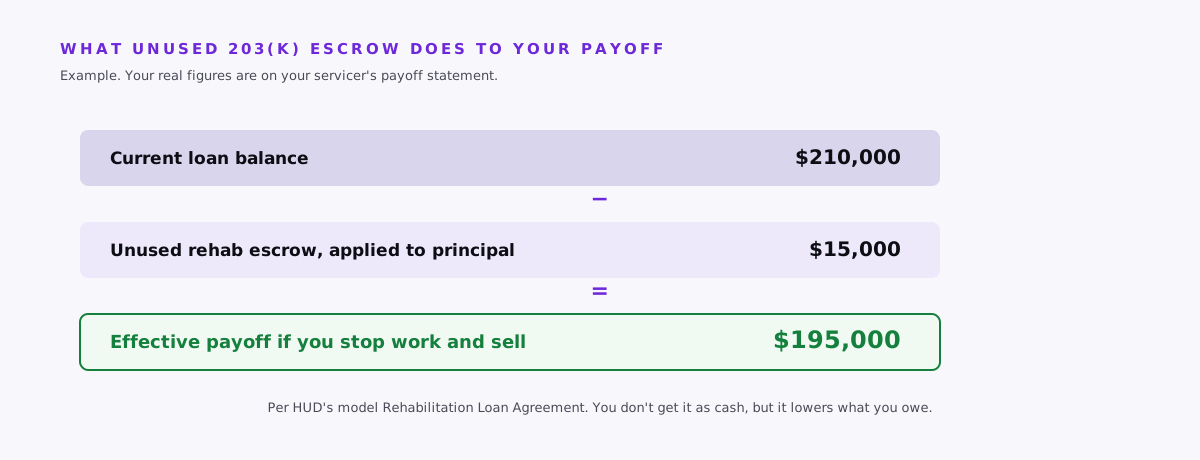
It lowers your payoff. The same HUD agreement covers this directly. If the contingency reserve was financed into your loan, “any unused Contingency Reserve funds must be applied to reduce the mortgage principal.” And if the project stalls (work can't sit idle more than 30 days in a row before the lender can stop further draws), “any funds remaining in the Rehabilitation Escrow Account must be used to reduce the mortgage principal.”
So the leftover money doesn't vanish, and you don't get a check for it either. It comes off what you owe the lender at closing, which counts in your favor when you work out what a sale nets you.
Your own lender doesn't have to sign off before you sell, but your buyer's lender matters a lot. A retail buyer with a mortgage almost always needs the house habitable and up to code. Half-finished or unpermitted structural, electrical, plumbing or roofing work is one of the most common reasons buyer financing stalls or an appraisal comes back with repair conditions.
HUD's agreement also lets the lender or HUD “enter upon the property at all times during the period of construction” to check on progress, which tells you how closely an open rehab is watched. If the work isn't signed off, expect delays, financing conditions, and fewer retail buyers until it is.
Say you have a $240,000 FHA 203(k) loan (purchase plus rehab budget), a current balance of $210,000, and $15,000 still unused in the rehab escrow. The renovation is 60% done.
Path A: Finish the rehab, then list. A contractor quotes $18,000 to finish the last 40%. Your $15,000 escrow covers most of it, so you put in the other $3,000 yourself. The work takes about two more months, and holding costs run about $2,000 a month, so $4,000. You list and sell for $265,000. The loan payoff is $210,000 (the escrow got used up finishing the work), commission at 5.5% is $14,575, and seller closing costs at 1.5% are $3,975.
Net proceeds: $265,000 − $210,000 − $14,575 − $3,975 − $3,000 (your share of the finish cost) − $4,000 (holding costs) = $29,450.
Path B: Sell as-is to a cash buyer now. A cash buyer offers $215,000 for the house as it stands and takes on the unfinished work. At closing, the $15,000 left in escrow is applied to your principal under the Rehabilitation Loan Agreement, so you owe the lender $210,000 − $15,000 = $195,000. No commission, no finish costs, no holding costs, and you close in about two to three weeks.
Net proceeds: $215,000 − $195,000 = $20,000.
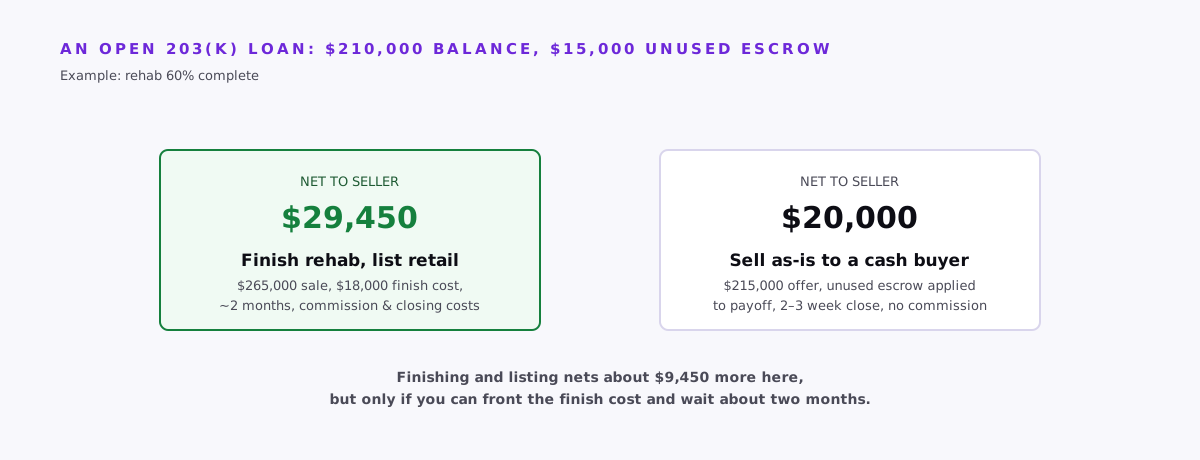
Here, finishing and listing nets about $9,450 more. That only works if you have the $3,000 plus holding costs on hand and two months to see the renovation through. If you don't have the cash or the time, or your completion deadline is close, the cash sale nets less but asks nothing up front and carries no risk of the rehab going sideways.
| Factor | Finish rehab, list | Sell as-is for cash |
|---|---|---|
| Cash needed up front | ~$3,000–$7,000+ | $0 |
| Time to close | 2+ months, then a normal sale | Usually 2–3 weeks |
| Loan payoff | Full remaining balance | Unused escrow lowers the payoff |
| Commission and closing costs | ~5.5% commission, ~1.5% closing | Usually none, buyer pays |
| Inspection and completion risk | Must pass buyer-lender conditions and code sign-off | Buyer takes on the unfinished work |
| Net proceeds (example above) | $29,450 | $20,000 |
Finish the rehab and list. Best when you can cover the remaining cost and holding costs and your deadline gives you room.
Ask your lender for a change order or extension. The Rehabilitation Loan Agreement has a formal change-order process (form HUD-92577) that lets you adjust the scope with the lender's written approval. Call your servicer before assuming you're stuck with the original plan and deadline.
Sell as-is to a cash buyer. No finish costs and no retail inspection hurdle, at a lower price that reflects the unfinished work.
If you owe more than the house is worth, ask your servicer about a short sale. It's a lender-by-lender process with tax and credit consequences, so have a HUD-approved housing counselor or an attorney look at it with you first.
We buy houses as-is for cash in 45 markets across Alabama, Arizona, Florida, Georgia, Indiana, Maryland, Michigan, Missouri, North Carolina, New York, Ohio and Texas. You get a written offer within 24 hours, you don't make repairs, there are no commissions, and you choose the closing date. We aren't your lender or a party to your 203(k) loan, so loan-specific questions go to your servicer. Your payoff statement is the number that counts.
We buy houses as-is for cash, including ones with a rehab half done. Send the address and you'll have a written offer within 24 hours. No repairs, no commissions, and you pick the closing date. If finishing the work and listing would put more in your pocket, we'll tell you that too.
All guides · Reading a mortgage payoff statement · Cost of lender-required repairs before closing · Should I repair before selling?
Step 1 of 5
No obligation, no fees, no repairs. We respond the same day.
You’ll talk to Trevor McAmis, Owner & Acquisitions Lead
(313) 710-6129
Takes about two minutes. Your address is never shared.
