Every market page publishes the numbers behind its offer. See the math
Home › Guides › The Cost of Lender-Required Repairs Before You Can Close
Guide
The Cost of Lender-Required Repairs Before You Can Close
A financed buyer's appraisal isn't only about value — FHA, VA, and conventional appraisers are also required to flag health, safety, and structural issues, and the lender generally won't fund the loan until they're fixed, escrowed, or credited. That single condition is one of the most common ways a financed sale stalls or falls apart weeks after you thought you had a deal.
Takes about two minutes. Or call
(313) 710-6129 — we answer.
Educational only. This explains how these situations generally work. It is not legal, tax or financial advice, and the rules differ by state — talk to an attorney or CPA about your own situation before you act on any of it.
The Cost of Lender-Required Repairs: The Short Answer
When an FHA, VA, or conventional appraiser flags a health, safety, or structural issue, your buyer's lender won't fund the loan until it's fixed, escrowed, or credited — adding real dollars and 1 to 8+ weeks to your closing. A cash sale isn't underwritten against an appraisal, so it skips this condition entirely.
This is educational information about how lender property-condition requirements generally work, not legal, contracting, or financial advice about your specific property. Repair costs, escrow rules, and appraiser judgment vary by loan program, lender, and locality. Confirm any specific repair condition with your real estate agent, the buyer's lender, and a licensed contractor before you rely on anything here.
Most sellers plan for the buyer's inspection contingency — a negotiation between two private parties. Fewer plan for the appraisal's condition requirements, which aren't a negotiation at all. FHA, VA, and conventional loans that a lender intends to sell to Fannie Mae, Freddie Mac, or insure through HUD or the VA all come with property-condition standards baked into the underwriting guidelines, and an appraiser who is required to report a defect can't simply look past it because the buyer is willing to.
What FHA Appraisers Are Required to Flag
FHA's property requirements come from HUD Handbook 4000.1 and federal lead-paint regulation, and they leave little room for a waiver on a few specific items:
Peeling, chipping, or flaking paint on any home built before 1978. This is a lead-hazard rule, not a cosmetic one — it applies to interior and exterior surfaces, porches, railings, fences, and even a detached garage or shed, and an FHA appraisal generally cannot close "as-is" over it.
Roofing with limited remaining life. A roof judged to have roughly two years of service life or less, or one that's failing to keep out moisture, typically triggers a "subject to" appraisal pending a roofer's inspection and repair or replacement.
Safety and soundness items generally: exposed or unsafe wiring, non-functioning heating, missing or unsafe stair handrails, broken windows, and active water intrusion are all standard triggers across FHA guidance.
See HUD Handbook 4000.1 for the official FHA single-family housing policy handbook.
What VA Appraisers Require, and What They're Told to Ignore
VA's Minimum Property Requirements (MPRs) are built around one standard: the home has to be safe, structurally sound, and sanitary. In practice, VA appraisers commonly flag the same pre-1978 peeling-paint lead hazard as FHA, missing handrails on stairways with three or more risers, and heating systems that can't maintain roughly 50°F in areas with plumbing, along with water heaters missing a required pressure-relief valve.
What sellers often don't expect: VA appraisers are explicitly instructed not to flag purely cosmetic issues or ordinary wear-and-tear — the trigger is safety, structural soundness, or sanitation, not appearance. VA also updated its MPR rules effective May 1, 2026, narrowing what has to meet the standard (for example, detached non-habitable structures like sheds and garages no longer have to comply). See the VA's announcement on updated home loan appraisal requirements and VA Circular 26-22-13 for the underlying MPR guidance.
Conventional Loans: More Flexibility, Not Unlimited
Fannie Mae and Freddie Mac appraisals assign a condition rating from C1 (new/like-new) to C6 (substantial damage or deficiencies affecting safety, soundness, or structural integrity). A C6 rating makes the loan ineligible for delivery until the property is repaired back up to at least a C5 — see Fannie Mae Selling Guide B4-1.3-06. An appraisal can be issued "subject to completion" of a specific repair, and a follow-up Form 1004D (or an accepted completion certificate) verifies the work before the loan can close or be sold — see Fannie Mae Selling Guide B4-1.2-05.
Conventional financing is genuinely more forgiving than FHA or VA on purely cosmetic items — the trigger is safety, soundness, or structural integrity, not the paint color or an outdated kitchen. But a real safety issue (bad wiring, a failing roof, a structural crack) can stop a conventional loan just as surely as an FHA one.
Your Four Options Once Repairs Are Flagged
Complete the repair before closing. The straightforward path when there's time: fix it, get a reinspection or completion certificate, and the loan proceeds.
Escrow holdback, for weather-dependent exterior items only. Lenders sometimes allow funds to be withheld at closing for repairs like exterior paint, roofing, handrails, or driveway work that can't be done in the current season — not for structural, foundation, septic, or (in most guidance) roof-related items. Typical caps: an FHA holdback is commonly limited to around $5,000; VA requires roughly 150% of the estimated repair cost to be escrowed; conventional loans generally cap the holdback at 10% of the appraised value with about 180 days to finish.
Renegotiate price or ask for a closing credit. The buyer keeps the property as-is and the numbers shift instead of the punch list.
The deal falls through. If none of the above can be arranged, the buyer's financing simply can't proceed, and the house goes back on the market with the repair issue now part of its known history.
What These Repairs Actually Cost
Illustrative, typical ranges — not a quote for any specific property or contractor market:
Roof replacement: roughly $5,900–$13,400, averaging around $9,600 nationally for an asphalt-shingle roof; metal or tile runs higher.
Electrical panel replacement: roughly $518–$2,192, averaging around $1,346; a 100-amp to 200-amp service upgrade commonly runs $1,800–$4,200.
Lead-safe exterior scrape and repaint (pre-1978 homes): roughly $8–$17 per square foot for compliant paint removal plus $1.50–$4 per square foot to repaint; a severe whole-house case can run $15,000–$30,000.
Handrail or stair repair: roughly $100–$1,000 depending on scope, or about $30–$45 per linear foot for a full replacement.
The dollar figure is only half the cost. Each round of appraiser-required repair and reinspection typically adds a week or two for minor items (paint, a handrail, a water heater) and four to eight-plus weeks for major ones (a roof, a structural issue, foundation work) — and every extra week is a week of mortgage interest, insurance, taxes, and utilities on a house you're still trying to sell.
The Honest Tradeoff: Meeting the Condition vs. Selling Around It
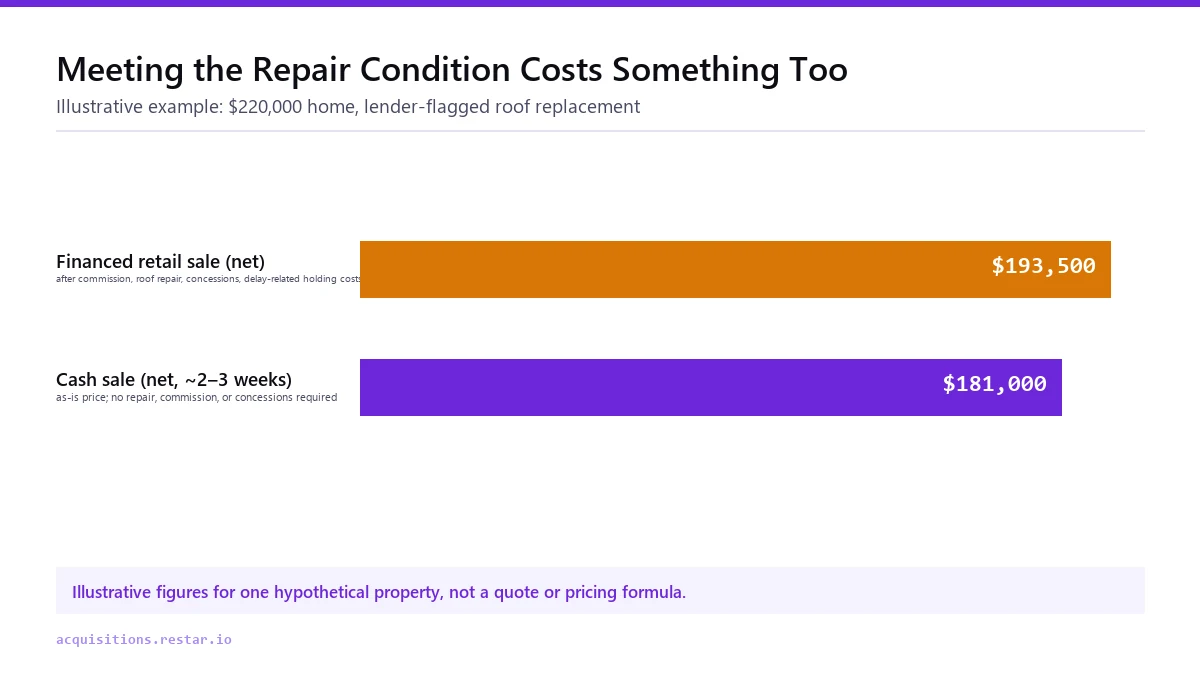
Here's an illustrative example, not a quote: a house worth $220,000 to a financed buyer once repaired, where the appraiser flags the roof and requires replacement before the loan can close.
Line item
Financed retail sale
Cash sale
Sale price
$220,000
$181,000 (illustrative, as-is)
Agent commissions (~5.5%)
−$12,100
$0
Roof replacement (lender-required)
−$9,600
$0
Buyer closing-cost concessions
−$3,000
$0
Extra holding costs from repair/reinspection delay
−$1,800
$0 (closes in ~2–3 weeks)
Net proceeds
$193,500
$181,000
Meeting the repair condition costs something tooRestar Acquisitions · illustrative example, $220,000 home with a lender-flagged roof
In this example, the financed sale nets about $12,500 more — but that number assumes the roof replacement goes smoothly, the reinspection clears on the first try, and the buyer's financing doesn't fall apart somewhere in the extra weeks that repair adds. If you have the cash to front the repair and the timeline to absorb the delay, meeting the lender's condition and selling retail is very likely the stronger financial outcome. A cash, as-is sale is the trade you make for speed and certainty, not for a higher number — and these are illustrative, rounded figures for one hypothetical property, not a quote or a formula we apply to offers.
Sources
U.S. Department of Housing and Urban Development, Single Family Housing Policy Handbook 4000.1 — hud.gov
U.S. Department of Veterans Affairs, updated home loan appraisal requirements — news.va.gov
VA Circular 26-22-13, Minimum Property Requirements guidance — benefits.va.gov
Fannie Mae Selling Guide, B4-1.3-06, Property Condition and Quality of Construction — selling-guide.fanniemae.com
Fannie Mae Selling Guide, B4-1.2-05, Verifying Completion and Postponed Improvements — selling-guide.fanniemae.com
Common questions
What repairs do FHA or VA lenders require before closing?
Both focus on health, safety, and structural items: peeling or chipping paint on pre-1978 homes (a lead-hazard rule with no waiver), roofs with little remaining service life, exposed or unsafe wiring, missing stair handrails, non-functioning heating, and active water intrusion are the most common triggers. Purely cosmetic issues generally aren't required, especially under VA rules.
Can lender-required repairs be done after closing?
Sometimes, through a lender-approved escrow holdback, but usually only for weather-dependent exterior items like paint, roofing, or handrails, and only up to specific dollar or percentage caps that vary by loan program. Structural, foundation, and most roof-related items typically have to be finished before closing, not after.
What if I can't afford the repairs a lender is requiring?
Your realistic options are a price reduction or closing credit to the buyer in place of the repair, or the sale not closing on that loan. A cash buyer who isn't underwriting against an appraisal doesn't have this condition at all, though the as-is price will reflect the property's condition.
Does a cash sale skip appraisal repair requirements?
Yes. A cash sale isn't financed against an appraisal, so there's no lender property-condition standard to satisfy and no reinspection to schedule. The tradeoff is a price that reflects the as-is condition, not a higher number.
How much time do lender-required repairs actually add?
Minor items like paint, a handrail, or a water heater typically add one to two weeks for the repair and reinspection. Major items like a roof, structural work, or foundation issues can add four to eight weeks or more, on top of whatever time the sale had already taken.
A cash sale isn't underwritten against an appraisal, so there's no lender-required repair list, no reinspection, and no financing that falls through over a roof or a panel upgrade. The tradeoff is an as-is price that reflects the property's condition — not a higher number, a faster and more certain one.
We buy houses as-is across 30 markets in Alabama, Arizona, Florida, Georgia, Indiana, Maryland, Michigan, New York, North Carolina, Ohio, and Texas, repair list or not, and we'll tell you plainly what your numbers look like before you decide anything.
Every offer on this site is underwritten by a person, not a form. If the
numbers do not work for you, say so and I will tell you what would.
Also from Restar
Want the data behind all of this?
Restar Acquisitions is the acquisitions arm of Restar — a housing-market analytics
platform tracking 180+ metrics across every U.S. market, with composite scores and 12-month
price forecasts. The numbers on this page come from the same work.