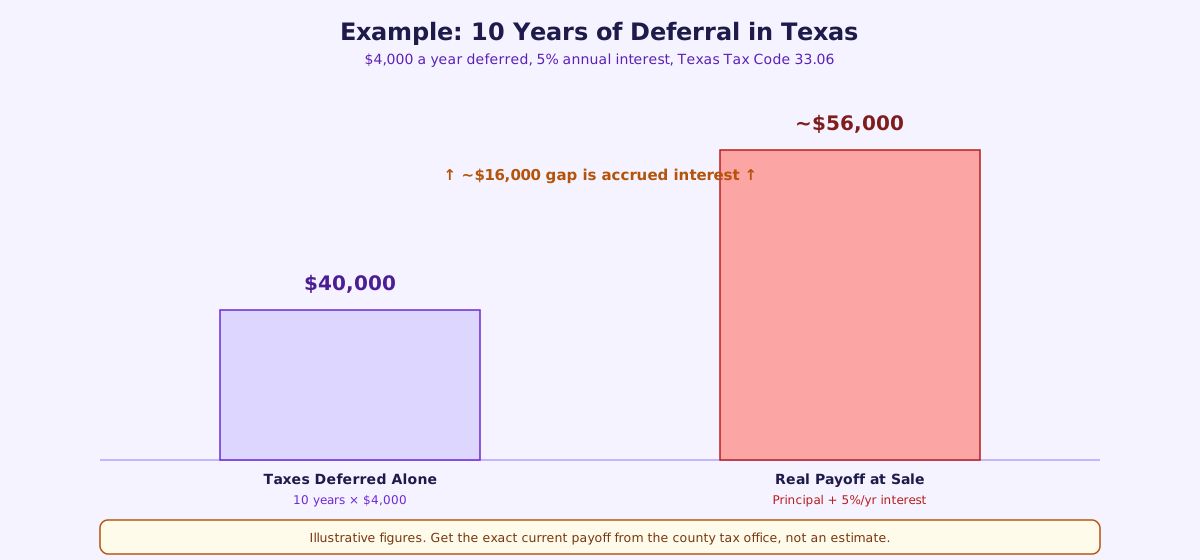
If you or a parent used a senior or disabled property tax deferral program, the taxes didn't disappear, they became a lien that's been quietly growing with interest every year, and the full balance comes due the moment the house sells. On a Texas home with $4,000 a year in deferred taxes over 10 years, the payoff at closing can run close to $56,000 once interest is added. Here's how the math works in the states where this comes up most, and why heirs are usually the ones blindsided by it.

Step 1 of 5
Send the address. We'll help you get the real payoff number and tell you what the house nets after it's paid.
You’ll talk to Trevor McAmis, Owner & Acquisitions Lead
(313) 710-6129
Takes about two minutes. Your address is never shared.
Educational only. This explains how these situations generally work. It is not legal, tax or financial advice, and the rules differ by state. Talk to an attorney or CPA about your own situation before you act on any of it.
Most people assume unpaid property taxes mean a looming foreclosure. For a 65-and-older or disabled homeowner who files a deferral affidavit, that's specifically not true, at least while they're alive and living in the house. Deferral programs let that homeowner stop paying property taxes on their primary residence without triggering a tax sale. The taxing authority can't foreclose during the deferral period.
What happens instead is the unpaid tax becomes a recorded lien against the property, and it accrues interest every year the deferral continues. Nothing is forgiven. The lien, plus everything it's accrued, becomes due and payable within a set window after the homeowner sells, moves out, or dies, generally before the next owner can get clear title.
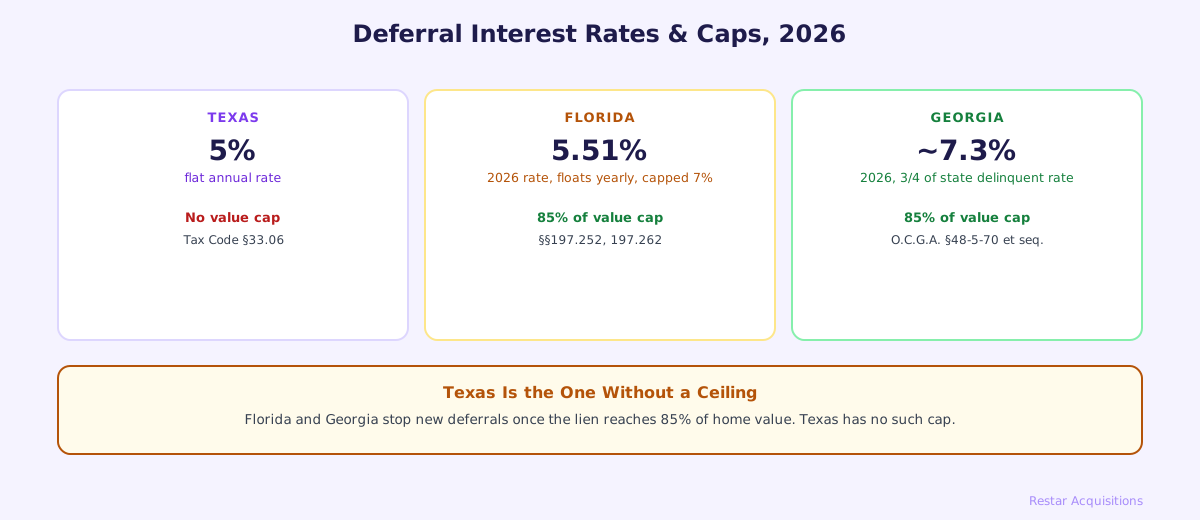
Texas Tax Code Section 33.06 lets a homeowner 65 or older, a person with a qualifying disability, or a disabled veteran defer property taxes on their homestead. The deferral interest rate is 5% a year, a reduction from the 8% the state used to charge, confirmed directly in the current statute text. Once the homeowner no longer owns and occupies the property, the deferred balance plus interest becomes due within 180 days, after which normal foreclosure risk resumes.
Two things make Texas's version notably riskier than it sounds at first. The statute doesn't cap the deferred amount as a percentage of the home's value, unlike Florida and Georgia, which both do, so a long enough deferral period can theoretically accrue a lien that eats a large share of the home's equity. And the deferral only protects against the taxing authority, it does nothing for a separate mortgage. If there's still a loan on the house, that lender can foreclose on a missed mortgage payment regardless of the tax deferral's protection.
Worked example: say a Texas homeowner deferred $4,000 a year in property taxes for 10 years, a plausible number for a mid-value home with several years of appreciation baked into rising assessments. At 5% annual interest with each year's deferred amount accruing separately for the years remaining, the running total compounds faster than people expect simply because new deferred amounts stack on top of prior years' growing balances. A simplified version of that math, treating it as a growing annuity at 5%, lands the payoff in the mid-$50,000s by year 10, not the $40,000 in taxes alone. The exact number depends on your specific county's assessed values and exactly when each year's deferral was filed, so get the real payoff figure from the county tax office rather than estimating it yourself, but the gap between total taxes deferred and total payoff due is the number that catches people off guard.
Florida's homestead tax deferral program, under Florida Statute Section 197.252 and Section 197.262, works differently in two ways. First, the interest rate isn't fixed. It's set annually based on a formula tied to the Florida Retirement System's investment yield plus 0.5%, capped at 7%. The Florida Department of Revenue publishes the actual rate each year; for 2026 it's 5.51%. Second, Florida caps the program itself: deferral isn't allowed once the total deferred taxes, interest, and other unsatisfied liens exceed 85% of the property's assessed just value, or if the existing mortgage already exceeds 70% of that value. If a later year's accrual would push past that 85% threshold, the excess becomes due within 30 days of notice, rather than waiting for a sale.
That cap is worth understanding if you're an heir: it means a Florida deferral lien can't quietly swallow the entire house the way an uncapped one theoretically could. It also means the county has almost certainly already flagged the account once it got close to that ceiling, so a Florida deferral that's been running for years without any correspondence from the county is less likely to be a surprise at closing than a Texas one.
Georgia's Tax Deferral for the Elderly Act, O.C.G.A. Sections 48-5-70 through 48-5-75, is opt-in by county or city rather than automatic statewide, available to homestead owners 62 and older with household income under a set threshold. The interest rate isn't a flat number either. It's set at three-quarters of the rate the state charges on other delinquent taxes under Code Section 48-2-40, which itself floats with the federal prime rate plus 3%, reset annually. For 2026, Georgia's base delinquency rate is 9.75%, which puts the elderly-deferral rate at roughly 7.3%, meaningfully higher than Texas's flat 5%. Georgia also caps total deferred taxes, interest, and other liens at 85% of the home's fair market value, similar to Florida's cap.
A deferring homeowner knows the arrangement exists, filed the affidavit themselves, and generally isn't surprised when the bill eventually comes due. Their heirs often are. An elderly parent quietly deferring taxes for a decade rarely mentions the running balance to their kids, and there's no reason an heir would think to ask, since the house looks, from the outside, like any other paid-off or low-mortgage home.
In practice, the deferral lien is a recorded lien against the property, the same as any other tax lien, which means a title search or a payoff request to the county tax office before closing should surface it. The problem is timing: many informal family transactions, and even some estate sales, don't involve a full title search until late in the process, sometimes after a sale price has already been agreed to. If you've recently inherited a house from a parent who was 65 or older, calling the county tax assessor's office directly and asking whether a deferral affidavit is on file costs nothing and takes one phone call, and it's worth doing before you price the house or sign anything.
A cash sale handles this cleanly either way, since the deferral lien, like any other lien, gets paid out of closing proceeds before you receive your share, and you never have to front the payoff yourself. Whether a cash sale or a listed sale nets you more after that payoff still depends on the house's condition and your market, so run both numbers once you have the real payoff figure in hand.
This article is educational, not legal or tax advice. Deferral programs, interest rates, and caps vary by state and change from year to year. Confirm the exact current payoff balance with your county tax office, and talk to a CPA or real estate attorney if the amount is significant.
A tax deferral lien, like any other lien, gets paid out of closing proceeds in a cash sale, not fronted by you. We'll help you get the real payoff figure from the county and give you a written offer that already accounts for it.
All guides · Selling a house with delinquent property taxes · Affidavit of heirship vs probate · Property tax reassessment when you sell a house
Step 1 of 5
No obligation, no fees, no repairs. We respond the same day.
You’ll talk to Trevor McAmis, Owner & Acquisitions Lead
(313) 710-6129
Takes about two minutes. Your address is never shared.
