An affidavit of heirship identifies a deceased person's heirs. It is not probate and does not transfer title by itself. Whether a title company will insure a sale off one alone depends on your state, how long it has been recorded, and whether every heir agrees.
Step 1 of 5
Send the address. We will put a written offer in front of you within 24 hours, before probate or any affidavit work is finished, so you have a real number to plan around.
You’ll talk to Trevor McAmis, Owner & Acquisitions Lead
(313) 710-6129
Takes about two minutes. Your address is never shared.
Educational only. This explains how these situations generally work. It is not legal, tax or financial advice, and the rules differ by state. Talk to an attorney or CPA about your own situation before you act on any of it.
An affidavit of heirship is a notarized statement, usually signed by two disinterested witnesses who knew the family, that lists who the deceased person's heirs are and how they are related. Recorded in the county where the property sits, it becomes part of the public chain of title. It is built for one specific gap: someone died without a will, owned real property, and the estate is otherwise small and uncontested.
What it does not do is transfer ownership. No statute makes an affidavit of heirship a deed. It is evidence of who the heirs are, offered to a title company so it can decide whether to insure a sale, not a court order granting anyone authority to sign on the decedent's behalf.
Texas is the state where this document is used most and best documented. Under Texas Estates Code 203.001, a recorded affidavit of heirship becomes evidence of the facts it states after it has been on file for five years. Texas title companies routinely accept one before the five years are up, paired with a title search and sometimes a short waiting period, but every company sets its own risk tolerance, and an affidavit filed last month is a materially weaker basis for insuring a sale than one that has been sitting on record since before anyone needed it. If there is any dispute about who the heirs are, a missing sibling, a second marriage, a child from a prior relationship, this document does not resolve it.
Probate is the court process that establishes who is legally authorized to act for the estate: sell the house, pay the deceased's debts, and distribute what is left. Full probate, with a judge appointing an executor or administrator and issuing Letters Testamentary or Letters of Administration, is what most states require once an estate is above a certain size or a will needs to be proven.
Below that size, many states offer a shortcut, but the shortcuts are not the same thing nationwide and most do not cover real estate the way people assume. Florida's version, summary administration under Florida Statutes Section 735.201, is available when the whole estate (minus exempt property) is worth $150,000 or less, or the decedent has been dead more than two years, and it can reach real property, but it still requires filing with the probate court and a judge's order. That $150,000 figure was raised by legislation passed in 2026 (chapter 2026-57); if you are relying on an older article citing a lower number, check the current statute first.
Several states cap their no-court small-estate affidavit at personal property only (bank accounts, vehicles, furniture) and specifically exclude real estate, which means the affidavit that worked for a parent's car will not work for a parent's house. Before planning around any affidavit, confirm with your state's probate court, or a local probate attorney, whether real property is actually covered and what dollar limit applies this year.
Three questions determine which route is actually available, regardless of what a neighbor or a search result assumes applies everywhere.
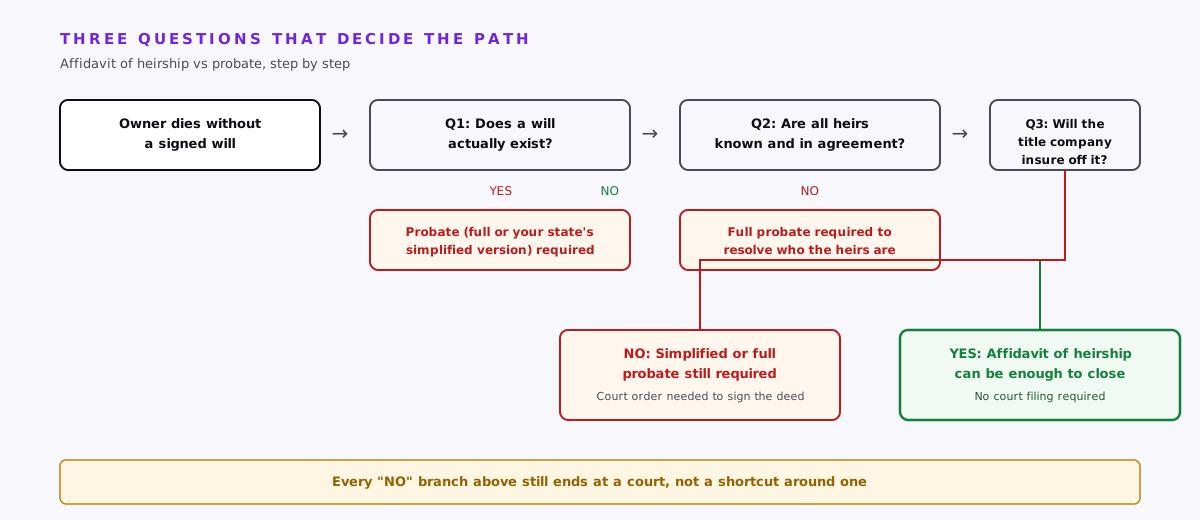
Is there a will? A valid will generally has to be admitted to probate even for a small estate. An affidavit of heirship is built for intestate situations, no will, where state law decides who the heirs are.
Do all the heirs agree, and are they all known? Affidavits of heirship and simplified probate both assume consensus. A single holdout heir, or an heir no one can locate, pushes toward full probate (or, in some states, a court process just to resolve who the heirs are) regardless of estate size.
Does the buyer's title company need to insure the sale today, or can the deal wait? This is the practical hinge. A title company can decline to insure a sale based on an affidavit of heirship alone and require a court-ordered Letters of Administration instead, especially if the affidavit is recent. Ask the closing attorney or title company handling the sale what they will accept before picking a path, not after.
Whichever path gets you a clean deed, it changes what the house is worth to list with an agent versus sell for cash now.
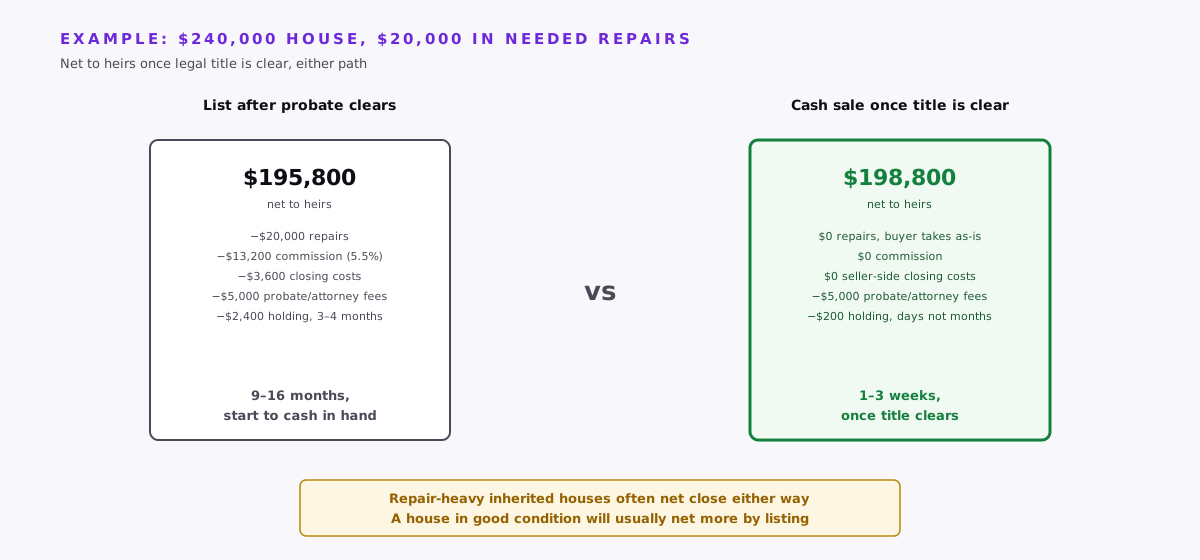
Example: an heir inherits a paid-off house worth $240,000 as-is. A full probate filing, uncontested but requiring a court-appointed administrator, typically runs 6 to 12 months and $3,000 to $8,000 in attorney and court fees depending on the state, paid from the estate before any heir sees proceeds. If the house also needs roughly $20,000 in repairs and updates to list at full retail, and sits on the market for three to four months with an agent, the math looks like this.
| List after probate clears | Cash sale once title is clear | |
| Sale price | $240,000 (post-repair) | $204,000 (as-is) |
| Repairs/updates | −$20,000 | $0 |
| Agent commission (about 5.5%) | −$13,200 | $0 |
| Closing costs (about 1.5%) | −$3,600 | $0 |
| Probate/attorney fees | −$5,000 | −$5,000 (same either way) |
| Holding costs | −$2,400 (3–4 months) | −$200 (days, not months) |
| Net to heirs | $195,800, in 9–16 months total | $198,800, in 1–3 weeks once title clears |
The numbers move with your market and your state's fee schedule, but the pattern holds. A house that needs real repair money often nets close to the same either way once you count what the renovation and the carrying months actually cost, and the cash path gets there without the heirs fronting repair cash or waiting through a listing season. A house in good shape with little repair need will usually net meaningfully more by listing. Run both sides with real numbers for your property before deciding, and if listing wins by a wide margin, that is the better move.
If you are an heir trying to sell a house and the paperwork, probate, an affidavit, or both, feels like the slow part, we buy houses as-is for cash, cover standard closing costs, and let you pick the closing date once title is actually clear. A written offer in 24 hours means you know the number while the estate work is still in progress, no waiting on a listing season on top of waiting on a court.
All guides · When heirs cannot agree to sell · Cost of probate when selling an inherited house · Selling an inherited house
Step 1 of 5
No obligation, no fees, no repairs. We respond the same day.
You’ll talk to Trevor McAmis, Owner & Acquisitions Lead
(313) 710-6129
Takes about two minutes. Your address is never shared.