A lost mortgage satisfaction or lien release means a loan you paid off years ago was never cleared from the public record, so a title search at your next sale still shows it as open. Fixing it usually costs $1,500 to $4,500 and takes two weeks to a few months, depending on which cure it needs.

Step 1 of 5
Send the address and what you know about the old loan. We'll help you figure out which cure fits and show you both paths, cash and listing.
You’ll talk to Trevor McAmis, Owner & Acquisitions Lead
(313) 710-6129
Takes about two minutes. Your address is never shared.
Educational only. This explains how these situations generally work. It is not legal, tax or financial advice, and the rules differ by state. Talk to an attorney or CPA about your own situation before you act on any of it.
A lost mortgage satisfaction or lien release means a loan you paid off years ago was never cleared from the public record, so a title search at your next sale still shows it as open. Fixing it usually costs $1,500 to $4,500 and takes two weeks to a few months, depending on which cure it needs.
This is not a dispute about whether the loan was paid. It was. The debt and the paperwork that removes it from the county's records are two separate steps, and the second one sometimes never happens: the lender loses the file, merges into another bank, or closes outright before anyone records the release.
A lost mortgage satisfaction or lien release happens when a loan secured by your house (a first mortgage, a second mortgage, or a home equity line) was paid in full, but the lender never filed the document that tells the county recorder the debt is gone. Until that document is filed, the county's records still show the old loan as a live lien, even though no money is owed on it.
This surfaces almost exclusively through a title search, because nobody checks whether an old loan was properly released until someone tries to sell or refinance. The gap between payoff and recording can run for years. Lenders get acquired, merge, or go out of business, and loan-servicing records from a defunct institution can be difficult or impossible to trace a decade or two later.
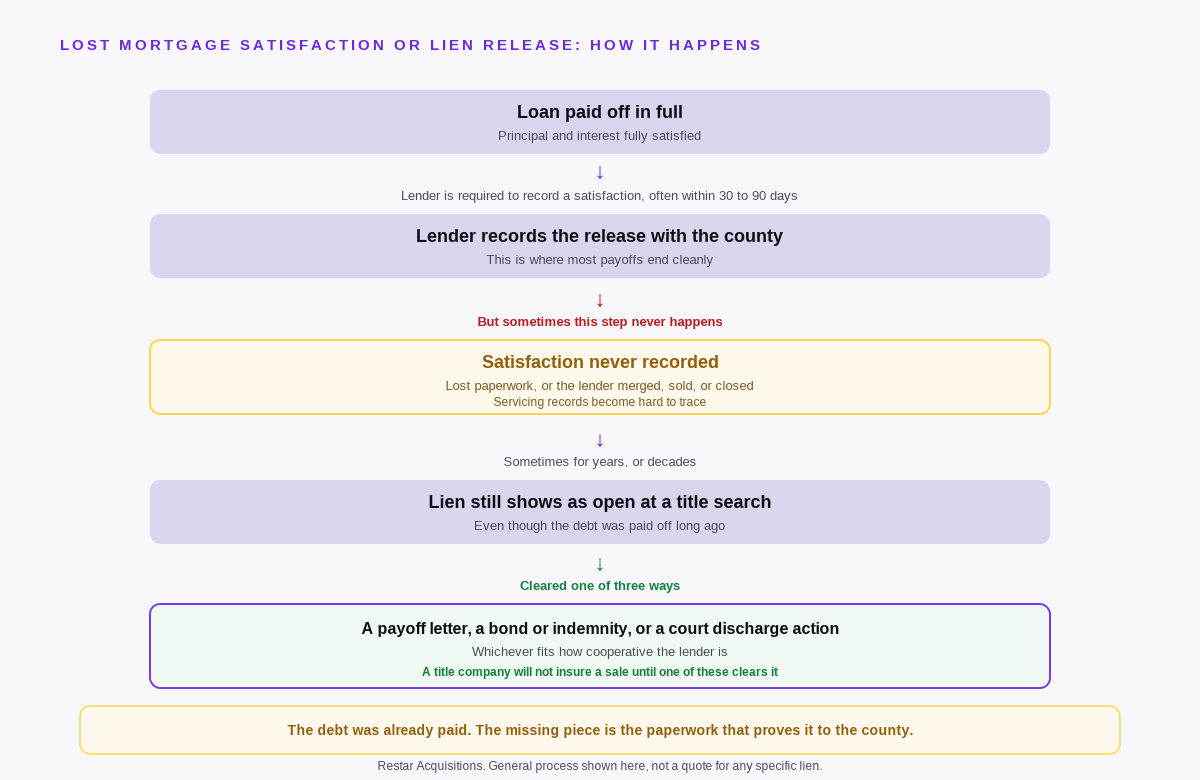
The result at closing is the same whether the missing release is from a first mortgage, a second mortgage, or a HELOC: the title company sees a recorded lien with no recorded release, and it will not insure a sale with that lien still open. This is a different problem from a loan that is still active and being paid off at this closing (see our guide to mortgage payoff statements), and different from a second lien someone disputes was ever properly forgiven (see selling a house with a zombie second mortgage). Here, nobody disputes the loan was paid. The only open question is how to prove it to the county's satisfaction.
Most states give a lender a fixed window, commonly 30 to 90 days after payoff, to record a satisfaction of mortgage, and several attach a real penalty for missing it. Texas gives lenders 60 days and lets a title insurance company step in and record the release itself if the lender ignores the deadline. Florida also sets a 60-day window and lets the borrower recover attorney fees in a civil action over it.
Texas created this fix in 1993 and updated it again in 2009: under Property Code Section 12.017, if a lender does not deliver a release within 60 days of a payoff, an authorized title insurance company can execute and record a release affidavit itself, after giving the lender 45 days' notice to object. It is a direct, built-in answer to exactly the problem in this guide, not a theoretical backstop.
Florida's version, Florida Statutes Section 701.04, requires the lender or servicer to record the release within 60 days of full payoff and makes the lender liable for the borrower's attorney fees and costs if a lawsuit is needed to force compliance. Both states still require someone to do the recording work. The statute creates the obligation; it does not, by itself, clear your title the day the deadline passes.
When the original lender can't be found or won't respond, a title company can often clear the lien without a lawsuit by accepting an indemnity, backed by an affidavit and sometimes a surety bond, that protects the title insurer if the old debt ever resurfaces. This is commonly called bonding around the lien, and it is the most common cure once direct contact with the lender fails.
The mechanics: an underwriter sets a bond or indemnity amount at a multiple of the lien's recorded face value, often 1.5 to 2 times the balance, specifically to cover any claim plus interest and costs if the old debt turns out to still be owed. Closing attorneys who handle this regularly describe the usual sequence as requesting a satisfaction from the current note holder first, then falling back to a lost-instrument affidavit backed by an indemnity supported by proof of payoff once the lender can't be located.
On a $38,000 lien, a bond set at 1.75 times that balance runs about $66,500, and surety premiums on this type of bond typically run 1 to 3 percent of the bond amount, so roughly $665 to $2,000 for the bond itself, plus a title company administrative or affidavit fee, usually a few hundred dollars more. This cost sits on top of, not inside, your regular title insurance premium; see our guide to title insurance costs for how that separate piece is priced. These figures move with the lien size, the state, and the specific title insurer underwriting the file; a title company or real estate attorney handling your closing will quote the real number for your lien.
In a few states, yes, after a long enough stretch past the loan's maturity date with no recorded action. This is not a nationwide rule. Many states have no automatic expiration at all, so check your specific state rather than assuming an old lien will simply fall off title on its own.
Arizona, one of the states we buy in, is a real example: under Arizona Revised Statutes Section 33-714, the lien of a mortgage or deed of trust expires 10 years after its final maturity date, if that date is on record, and the statute treats that expiration as equivalent to a formal release. New York gives old, unenforced mortgages a 20-year window before they're considered ancient and dischargeable through a court proceeding, and a few other states, including California and Delaware, use their own 10-year versions of the same idea. The exact years, and whether any rule exists at all, depend entirely on your state. Confirm yours before assuming it applies to your lien.
Example: A seller is under contract to sell a house for $268,000 to a financed buyer with a 45-day rate lock. The title search turns up a $38,000 second mortgage the seller paid off in full 16 years ago. The original lender was acquired twice since then, and nobody at either successor can locate the loan file.
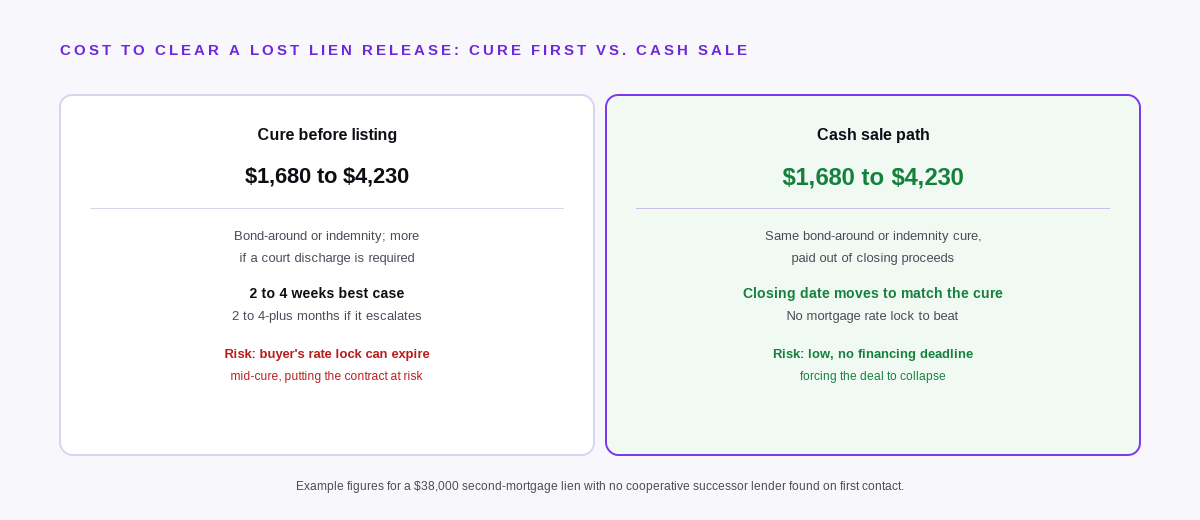
| Cure before listing | Cash sale path | |
|---|---|---|
| Cost to cure | $1,680 to $4,230 | $1,680 to $4,230 (same cure, paid from proceeds) |
| Timeline | 2 to 4 weeks best case; 2 to 4-plus months if a court discharge is needed | Closing date moves to match the cure; no forced deadline |
| Risk if a retail lender won't close with the title cloud | Financed buyer's rate lock can expire mid-cure, forcing an extension fee, a re-lock, or a walked deal | Low; no mortgage rate lock tied to the closing date |
The title company first tries the direct route: a written payoff request to the most recent successor servicer, asking for a release based on the seller's old payment records. In this example, that takes about three weeks and ends with no response, a common outcome when a lender has changed hands more than once. With the rate lock already a third gone, the title company moves to a lost-lien indemnity: a bond set at 1.75 times the $38,000 balance, about $66,500, with a premium near 2 percent, $1,330, plus a $350 affidavit fee, for a cure cost of about $1,680. If the insurer will not accept an indemnity for this lien and a court discharge petition becomes necessary instead, add a filing fee of roughly $350 and attorney fees of about $2,200, pushing the total to around $4,230 and the timeline out to two to four-plus months.
The cure cost is the same $1,680 to $4,230 whether the buyer is financed or paying cash. What changes is what happens while the cure is in progress. A financed buyer's 45-day rate lock does not pause for a title company to trace two bank mergers; if the lock expires before the lien clears, the buyer either pays an extension fee, re-locks at a worse rate, or walks. A cash buyer's closing date is not tied to a rate lock at all, so the same curative work can finish on its own timeline without threatening the contract. Example figures for one lien; not a quote for any specific property.
Four paths clear a lost lien release, roughly in order of how often they work and how fast: contact the original lender's successor directly for a payoff letter and reissued release, use a title company's lost-instrument or bond-around process once direct contact fails, pursue a statutory discharge or quiet-title action when the lender can't be found or won't cooperate, and get a real estate attorney or title company involved before you list rather than after an offer is already signed.
Restar Acquisitions buys houses as-is, for cash, in 69 markets across Alabama, Arizona, Florida, Georgia, Indiana, Maryland, Michigan, Missouri, North Carolina, Nevada, New York, Ohio, Pennsylvania, and Texas. We give a written offer within 24 hours, don't require repairs, don't charge commissions, and let you pick the closing date. A lost mortgage satisfaction or lien release still has to be cleared before any sale closes, cash or financed; what a cash sale removes is the rate-lock clock that can turn a slow curative process into a collapsed contract. If your equity and timeline point toward listing instead, we'll say so.
Send us the address and we'll give you a written offer within 24 hours, then work the lost lien release into the closing ourselves rather than making it your problem to chase down a defunct lender's successor. The cure itself (a bond, an indemnity, or a court action if one is truly needed) still has to happen either way; what we remove is the rate-lock deadline that can turn a slow title fix into a collapsed contract.
If your equity and timeline make listing with an agent the better math once the lien is cleared, we'll tell you that directly. Send us the property here if the curative chase is the part you'd rather not run yourself.
All guides · Mortgage payoff statements explained · Selling a house with a zombie second mortgage · Title insurance cost explained
Step 1 of 5
No obligation, no fees, no repairs. We respond the same day.
You’ll talk to Trevor McAmis, Owner & Acquisitions Lead
(313) 710-6129
Takes about two minutes. Your address is never shared.