A zombie second mortgage is an old home equity loan or HELOC — usually from before 2008 — that the original lender charged off and stopped billing on for years, then a debt collector bought cheap and is now trying to collect, often discovered during a title search when you try to sell. It's still a real lien. It can usually still be resolved before closing.

Step 1 of 5
Tell us about the lien and the collector you're dealing with. We'll give you a straight answer, including when resolving it and listing nets more.
You’ll talk to Trevor McAmis, Owner & Acquisitions Lead
(313) 710-6129
Takes about two minutes. Or call (313) 710-6129 — we answer.
Educational only. This explains how these situations generally work. It is not legal, tax or financial advice, and the rules differ by state — talk to an attorney or CPA about your own situation before you act on any of it.
A zombie second mortgage is a second lien — a home equity loan or HELOC, most often originated during the mid-2000s housing boom — that the original lender wrote off as a loss and stopped sending statements on, often for a decade or more. The homeowner reasonably assumes it's gone: forgiven, discharged, folded into a modification of the first mortgage, or simply forgotten by everyone involved. It isn't gone. Years later, a debt collector that bought the charged-off loan for a fraction of its face value resurfaces, demanding the full original balance plus years of accrued interest and fees — and in some cases threatening foreclosure.
The federal Consumer Financial Protection Bureau has documented exactly this pattern. In an April 2023 blog post, the CFPB described how these "long-dormant loans" from before the 2007-2008 financial crisis "came back to life" once home values recovered enough to make foreclosing on the second lien worth pursuing again. (CFPB, "Zombie second mortgages") The same month, the CFPB issued formal guidance clarifying that debt collectors cannot sue — or even threaten to sue or foreclose — to collect a mortgage debt that's past its state's statute of limitations, regardless of whether the collector actually knew it was time-barred. (CFPB newsroom, April 2023)
One nuance worth knowing if you search further on this: the CFPB withdrew that 2023 advisory opinion, along with dozens of other guidance documents, in May 2025. That withdrawal pulled back the Bureau's interpretive guidance — it did not repeal the underlying Fair Debt Collection Practices Act, which still prohibits misrepresenting the legal status of time-barred debt. Don't assume the protection itself disappeared just because that specific CFPB document was withdrawn.
Most sellers discover this the same way: a title search run before closing turns up a recorded second lien nobody remembered, or a debt collector's letter arrives demanding payment right as the house goes on the market.
Reporting from Bloomberg's 2025 investigation into this issue identified more than two dozen companies collecting on an estimated $32 billion in these old second-lien loans, with homeowners affected in the hundreds of thousands and geographic concentration in Southern California and Florida — figures from that investigation, not independently verified by us beyond the reporting itself.
A few states have moved to address it directly. Massachusetts Attorney General Andrea Campbell announced a settlement in October 2024 with mortgage servicer Franklin Credit Management Corporation, requiring the company to cancel more than $10 million in second-lien debt owed by hundreds of Massachusetts homeowners and pay a $300,000 civil penalty, after alleging the company tried to collect on liens following years of no communication with borrowers. California signed Assembly Bill 130 in June 2025, adding a new requirement that a mortgage servicer file a sworn certification — attesting that it and every prior servicer complied with required communication and disclosure rules — before it can foreclose on a dormant second lien; if a homeowner can show the certification is false or missing, the foreclosure sale can be stayed while a court reviews it.
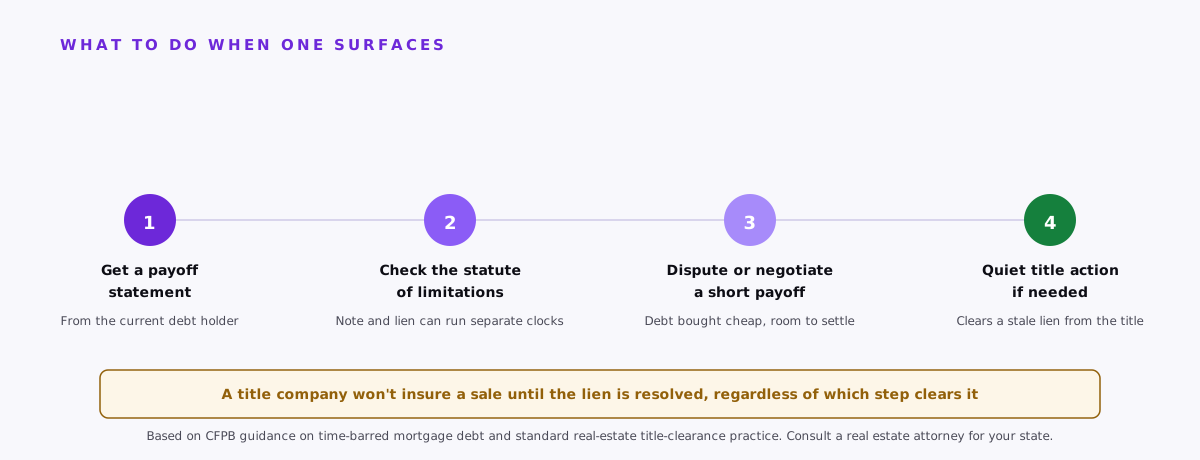
The good news: a zombie second lien being old doesn't mean it's automatically unenforceable, but it also doesn't mean you're stuck paying full freight. Real options, roughly in the order worth trying:
1. Get a payoff statement from whoever currently holds or services the debt. You need this regardless of whether you think the lien is valid, since title can't transfer clean with it unresolved.
2. Check your state's statute of limitations on mortgage/lien enforcement — and understand it may not match the SOL on the underlying note. This genuinely varies by state and is sometimes two separate clocks within the same state. New York, for example, gives a lender six years to foreclose from the date of acceleration under CPLR §213; if that window has closed, a homeowner can affirmatively sue to cancel the stale mortgage of record under RPAPL §1501(4). Other states run the clock from the loan's stated maturity date rather than the default date — which matters because some 2000s-era HELOCs had balloon maturities set decades out, meaning the lien-side clock may not have even started yet on a loan that looks "dead" by other measures.
3. Ask whether the collector can prove it is misrepresenting the debt's legal status or your prior lender ever sent required ownership-transfer and periodic-statement notices. Years of silence followed by a sudden demand is itself the fact pattern regulators have gone after — it's worth a consultation specifically to see if that silence is a defense, not just an inconvenience.
4. Negotiate a lien release or short payoff. Debt buyers who purchased the loan for a fraction of face value often have real room to settle for a fraction of the balance to get a clean release before your closing date, rather than litigate.
5. If the lien is genuinely stale and unenforceable, a quiet title action can clear it from the record so a title company will insure the sale — the standard legal mechanism for removing a cloud on title from an old, satisfied, or time-barred lien.
This is general information, not legal advice. Statute-of-limitations rules on mortgage and lien enforcement vary by state and sometimes by loan terms within the same state — talk to a real estate or foreclosure-defense attorney about your specific lien, your state, and your loan documents before assuming any outcome.
A zombie second mortgage rarely shows up in isolation — it usually surfaces while a house is already under contract or about to be listed, which means the resolution path adds real time. Worked on a $240,000 house with a $22,000 charged-off second lien a debt collector is actively trying to collect on:
| Route | Gross price | Lien resolution | Commission/fees | Net to seller | Timeline |
|---|---|---|---|---|---|
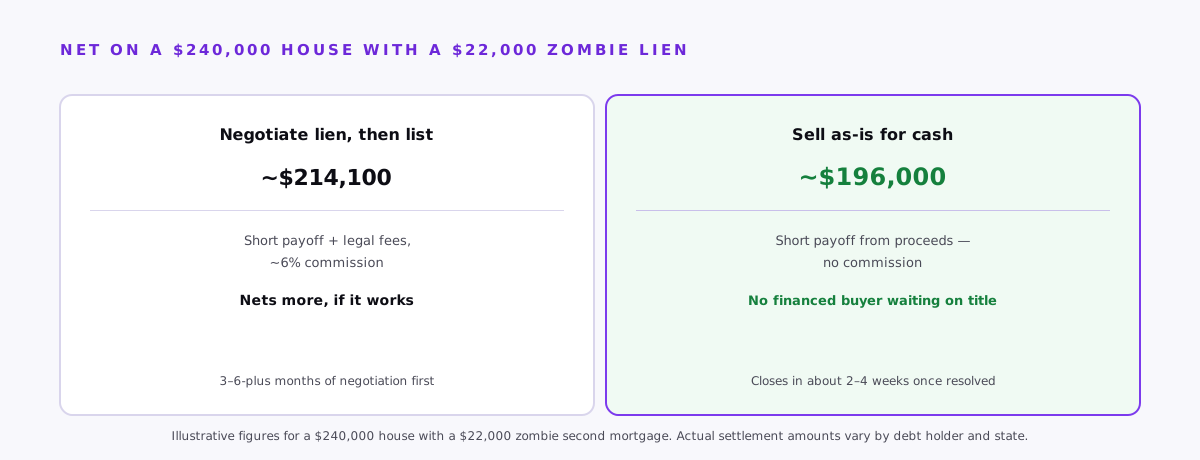
| Dispute/negotiate the lien, then list with an agent | $240,000 | Attorney negotiates a short payoff, say $9,000, plus legal fees ~$2,500 | ~6% (−$14,400) | ~$214,100 | 3-6+ months: attorney negotiation or quiet title, then a normal listing |
| Pay the full demanded balance, then list | $240,000 | Full payoff: −$22,000 | ~6% (−$14,400) | ~$203,600 | 60-100 days once the lien is cleared |
| Sell as-is to a cash buyer, lien resolved out of proceeds | $205,000 (as-is discount; buyer's title company still requires the lien cleared at closing) | Negotiated short payoff from proceeds, say $9,000 | $0 | ~$196,000 | 2-4 weeks once a payoff figure is in hand |
Disputing or negotiating the lien down before you sell almost always nets the most — but it takes real time, usually months, and the outcome isn't guaranteed if the debt buyer refuses to budge or the SOL question is genuinely unclear in your state. A cash sale doesn't make the lien disappear; the title company still won't close without it resolved. What it compresses is everything around the lien — no financed buyer waiting through a lender's underwriting while your attorney and the debt collector go back and forth, and a closing that can happen within weeks of getting a payoff number instead of months after a listing agent finds a buyer willing to wait that out.
If you have time to dispute or negotiate the lien down before selling, that route usually nets more — we'd tell you that directly.
Where a cash sale earns its place is when you can't wait months for an attorney negotiation or a quiet title action to play out. Send the address and we'll send a written offer within 24 hours. No cost, no obligation.
All guides · Cost of a HELOC or second mortgage when you sell · Selling a house with a judgment lien · Cash offer vs listing net proceeds
Step 1 of 5
No obligation, no fees, no repairs. We respond the same day.
You’ll talk to Trevor McAmis, Owner & Acquisitions Lead
(313) 710-6129
Takes about two minutes. Or call (313) 710-6129 — we answer.
