<b>A chimney with a cracked crown and a deteriorated liner commonly runs $3,600 to $15,500 to fully repair, and that's before you've touched the roof or interior drywall patching that removal would add on top of that number.</b> A chimney is one of the most common things a home inspector flags because its two real jobs — keeping water out and keeping fire and carbon monoxide inside the flue — both fail quietly until an inspection catches it. The cost of a chimney repair before selling a house depends entirely on which part failed and how far the damage spread, from a simple cap swap to a full above-roofline rebuild. This guide walks through what each repair actually costs, when removal makes more sense than fixing it, and the honest math on paying for the work yourself versus selling as-is.
Step 1 of 5
Tell us what the inspection found and we'll walk through the real numbers with you.
You’ll talk to Trevor McAmis, Owner & Acquisitions Lead
(313) 710-6129
Takes about two minutes. Or call (313) 710-6129 — we answer.
Educational only. This explains how these situations generally work. It is not legal, tax or financial advice, and the rules differ by state — talk to an attorney or CPA about your own situation before you act on any of it.
A chimney doesn't fail all at once — it usually starts with a cracked or missing crown (the concrete cap over the masonry) letting water into the brick, which then migrates down and compromises the flue liner or the mortar joints lower down. By the time a home inspector gets to it, several of these problems are often showing up together, which is why chimney line items on an inspection report tend to come in clusters rather than one at a time.
The reason it can stall or kill a financed sale isn't cosmetic. A cracked or deteriorated liner exposes the surrounding masonry and wood framing directly to combustion heat and flue gases, which is a documented fire and carbon-monoxide risk. The Chimney Safety Institute of America's own inspection standard, last revised in 2019, specifically instructs certified inspectors to video-scan the flue and report any cracks or gaps in the liner during what's called a Level 2 inspection, and notes that roughly 25 thousand chimney fires occur in the U.S. every year, most of them preventable with a sound, properly maintained liner. That standard, built on NFPA 211, recommends a Level 2 inspection whenever a property is being sold. That's an industry best-practice recommendation, not a nationwide legal requirement — no state law we found mandates a chimney-specific inspection at sale — but it's exactly the kind of recommendation most home inspectors and insurers already follow in practice, which is why a chimney issue surfaces on almost every standard inspection anyway.
Here's what each repair actually runs, from cheapest to most involved, based on cost data gathered directly from contractor pricing pages rather than estimated from a general range.
Tuckpointing / repointing (repairing or replacing the mortar between bricks): a partial repair typically runs $500 to $1,500; repointing the full chimney runs $2,500 to $6,000.
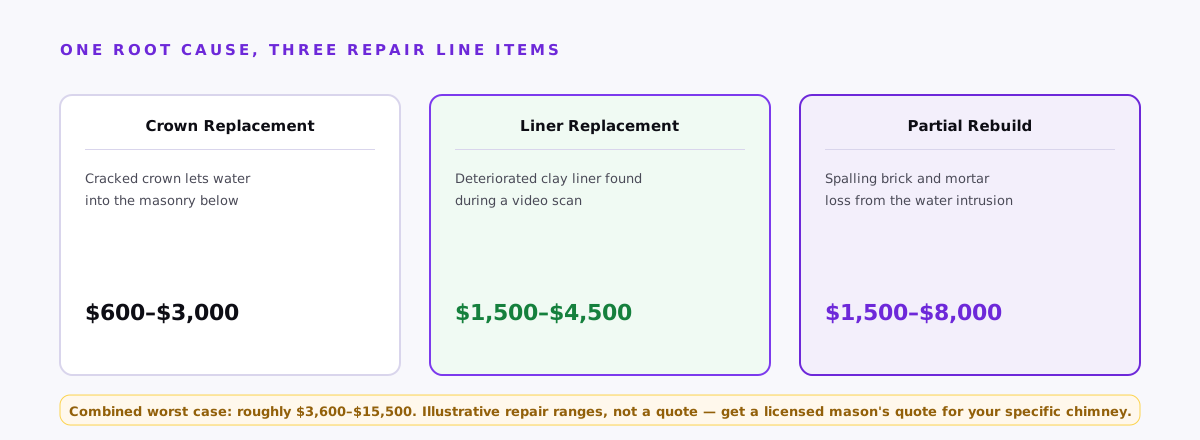
Cap and crown: a straightforward cap replacement runs $100 to $600; minor crown repair is $150 to $400; a full crown replacement runs $600 to $3,000 depending on size and access.
Liner replacement, the item most likely to be a financing-blocking inspection flag: material and installation vary widely by liner type. Clay or terra-cotta tile runs roughly $6 to $15 per linear foot in material; stainless steel, the most common replacement choice, runs $20 to $40 per foot rigid or $40 to $90 per foot flexible; cast-in-place liners run $25 to $250 per foot. A full installed project typically lands at $1,800 to $4,000 for most homes, with a straight replacement (removing the old liner and installing new) running $1,200 to $4,600; larger cast-in-place jobs can reach $7,000. A cracked or missing liner is also a documented fire and carbon-monoxide hazard, not just a cost line item — see Bob Vila's breakdown of why insurers and inspectors treat it as a safety issue, not a cosmetic one.
Partial or full rebuild (needed when spalling brick or structural deterioration has spread beyond what repointing can fix): a partial rebuild above the roofline runs $1,500 to $8,000; a full rebuild runs $10,000 to $30,000 or more. Full rebuilds are the outlier high end — most chimney repairs overall fall in the $250 to $3,500 range, with rebuilds reserved for chimneys that have been neglected for years.
Full removal, usually chosen when converting away from a wood-burning fireplace entirely rather than repairing it: removing everything above the roofline runs $800 to $2,000; a partial removal through the attic runs $2,000 to $4,000; full demolition from roof to foundation runs $2,500 to $7,500, or $4,000 to $10,000 if the fireplace itself comes out too. Removal always carries add-on costs beyond the demolition line item: roof repair where the chimney penetrated runs $300 to $1,800, and interior patching for ceilings, walls, or floors runs roughly $200 to $2,000 per room or floor depending on scope.
Here's what a realistic worst case looks like on an older brick chimney where water intrusion through a failed crown has been going on long enough to also compromise the liner and the top few feet of masonry — a common pattern because all three problems usually share the same root cause.
Here's an illustrative example on a $265,000 home where an inspection flagged a cracked crown and a deteriorated liner, totaling roughly $5,200 in required repairs to satisfy a financed buyer's lender.
| Retail listing | Cash sale | |
|---|---|---|
| List / offer price | $265,000 | $239,000 |
| Chimney crown + liner repair | −$5,200 | $0 (sold as-is) |
| Agent commission (~5.5%) | −$14,575 | $0 |
| Seller closing costs | −$2,900 | −$1,100 |
| Carrying costs while repairs and marketing proceed (6–10 weeks) | −$2,100 | $0 |
| Net to seller | ~$240,225, in 6–10+ weeks, if the repair satisfies the lender | ~$237,900, in 1–2 weeks, with certainty |
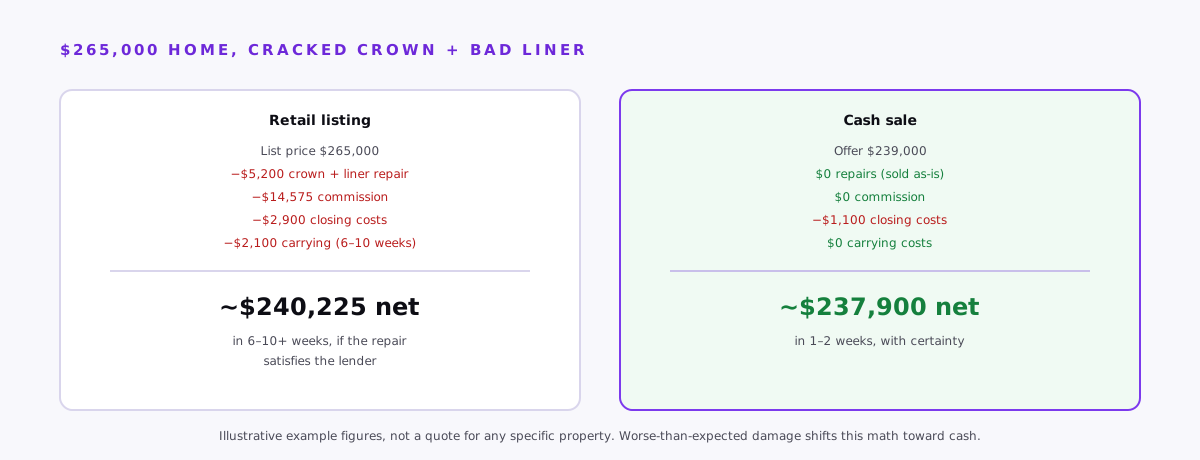
Retail nets slightly more in this example, and that's the honest result when a chimney repair is a known, bounded cost that a contractor can usually complete in a few weeks. The math shifts toward cash when the damage turns out to be worse than expected once a contractor opens things up (a common outcome with masonry work), when you don't have the cash on hand to pay for repairs before closing, or when you need the certainty of a set closing date over a potentially larger number. See our roof repair cost guide if your chimney issue is tied to broader roof damage rather than the masonry alone.
Restar Acquisitions buys houses as-is for cash in 12 states, and we factor chimney condition into our offer the same way we factor in any other repair item — before we give you a number, not after an inspection blows up a financed deal. We give a written offer within 24 hours, no repairs or commissions, and you pick the closing date. We're a direct buyer, not your real estate agent, and we don't represent you in the transaction.
Alternatives worth checking before you decide:
This article is for general education only and isn't a quote or a substitute for a licensed chimney inspection. Repair costs vary by region, chimney size, and the extent of damage found once work begins. Get a CSIA-certified chimney sweep or licensed mason to inspect and quote your specific chimney before you budget around any figure here.
We factor chimney condition into our offer the same way we factor in any repair item — before we give you a number, not after. You'll get a written offer within 24 hours, no repairs or commissions, and you pick the closing date.
All guides · Cost of a new roof before selling a house · Cost of lender-required repairs before closing · Should I repair before selling
Step 1 of 5
No obligation, no fees, no repairs. We respond the same day.
You’ll talk to Trevor McAmis, Owner & Acquisitions Lead
(313) 710-6129
Takes about two minutes. Or call (313) 710-6129 — we answer.