The cost of a bankruptcy court-approved sale, what the Bankruptcy Code calls a Section 363 sale, is not one number. It is a stack of separate costs: a quarterly fee to the U.S. Trustee based on how much money moves through the case, legal fees for drafting and arguing the motion that asks the court to approve the sale, a court filing fee for that motion, a broker's commission if one is used, and the carrying costs that pile up during the notice-and-hearing period before a judge signs off. Some sellers search this as the cost of a 363 bankruptcy sale, others as the cost of a bankruptcy court-approved sale. Both are asking about the same stack of fees, and the real answer is that the total depends on your district, your judge, and whether anyone shows up to object. This page walks through every cost component with current numbers, then runs a full worked example on a $290,000 house so you can see where more process can still net more money, and where it cannot.
Step 1 of 5
Send the address and the rough sale price your case needs. We'll show you what a cash sale into the case would net, so your legal team has a real comparison.
You’ll talk to Trevor McAmis, Owner & Acquisitions Lead
(313) 710-6129
Takes about two minutes. Your address is never shared.
Educational only. This explains how these situations generally work. It is not legal, tax or financial advice, and the rules differ by state. Talk to an attorney or CPA about your own situation before you act on any of it.
A bankruptcy court-approved Section 363 sale commonly adds $20,000 to $30,000 in trustee fees, legal fees, the motion fee, and holding costs, before any broker commission, on a $290,000 house. A cash sale into the same case cuts most of that, but usually sells for less. The cost of a 363 bankruptcy sale depends on your district and your buyer.
This is educational information, not legal advice. Whether your case needs a separate sale motion at all, and how fast your district moves one through notice and a hearing, depends on your judge and your plan. Confirm both with a bankruptcy attorney before you list the house or sign anything.
Section 363 of the Bankruptcy Code is the provision that lets a trustee or a debtor-in-possession sell property of the estate, including a house, outside the plan confirmation process itself. Cornell's Legal Information Institute lays out the mechanics: property can be sold free and clear of liens under subsection (f) if the price covers every lien, every lienholder consents, or one of a short list of other conditions is met, and anything outside the ordinary course of the debtor's business needs notice and a hearing under subsection (b) before the court will approve it (Cornell Legal Information Institute, 11 U.S.C. §363).
A homeowner's house sale during Chapter 11 almost always falls into that notice-and-hearing bucket, since selling your home is not “the ordinary course of business” for a person reorganizing personal debt. That means a motion, a notice period, and a hearing stand between an accepted offer and a closed sale, and each of those steps has a real cost attached to it.
The U.S. Trustee's quarterly fee. The U.S. Trustee charges a fee every quarter the case stays open, scaled to how much money moves through the case that quarter, not just this one sale. Under the fee schedule effective April 1, 2026 through December 31, 2030, cases with $0 to $62,624 in quarterly disbursements pay a flat $250; cases with $62,625 to $999,999 pay 0.4% of disbursements; cases with $1,000,000 to $27,777,722 pay 0.9%; and the largest cases pay a flat $250,000 (justice.gov, Chapter 11 Quarterly Fees). A $290,000 house sale alone lands in the 0.4% tier, so that one disbursement adds about $1,160 to whichever quarter it closes in. If the case stays open for several more quarters after that, the fee repeats each quarter based on whatever else moves through the case, which a one-time number like $1,160 does not capture.
Legal fees for the sale motion. Legal fees are the biggest swing factor. A traditional Chapter 11 case commonly runs $25,000 to $100,000 or more in total legal fees across its whole life, built from hourly billing and approved by the court as an administrative expense under 11 U.S.C. §330 (bankruptcycost.org, Chapter 11 legal fee ranges). A single sale motion is a slice of that, not the whole case: drafting the motion, preparing and serving the notice, responding to any objection, and arguing the hearing. For an uncontested motion on a house-sized sale, that slice commonly runs $3,500 to $15,000. A contested motion, where a creditor or a lienholder objects, costs more and takes longer, because every added hour of hearing time and every round of briefing is billed the same way.
Court filing fees. Opening the Chapter 11 case itself costs $1,738 ($1,167 case filing fee plus a $571 administrative fee under 28 U.S.C. §1930(a)(3), per the federal Bankruptcy Court Miscellaneous Fee Schedule), but that is a cost of being in Chapter 11 at all, not a cost of selling this specific house. The fee tied directly to the sale is the $199 charge for filing a motion to sell free and clear of liens under 11 U.S.C. §363(f), listed on the same schedule (uscourts.gov, Bankruptcy Court Miscellaneous Fee Schedule).
The broker's commission. If the sale uses a broker, and court-approved sales usually do, since marketing the property to get the best price is part of what justifies the sale to the judge, the commission is the same 5% to 6% of the sale price you would pay on any retail listing. The bankruptcy process does not change this cost. It just adds the other costs on top of it.
Holding costs during notice and hearing. Federal Rule of Bankruptcy Procedure 2002(a)(2) sets a floor of at least 21 days' mailed notice to the debtor, the trustee, and all creditors before the court can approve a sale outside the ordinary course of business (Cornell Legal Information Institute, Fed. R. Bankr. P. 2002). That is a floor, not a typical timeline. Once you add the time to find a buyer, file the motion, let the 21 days run, and get a hearing date on a judge's calendar, 45 to 90 days between an accepted offer and a closed sale is a realistic range in most districts, longer if anyone objects or a hearing gets continued. Every one of those days is a day of mortgage interest, property tax, insurance, and utilities that the seller is still paying.
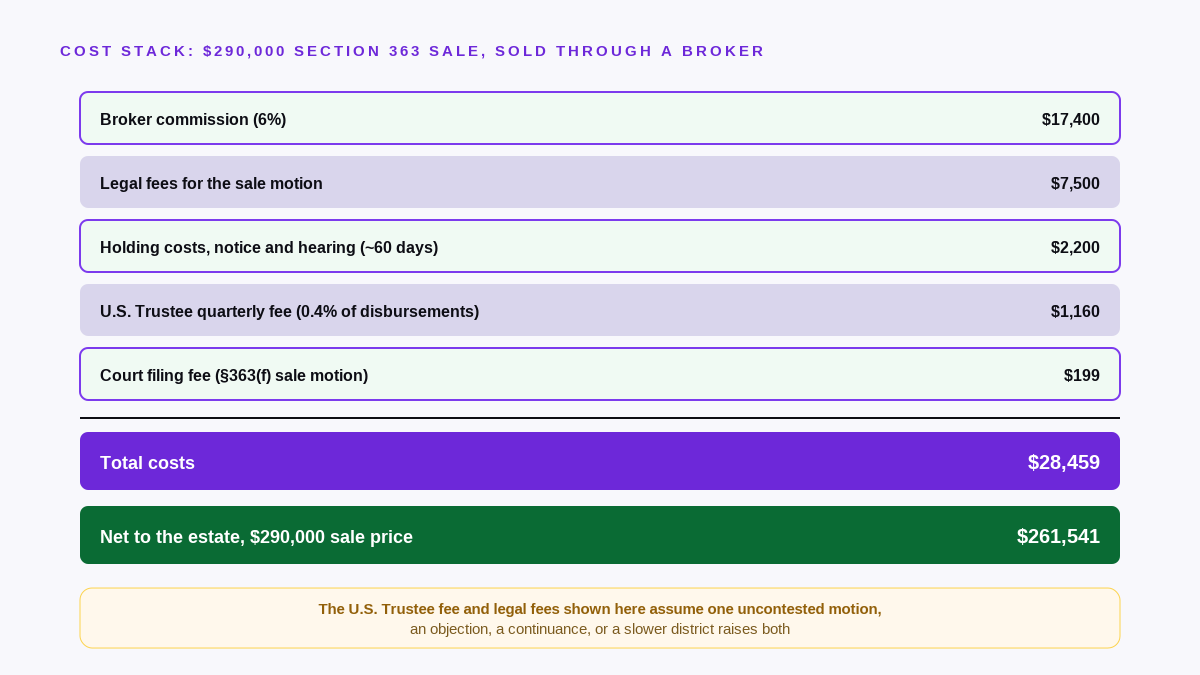
Start with a house that would list for $290,000 in normal retail condition. Run it through a court-approved sale with a broker, run the same house as a cash sale into the same case, and run it as a private sale if the case already allows one without a new motion.
Path 1: Retail-listing-into-the-case, sold through a formal Section 363 motion with a broker, at $290,000.
| Broker commission (6%) | $17,400 |
| Legal fees for the sale motion | $7,500 |
| Court filing fee (§363(f) motion) | $199 |
| U.S. Trustee quarterly fee (0.4% of $290,000) | $1,160 |
| Holding costs, listing/notice/hearing (~60 days) | $2,200 |
| Total costs | $28,459 |
| Net to the estate | $261,541 |
Path 2: Cash-sale-into-the-case, sold as-is to a buyer like Restar at $261,000 (a 10% as-is discount from the $290,000 retail value).
| Broker commission | $0 |
| Legal fees for the (simpler, usually faster) sale motion | $4,000 |
| Court filing fee (§363(f) motion) | $199 |
| U.S. Trustee quarterly fee (0.4% of $261,000) | $1,044 |
| Holding costs, notice/hearing (~30 days) | $1,100 |
| Total costs | $6,343 |
| Net to the estate | $254,657 |
In this example, the broker path nets $6,884 more than the cash path, because the higher sale price outweighs the extra fees and the extra month of holding costs. That is the real tradeoff: more process and more cost can still win, if the price premium is big enough.
It is also fragile. If that same sale motion draws an objection (a lienholder disputing the free-and-clear terms is a common one) and the hearing gets continued once, add roughly $3,000 in extra legal time and another month of holding costs. The broker path's net drops to about $257,441, and its lead over the cash path shrinks from $6,884 to about $2,784. A slower district or a second continuance can erase the lead entirely.
| Cost component | Cash-sale-into-the-case | Retail-listing-into-the-case |
|---|---|---|
| Sale price | $261,000 | $290,000 |
| Broker commission | $0 | $17,400 |
| Legal fees (sale motion) | $4,000 | $7,500 |
| Court filing fee (§363(f) motion) | $199 | $199 |
| U.S. Trustee quarterly fee | $1,044 | $1,160 |
| Holding costs during notice/hearing | $1,100 | $2,200 |
| Total costs | $6,343 | $28,459 |
| Net to the estate | $254,657 | $261,541 |
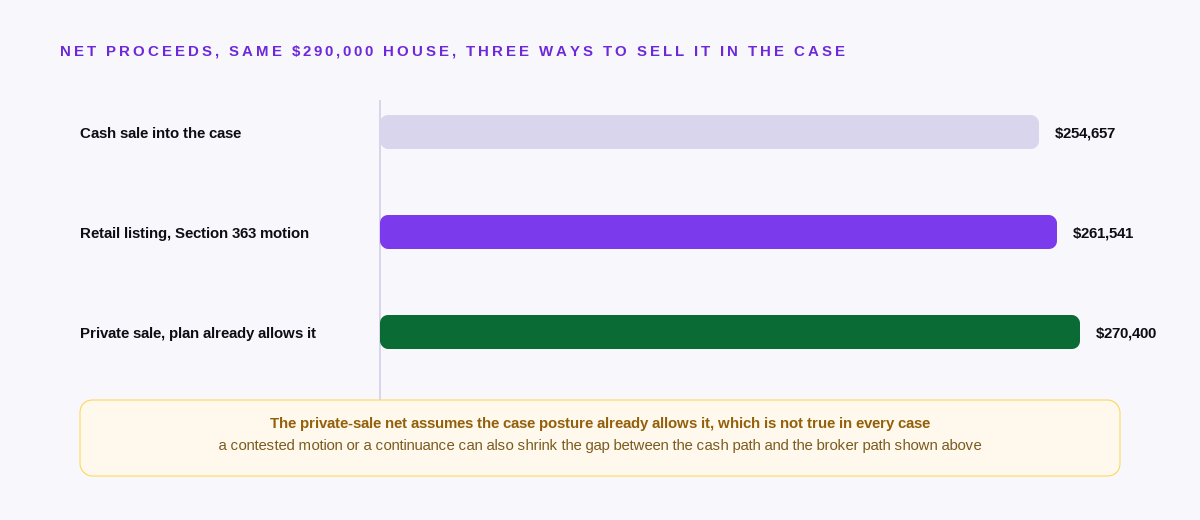
Path 3, for comparison: a private sale authorized by the plan, with no new motion, at the same $290,000 retail price. Broker commission $17,400, holding costs around $2,200, no $199 motion fee and no sale-motion-specific legal fees because the authority to sell already came from the plan. That nets about $270,400, the best of the three, but only if your case is in a posture where that path is available, which is not something to assume on your own.
A private sale already authorized by a confirmed plan. If the plan or a prior court order already gives you the authority to sell without filing a fresh motion each time, you skip the $199 filing fee and the motion-specific slice of legal fees, as shown in Path 3 above. The case-level U.S. Trustee quarterly fee still applies as long as the case stays open, since that fee is not tied to any one sale. See our companion guide on selling a house during Chapter 11 bankruptcy for how that authority typically gets decided case by case.
Converting to Chapter 13, if your debts and income fit the limits. Chapter 13 debtors generally keep and manage their own property, and most ordinary sales do not need a separate court-approved sale motion the way a Chapter 11 estate sale often does. That can remove the whole Section 363 layer of cost, but it comes with its own structure: a repayment plan, a Chapter 13 trustee, and eligibility limits on how much debt you can have. See our guide on selling a house during Chapter 13 bankruptcy for what that looks like in practice. If you are in a Chapter 7 case instead of Chapter 11, the trustee (not you) generally controls the sale decision; see our guide on selling a house during Chapter 7 bankruptcy for how that differs.
A straightforward retail listing, if there is no bankruptcy constraint on the house at all. If the house was never part of the estate, or the trustee abandoned it, or the case has closed, a normal listing with a local agent works like any other sale, with none of the costs above. Compare what that nets against a cash sale on its own terms in our guide on cash offer vs listing net proceeds.
We buy houses directly, as-is, for cash, in 69 markets across 14 states: Alabama, Arizona, Florida, Georgia, Indiana, Maryland, Michigan, Missouri, North Carolina, Nevada, New York, Ohio, Pennsylvania, and Texas. We give a written offer within 24 hours, we do not require repairs, and we do not charge commissions. You pick the closing date.
We are not a law firm and we do not represent you in your bankruptcy case. The decision to convert, to sell by motion, or to sell under an existing plan still runs through the lawyer handling your case and the judge assigned to it. What we can do is give you a real number: what a cash sale into your case would net on your specific house. That gives you and your legal team an actual figure to put next to a court-approved broker sale, instead of guessing. If listing nets your case more once every cost above is counted, we will tell you that too.
We'll give you a written offer on the house within 24 hours, as-is, with no repairs and no commissions, and you still pick the closing date. That offer becomes one real number your legal team can put next to a court-approved broker sale instead of guessing. If a broker-run Section 363 sale nets your case more once every fee above is counted, we will tell you that directly.
All guides · Selling a house during Chapter 11 bankruptcy · Selling a house during Chapter 13 bankruptcy · Cash offer vs listing net proceeds
Step 1 of 5
No obligation, no fees, no repairs. We respond the same day.
You’ll talk to Trevor McAmis, Owner & Acquisitions Lead
(313) 710-6129
Takes about two minutes. Your address is never shared.