If you're selling a house during Chapter 11 bankruptcy, your case works differently than a Chapter 7 liquidation or a Chapter 13 repayment plan. Chapter 11 is built for individuals whose debts are too large for Chapter 13, or for a self-employed person or small business owner trying to reorganize. The house can still be sold, but almost always only after the bankruptcy court signs off, through your plan or a motion under 11 U.S.C. Section 363.
Step 1 of 5
Tell us about your property and we'll send a written offer within 24 hours. No repairs, no showings, no commissions.
You’ll talk to Trevor McAmis, Owner & Acquisitions Lead
(313) 710-6129
Takes about two minutes. Your address is never shared.
Educational only. This explains how these situations generally work. It is not legal, tax or financial advice, and the rules differ by state. Talk to an attorney or CPA about your own situation before you act on any of it.
Yes, you can sell a house during Chapter 11 bankruptcy, but the sale generally needs the court's approval first, either because your confirmed plan already authorizes it or because you file a motion under 11 U.S.C. §363. The automatic stay still protects you from foreclosure and collection while this plays out, and the US Trustee's office has an ongoing supervisory role, including quarterly fees in most cases, until the case closes.
This is educational information, not legal advice. Bankruptcy procedure is federal law applied through your district's local rules, and the facts of your case change the answer. Get your case reviewed by a professional before you sign a listing agreement or accept any offer on a house that's part of an open Chapter 11 case.
Most homeowners searching for help selling a house in bankruptcy are in Chapter 7 or Chapter 13, not Chapter 11. If that's you, our selling a house during Chapter 7 bankruptcy guide covers trustee liquidation and the homestead exemption, and our selling a house during Chapter 13 bankruptcy guide covers the 3-to-5-year repayment plan most individuals use. Chapter 11 is a different process with different mechanics, built specifically for larger debts or a business reorganization.
Individuals end up in Chapter 11 for one of two reasons. Either their combined debts exceed the Chapter 13 eligibility cap (recently raised to a combined debt limit under $2.75 million for qualifying individual debtors), or they're self-employed or run a small business and need a reorganization structure Chapter 13 wasn't built for. A newer path, Subchapter V of Chapter 11, exists specifically for small business debtors, including qualifying individuals whose debt is mostly business-related, and streamlines a lot of what makes standard Chapter 11 slow and expensive.
Filing any bankruptcy petition, including Chapter 11, triggers the automatic stay under 11 U.S.C. §362. The stay halts "the commencement or continuation... of a judicial, administrative, or other action or proceeding against the debtor," along with foreclosure, collection calls, lawsuits, and most creditor actions that arose before you filed. This doesn't change in Chapter 11. What changes is who is running your case day to day, and what it takes to sell real property once it's part of the estate.
Your house becomes property of the bankruptcy estate the moment you file, and selling it is a transaction outside the ordinary course of business. Under 11 U.S.C. §363(b), a sale like that requires "notice and a hearing" before it can happen. As debtor in possession, you generally hold the powers a trustee would have, but you still have to go through the same notice-and-hearing process.
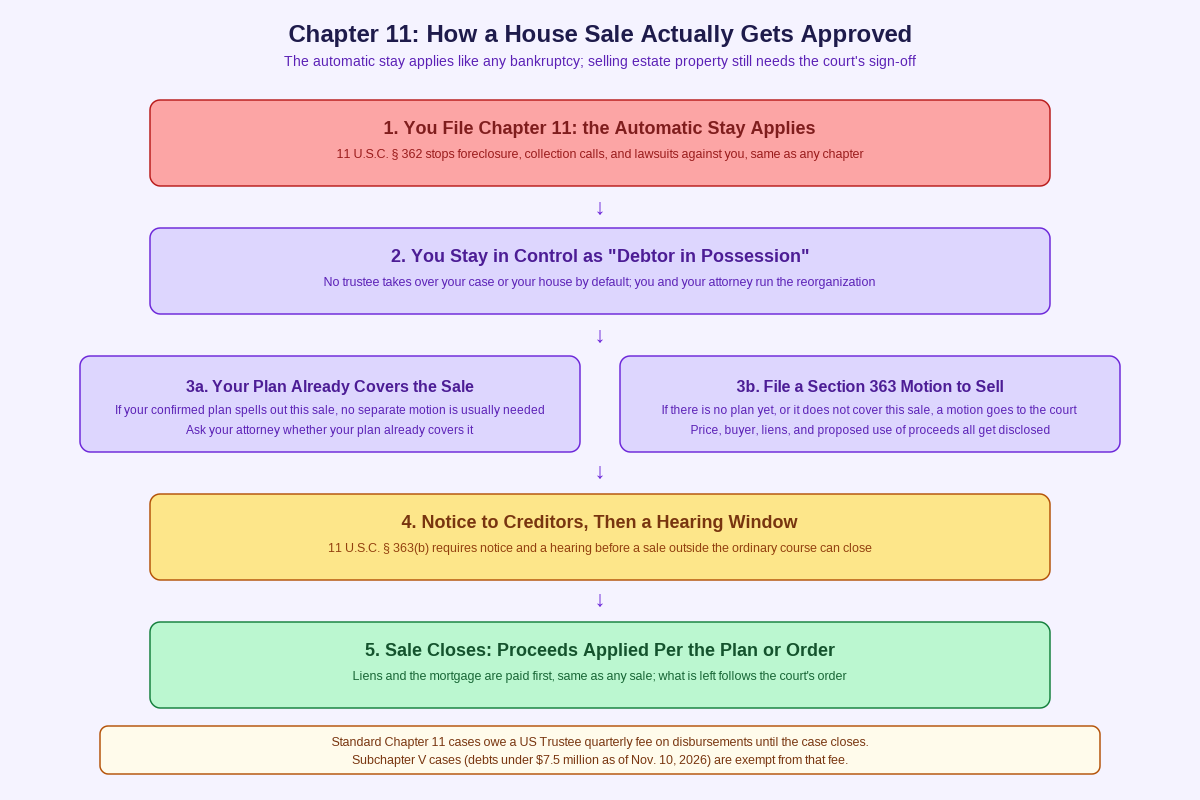
This is exactly where a bankruptcy attorney earns their fee: whether your plan already authorizes the sale, whether you qualify for Subchapter V, and how your specific district's local rules handle the Section 363 motion timeline are all judgment calls that depend on your case's facts, not a one-size-fits-all answer. Confirm these specifics before you sign anything.
If a national rule varies by district, say so clearly: notice periods, how quickly a judge schedules a hearing, and how strictly a particular court reads "ordinary course of business" all differ by district and by judge. Treat every timeline on this page as a realistic range, not a guarantee for your court.
Subchapter V matters here because it changes two things that drive your cost and your timeline: who has to vote on your plan, and whether you owe the US Trustee's quarterly fee at all.
To qualify, you (or your business) generally need to be a "small business debtor" under the Bankruptcy Code, meaning most of your debt arose from commercial or business activity, and your total debt falls under the statutory cap. That cap just moved. For cases filed on or after November 10, 2026, the Subchapter V debt limit is a permanent $7.5 million, following the Bankruptcy Threshold Adjustment Act. Before that date, the limit had reverted to $3,424,000 after a temporary pandemic-era increase to $7.5 million expired in June 2024. If your debts sat between those two numbers, a case you couldn't have filed as Subchapter V a few weeks ago may qualify now. Have the current numbers run against your case before you file or amend anything.
Subchapter V cases skip the disclosure statement most standard Chapter 11 cases need, move on a faster confirmation timeline, and, the part that changes the math below, are exempt from the US Trustee's quarterly fee. A Subchapter V trustee is appointed in every case, but their role is closer to a facilitator than a Chapter 7-style liquidator.
This is the piece that doesn't exist in Chapter 7 or Chapter 13 at all, and it's the reason "just wait longer and net more" isn't automatically the right call the way it can be in a simpler case. Standard Chapter 11 cases (not Subchapter V) owe a quarterly fee to the US Trustee System Fund for every calendar quarter the case stays open, calculated as a percentage of that quarter's disbursements. For the schedule effective April 1, 2026 through December 31, 2030: $250 flat on quarterly disbursements up to $62,624, 0.4% on disbursements from $62,625 to $999,999, 0.9% from $1,000,000 to $27,777,722, and a $250,000 cap above that. The fee is owed even in a quarter with minimal activity, and it keeps accruing every quarter the case remains open, which means a longer sale process doesn't just cost you time, it can cost you another quarter's fee.
| Chapter 7 | Chapter 13 | Chapter 11 | |
|---|---|---|---|
| Who controls the sale | Trustee (or you, if the trustee abandons the property) | You, using the trustee's powers under §1303, with court approval | You, as debtor in possession, with court approval |
| How a sale gets approved | Motion, notice, and hearing (asset cases only) | Motion to sell, FRBP 2002(a)(2) notice, objection window | Plan already authorizes it, or a Section 363 motion, notice, and hearing |
| Typical case length | A few months to discharge | 3 to 5 years | Several months to a few years; Subchapter V moves faster |
| US Trustee quarterly fees | None | None | Yes, unless Subchapter V applies |
| Built for | Liquidation, no viable repayment plan | Steady income, debts within Chapter 13's caps | Debts above Chapter 13's caps, or a business/self-employment reorganization |
A fast cash sale nets less than a fully repaired retail sale. That's true in or out of bankruptcy. In Chapter 11, the extra wrinkle is that the retail path's longer timeline runs up against the Section 363 motion-and-hearing process and another quarter, sometimes two, of US Trustee fees, which eats into the math that normally favors waiting.
Example: a house worth $280,000 once repaired, with $14,000 in needed repairs and updates, moving through the same Chapter 11 case under two different sale paths.
Path A (repair and list retail, sold under the same Section 363 motion). Sale price $280,000, minus $14,000 in repairs before listing, minus a 5.5% agent commission ($15,400), minus seller closing costs around 1.5% ($4,200), minus roughly $6,400 in holding costs across the roughly 16 weeks this path realistically takes (repairs, listing, marketing, the motion, notice, and a possible hearing), minus two quarters of US Trustee fees on this case (0.4% of disbursements each quarter, about $2,240 combined at this disbursement level). Net to the filer: roughly $237,760, in about 16 weeks.
Path B (sell as-is for cash, same court process). Cash offer $235,000, no repair cost, no commission, roughly $500 in closing costs, about $200 in holding costs over the 5-to-6 weeks this path typically takes (FRBP 2002's 21-day minimum notice period plus time to schedule a hearing and close), minus one quarter of US Trustee fees (about $940 at this disbursement level, since the case closes out that chapter of the process faster). Net to the filer: roughly $233,360, in about 5 to 6 weeks.
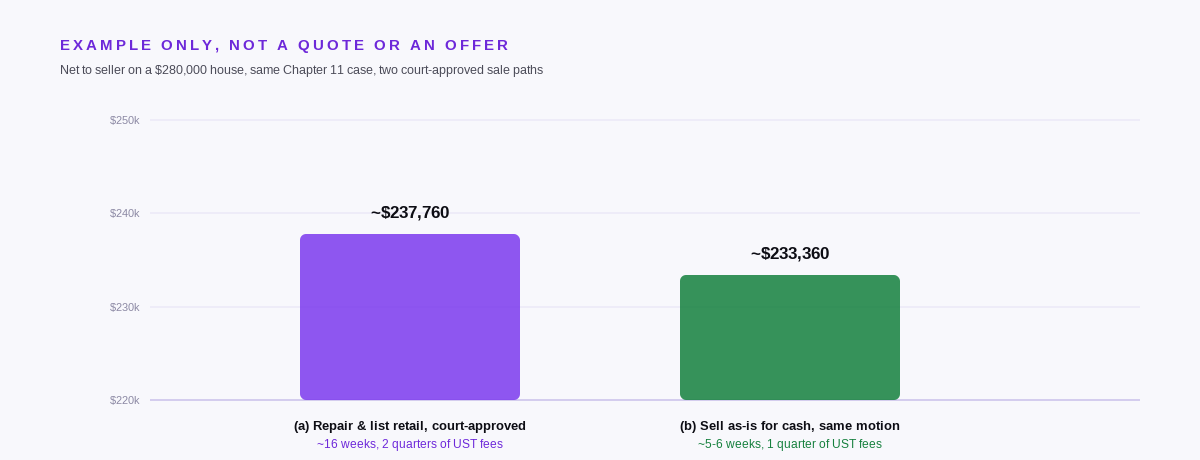
In this example, the retail path still nets about $4,400 more, but it takes roughly three times as long and carries real execution risk: a financed buyer's loan can fall through during that longer window, a repair bid can run over, and every extra quarter the case stays open adds another fee. If this same case qualified for Subchapter V, neither number above would include a US Trustee quarterly fee at all, since those cases are exempt, closing most of that $4,400 gap on its own. These are example numbers built to show how the pieces fit together, not a quote for any specific house or case.
None of these are a DIY decision. Each one changes your case's structure and your creditors' recovery, which is exactly the kind of call that needs professional legal guidance, not a guide like this one.
The core tradeoff behind the numbers above, a cash sale nets less, a retail sale takes longer and carries more risk, isn't specific to bankruptcy. See our cash offer vs listing net proceeds guide for that same math without a bankruptcy court in the picture, if you want to compare what changes and what doesn't.
A cash sale doesn't skip the court's approval process. Nothing does, whether your plan already authorizes the sale or you need a Section 363 motion. What it removes is financing risk on the buyer's side while that approval is pending, since there's no lender underwriting file that can fall through separately from the court's own timeline.
We buy houses as-is across 69 markets in Alabama, Arizona, Florida, Georgia, Indiana, Maryland, Michigan, Missouri, Nevada, New York, North Carolina, Ohio, Pennsylvania, and Texas. We send a written offer within 24 hours, there are no repairs and no commissions, and you pick the closing date once the court clears it. If listing with an agent nets you more once US Trustee fees and your timeline are counted, we'll tell you that instead.
All guides · Selling a house during Chapter 13 bankruptcy · Selling a house during Chapter 7 bankruptcy · Cash offer vs listing net proceeds · How a fast, as-is sale works
Step 1 of 5
No obligation, no fees, no repairs. We respond the same day.
You’ll talk to Trevor McAmis, Owner & Acquisitions Lead
(313) 710-6129
Takes about two minutes. Your address is never shared.