Every market page publishes the numbers behind its offer. See the math
Home › Guides › Selling a House During Chapter 7 Bankruptcy
Guide
Selling a House During Chapter 7 Bankruptcy
If you've filed or are considering Chapter 7 bankruptcy and you own a house, the question that matters most is simple to ask and genuinely complicated to answer: does the trustee get to sell it, or do you? Your house becomes part of the bankruptcy estate the moment you file, and whether it gets sold depends almost entirely on how much of your equity your state's homestead exemption covers. If the exemption covers all of it, the trustee has no financial reason to sell and typically abandons the house back to you. If it doesn't, the trustee can sell it — but only with court approval, and the process nets you far less than selling it yourself.
Tell us about your property and we'll send a written cash offer within 24 hours. No repairs, no showings, no commissions. Talk to your bankruptcy attorney about timing first.
Takes about two minutes. Or call
(313) 710-6129 — we answer.
Educational only. This explains how these situations generally work. It is not legal, tax or financial advice, and the rules differ by state — talk to an attorney or CPA about your own situation before you act on any of it.
Selling a house during Chapter 7: the short answer
Your house becomes part of the bankruptcy estate the moment you file, and whether it gets sold depends almost entirely on how much of your equity your state's homestead exemption covers. If the exemption covers all of it, the trustee typically abandons the house back to you. If it doesn't, the trustee can sell it — but only with court approval.
This is educational information, not legal advice. Bankruptcy is federal law applied through your state's exemption rules and your local court's procedures — talk to a bankruptcy attorney before you file, and before you sign anything to sell a house that's part of an open case.
Why your house becomes part of the "estate" the moment you file
Under 11 U.S.C. §541, filing a Chapter 7 petition creates a bankruptcy estate that includes virtually everything you own as of that moment — including your house, regardless of whether you have a mortgage on it. At the same time, the automatic stay under 11 U.S.C. §362 stops foreclosure, collection calls, and lawsuits against you.
That estate is administered by a court-appointed Chapter 7 trustee, whose job is to identify anything of value that isn't protected by an exemption and liquidate it for the benefit of your unsecured creditors. Your house doesn't stop being your home — you still live in it, you're still responsible for the mortgage payments if you want to keep it — but legally, you don't have unrestricted authority to sell it while the case is open. That authority sits with the trustee and the court until the case closes, the trustee abandons the property, or you get specific permission.
Asset case vs. no-asset case: the homestead exemption decides it
Whether your house is actually at risk comes down to one comparison: your equity (home value minus mortgage and liens) against your homestead exemption.
Federal exemption: if you use the federal exemption scheme under 11 U.S.C. §522(d)(1), the homestead exemption is $31,575 per filer for cases filed on or after April 1, 2025 — roughly a 13% increase over the $27,900 figure that applied before that date, part of the routine three-year inflation adjustment published in the Federal Register in February 2025. Married couples filing jointly can generally double it to $63,150, since each spouse claims their own exemption.
State exemptions: about a third of states let you choose between the federal exemptions and your state's own; the rest require you to use your state's exemption scheme exclusively, per the opt-out allowed under §522(b). State homestead amounts vary enormously — some states protect an unlimited amount of home equity (with acreage limits), while others cap it well below the federal figure. Have your attorney confirm the actual number where you live.
If your equity is fully covered by the applicable exemption, there's nothing for the trustee to gain by selling — the case is a "no-asset" case, and according to the American Bankruptcy Institute, this describes roughly 92% of all Chapter 7 filings. If your equity exceeds the exemption, the case becomes an "asset case," and the trustee has to weigh whether selling the house — after paying the mortgage, your exemption, and the costs of sale — would actually leave enough to matter to your creditors.
If the trustee decides to sell: what actually happens
In an asset case, the trustee doesn't just list your house — selling estate real estate requires a formal motion and court approval, typically under Federal Rule of Bankruptcy Procedure 6004, with notice to creditors and an objection window before the sale can close.
If the sale goes through, the proceeds are distributed in a set order: the mortgage and any valid liens get paid first, then your exemption amount is set aside for you, then the trustee's own compensation, then whatever remains goes to unsecured creditors. That trustee compensation isn't unlimited — 11 U.S.C. §326(a) caps it at 25% of the first $5,000 disbursed, 10% of the next amount up to $50,000, 5% up to $1,000,000, and 3% above that, subject to the court finding it "reasonable" under §330. It's a ceiling, not a fixed fee, and courts can and do approve less.
Here's the part that surprises people: the nonexempt slice of your equity doesn't come back to you — it goes to your creditors, because it was never yours to keep once the case established it as nonexempt. You keep your exemption amount. Everything above that funds the case.
Can you sell the house yourself while the case is open?
Not on your own authority — but it's more workable than it sounds. If your equity is fully exempt and the trustee has no interest in the property, the trustee typically files a formal notice of abandonment, giving creditors at least 14 days to object. Once that's on file, the house is legally back in your hands and you can sell it like anyone else, without further court involvement.
If you're in an asset case and want to sell rather than let the trustee run the process, it's often still possible — but it happens through the trustee, not around them. Many trustees will agree to a buyer you've found if the price is fair and it saves them the work of marketing the property themselves; the sale still goes through the same motion-and-notice process described above, and the court has to approve the price and terms.
What you cannot do is close a sale on your own, sign away the property, or transfer it to a family member for less than it's worth while the case is pending — that's a fast path to the trustee unwinding the transaction, and worse, to accusations that you tried to hide the sale from the estate.
The risk of selling right before you file
If you're weighing whether to sell before filing at all, timing matters more than most people expect. Under 11 U.S.C. §548, a trustee can unwind — "avoid" — any transfer made within two years before filing if it was made to hinder or defraud creditors, or if you received less than the property's reasonably equivalent value while insolvent. An arm's-length sale at fair market value, with the proceeds properly accounted for (and protected by an exemption where one applies), is not what this rule targets. But selling to a relative for a discount, or converting equity into an exempt asset right before filing specifically to shield it, is exactly the pattern trustees and courts scrutinize — and it's a decision to make with a bankruptcy attorney, not on your own timeline.
Chapter 7 vs. Chapter 13: two different ways your house gets handled
Chapter 7 is a liquidation case — it moves fast (a discharge typically arrives a few months after your 341 meeting of creditors), but nonexempt equity is at risk of being sold off along the way. Chapter 13 works differently: it's a 3–5 year repayment plan, and it's the more common choice specifically because it lets you keep a house with nonexempt equity by repaying that value to creditors over the life of the plan instead of losing the house outright. See our Chapter 13 guide for how selling works in that structure — the mechanics of court approval are similar, but the incentive to sell at all is different.
The honest price tradeoff: four paths on the same house
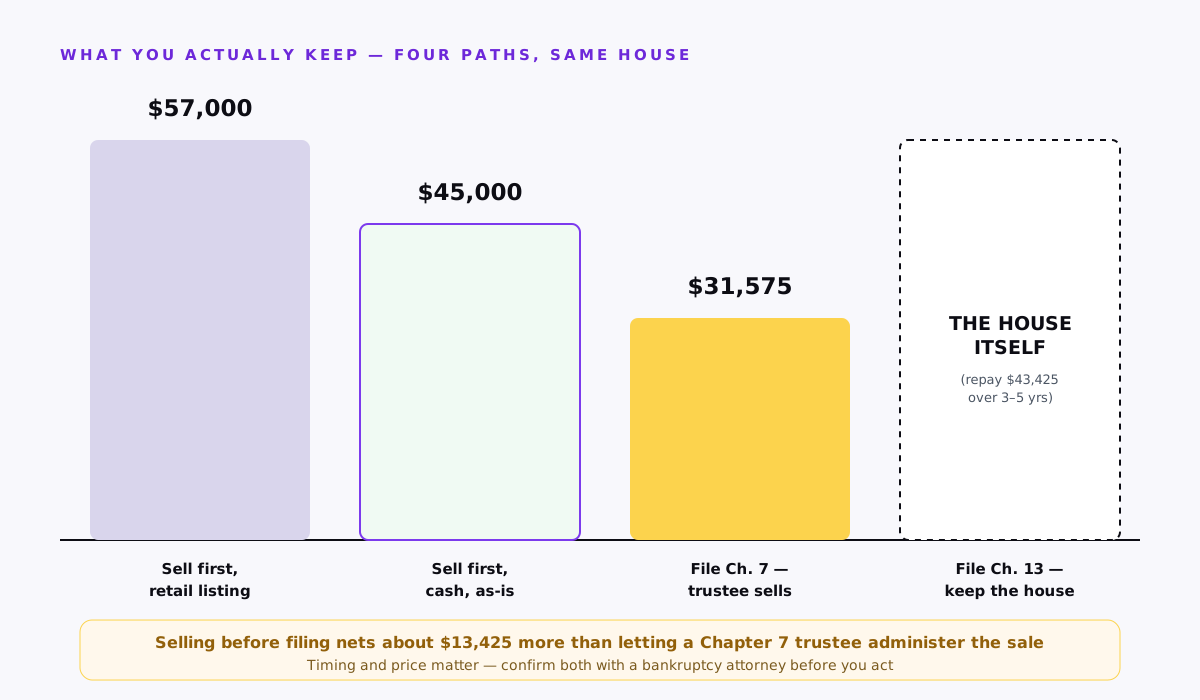
Who controls the sale determines who keeps the equityRestar Acquisitions · worked example from this page
Take a house worth $240,000 with a $165,000 mortgage balance — $75,000 in equity — owned by a single filer using the federal exemption ($31,575). That leaves $43,425 in nonexempt equity, enough to make this an asset case in most courts. Here's what the filer actually walks away with under four different paths. These are illustrative numbers, not a quote.
Path 1 — Sell before filing, retail listing with an agent.
Sale price
$240,000
Mortgage payoff
−$165,000
Agent commission (6%)
−$14,400
Seller closing costs (~1.5%)
−$3,600
Net to seller
$57,000
Time
~10–12 weeks
Path 2 — Sell before filing, fast cash sale, as-is.
Cash offer (discounted for speed, no repairs, no marketing period)
$210,000
Mortgage payoff
−$165,000
Commission / closing costs
$0 — buyer covers standard costs
Net to seller
$45,000
Time
~2–3 weeks
Path 3 — File Chapter 7, trustee administers an asset-case sale.
Trustee-supervised sale price (as-is, compressed timeline)
$215,000
Mortgage payoff
−$165,000
Debtor's exemption (paid to filer)
$31,575
Remaining before trustee fee
$18,425
Trustee's statutory fee (illustrative, on this residual)
−$2,592.50
Net to unsecured creditors
≈$15,832.50
Net to debtor
$31,575 — the exemption only
Time
Several months to a year or more
Path 4 — File Chapter 13 instead, keep the house, repay the nonexempt equity over the plan.
House
Kept
Nonexempt equity ($43,425)
Repaid to creditors over 3–5 years through the plan, not surrendered at once
Net effect
No forced sale, but a multi-year repayment commitment
Time
3–5 years to discharge
Path
What the filer keeps
Timeline
Requires
1 — Sell first, retail
$57,000
~3 months
Marketing time, repairs, an agent, staying current on payments meanwhile
2 — Sell first, cash
$45,000
2–3 weeks
Nothing — as-is, no repairs, no listing period
3 — File, trustee sells
$31,575 (exemption only)
Months to a year+
No control over price, timeline, or buyer
4 — File Chapter 13
The house itself
3–5 years
A repayment plan you can actually afford
The number that should stand out: selling before filing — even at a discounted cash price — nets the filer roughly $13,425 more than letting a Chapter 7 trustee administer the sale, because a pre-filing sale isn't limited to the exemption amount and doesn't carry a trustee's statutory fee. That's not a loophole; it's simply who's authorized to sell and on whose terms. It's also exactly why this decision needs a bankruptcy attorney's sign-off before you act — the same sale, done at the wrong time or the wrong price, can turn into the fraudulent-transfer problem described above instead of a clean pre-filing transaction.
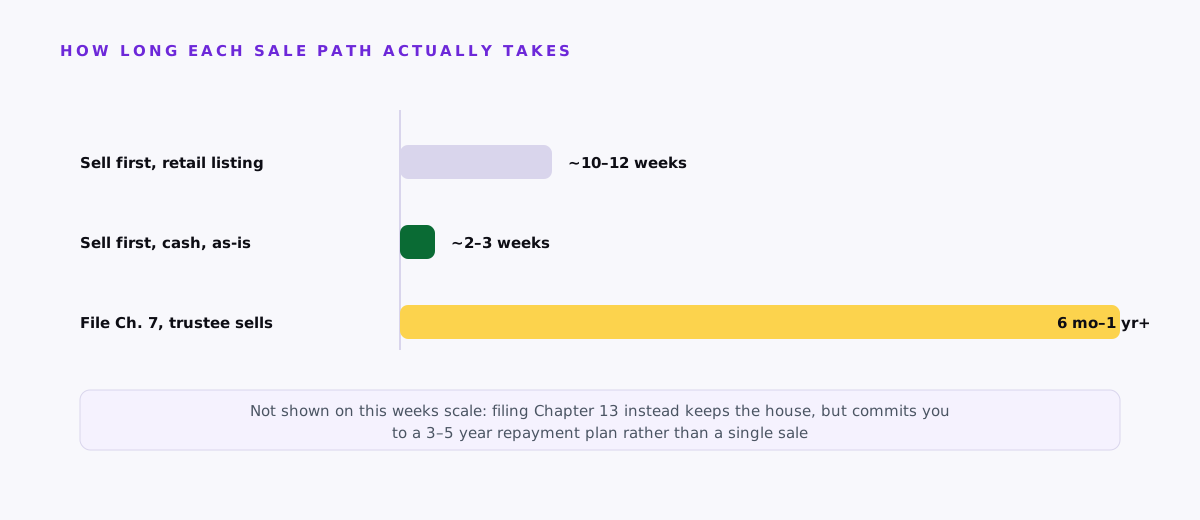
Trustee-administered sales are also the slowest path, not just the lowest-net oneRestar Acquisitions · timeline for the same example
Alternatives worth raising with your attorney
Filing Chapter 13 instead of Chapter 7 if you have nonexempt equity you want to protect and can afford a repayment plan.
Selling before you file, at a fair, arm's-length price, with your attorney confirming the timing and how the proceeds should be handled or exempted.
Loan modification or forbearance with your mortgage servicer if the underlying problem is the mortgage payment rather than other debt.
Doing nothing and letting the case run its course if your equity is fully exempt — in the roughly 92% of cases with no nonexempt assets, there's no sale to worry about at all.
Can I sell my house during an active Chapter 7 bankruptcy?
Not entirely on your own — the house is part of the bankruptcy estate until the case closes or the trustee abandons it. If your equity is fully exempt, the trustee typically files a notice of abandonment, after which you're free to sell normally. If it's an asset case, a sale usually still requires the trustee's agreement and court approval.
Will the bankruptcy trustee take all my home equity?
No — only the portion above your applicable homestead exemption. If your state or the federal exemption covers your full equity, none of it is at risk. If it doesn't, only the nonexempt slice funds the case; your exemption amount is set aside for you first when the house is sold.
Can I sell my house before filing Chapter 7 to protect my equity?
Often, yes, and it frequently nets more than letting a trustee administer a later sale — but the timing and price matter. A sale made within two years of filing can be scrutinized under 11 U.S.C. §548 if it wasn't at fair market value or was structured to hide assets from creditors. Talk to a bankruptcy attorney before you sign anything.
What's the real difference between Chapter 7 and Chapter 13 when it comes to my house?
Chapter 7 is liquidation — it moves faster, but nonexempt equity can be sold off to pay creditors. Chapter 13 is a repayment plan over 3–5 years that generally lets you keep the house by repaying nonexempt equity over time instead of surrendering it. Which one fits depends on your income, your equity, and whether you can afford a plan payment.
How long does it take if the trustee decides to sell my house?
There's no fixed timeline. It depends on your court's schedule, whether creditors object to the sale motion, and how quickly a buyer can close. Realistically, asset-case sales run from several months to over a year, compared to a pre-filing sale that can close in weeks.
Does using a cash home buyer instead of an agent change anything about the bankruptcy process?
No — the exemption, trustee, and court-approval rules apply the same way regardless of who the buyer is or how they're paying. What a cash sale changes is speed and certainty, which matters most if you're trying to sell before you file or before a scheduled court date.
Selling before you file, or need a fast, certain sale during a case? We can send a number to run past your attorney
We're happy to look at the numbers with you, including how a fast, as-is cash sale compares to letting a case run its course. Send us the address and we'll get back to you with a written offer within 24 hours. This isn't legal advice, and any sale during an open bankruptcy needs your attorney's and the court's sign-off first.
Every offer on this site is underwritten by a person, not a form. If the
numbers do not work for you, say so and I will tell you what would.
Also from Restar
Want the data behind all of this?
Restar Acquisitions is the acquisitions arm of Restar — a housing-market analytics
platform tracking 180+ metrics across every U.S. market, with composite scores and 12-month
price forecasts. The numbers on this page come from the same work.