Every market page publishes the numbers behind its offer. See the math
Home › Guides › Selling a House During Chapter 13 Bankruptcy
Guide
Selling a House During Chapter 13 Bankruptcy
If you're in an active Chapter 13 repayment plan, your house is still part of the bankruptcy estate — which means you can't just list it and close like a normal sale. Selling requires the bankruptcy court's approval first, through a motion the trustee and your creditors get to review and object to, and that step applies no matter who the buyer is or how they're paying.
Takes about two minutes. Or call
(313) 710-6129 — we answer.
Educational only. This explains how these situations generally work. It is not legal, tax or financial advice, and the rules differ by state — talk to an attorney or CPA about your own situation before you act on any of it.
Selling a house during Chapter 13: the short answer
Yes, you can sell a house while in an active Chapter 13 repayment plan — but only with the bankruptcy court's approval. Because the house remains property of the bankruptcy estate until your case closes, is dismissed, or converts, selling it requires filing a motion, giving your creditors and the Chapter 13 trustee notice, and clearing an objection window before you can close.
This is educational information, not legal advice. Bankruptcy procedure is court- and district-specific — talk to your bankruptcy attorney before listing or accepting any offer on a house that's part of an active case.
This guide covers what's specifically different about Chapter 13, as opposed to a Chapter 7 liquidation case. For the broader picture of selling during bankruptcy generally, see our selling a house during bankruptcy guide.
Why your house is still part of the bankruptcy estate
Chapter 13 is a court-approved repayment plan, typically running three to five years, where you keep your property and pay creditors over time instead of surrendering assets the way Chapter 7 liquidation works (see U.S. Courts: Chapter 13 Bankruptcy Basics). Under 11 U.S.C. §1306, property you acquire, and property you already own, stays part of the Chapter 13 estate for as long as the case is open — it doesn't automatically revert to being "just yours" the way it would after a Chapter 7 discharge (see 11 U.S.C. §1306).
That's the mechanic that makes Chapter 13 different from Chapter 7 for a seller: in a typical Chapter 7 case, the house is often either abandoned by the trustee (no equity worth pursuing) or the case moves to discharge fairly quickly, after which the debtor's own property decisions aren't controlled by the bankruptcy court anymore. In Chapter 13, the case stays open for years, and the estate's grip on your property — including your house — stays in place for the life of the plan.
The step Chapter 13 adds: a motion to sell, with notice and an objection window
Because the house is estate property, selling it counts as a transaction outside the ordinary course of business, which under 11 U.S.C. §363(b) requires "notice and a hearing" before it can happen (see 11 U.S.C. §363). As the Chapter 13 debtor, you hold the trustee's power to do this yourself under 11 U.S.C. §1303, but you still have to go through the same notice-and-hearing process a trustee would (see 11 U.S.C. §1303).
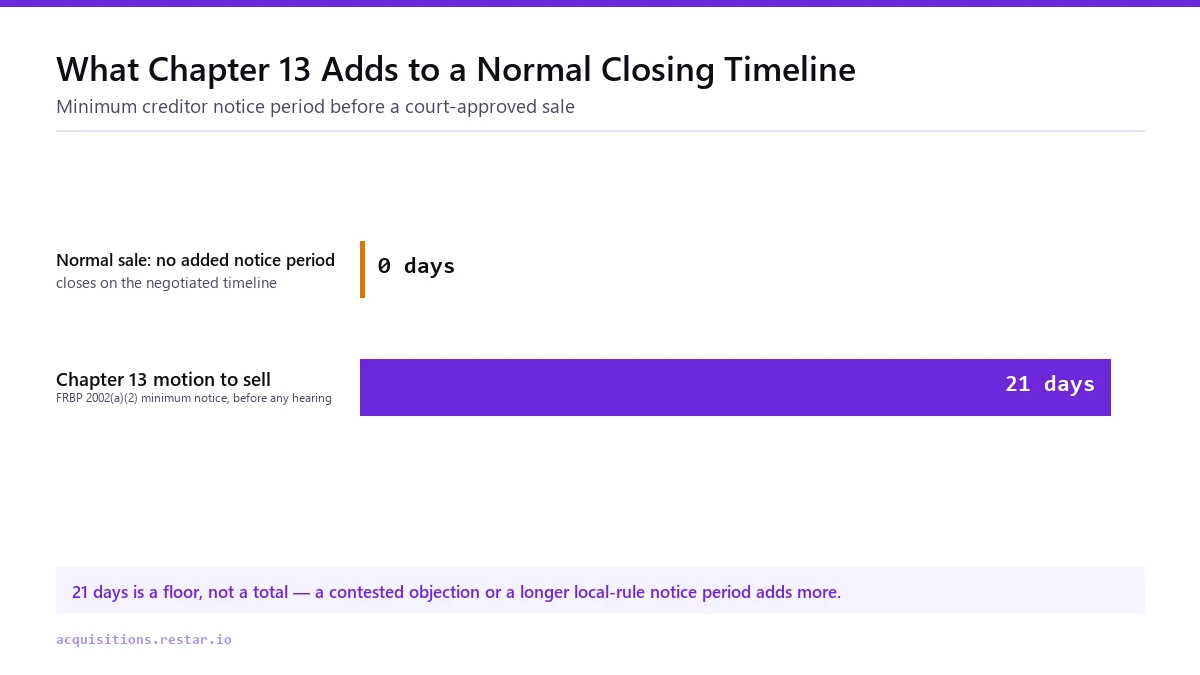
In practice, that means filing a Motion to Sell (or Motion for Authority to Sell Real Property) with the bankruptcy court, describing the property, the sale price, the buyer, the liens against it, and how the proceeds will be applied. Federal Rule of Bankruptcy Procedure 6004 governs the process, and Rule 2002(a)(2) sets a baseline minimum of 21 days' notice to creditors before a sale outside the ordinary course of business can proceed (see FRBP 6004 and FRBP 2002). If a creditor or the trustee files a timely objection, the court holds a hearing before deciding whether the sale can proceed.
This step applies to every sale, regardless of the buyer or how they're paying — a cash offer goes through the identical motion-to-sell process a financed offer would, because the approval requirement attaches to the transfer of estate property, not to the buyer's financing.
File the motion. Sale price, buyer, lien payoff amounts, and proposed use of proceeds, filed with the court.
Notice goes out. Creditors and the trustee get at least 21 days' notice and a chance to object.
No objection, or objection resolved. If nobody objects (or objections are resolved), the sale can proceed on the court's approval; if a creditor or the trustee contests it, a hearing decides the outcome.
Close, with proceeds applied per the order. Liens and the mortgage get paid at closing as in any sale; what's left is handled per the court's order and your plan.
What happens to the proceeds
At closing, the mortgage and any other liens against the house get paid first, the same as in any sale. What's left beyond that is where Chapter 13 adds a wrinkle: net proceeds are generally estate property, expected to go toward your confirmed repayment plan, unless they fall under your state's homestead exemption or another exemption under 11 U.S.C. §522 (see 11 U.S.C. §522).
How much of your equity is actually protected depends heavily on your state — homestead exemption amounts vary widely, since §522(b) lets states opt out of the federal exemption scheme and set their own. There's no single dollar figure that applies everywhere; your attorney can tell you what your state's exemption actually protects and how to petition the court to let you keep exempt proceeds as part of the same motion to sell.
What happens if you sell without getting approval first
Don't sign a contract and close before the motion is approved, even if you're under real pressure to move fast. Under 11 U.S.C. §549, the trustee can move to avoid — unwind — a transfer of estate property made after the case was filed if it wasn't authorized by the Bankruptcy Code or the court (see 11 U.S.C. §549). In practice, an unauthorized sale can create a title defect for the buyer, get challenged by the trustee, and put your Chapter 13 case itself at risk — not something to test with a real transaction.
This is exactly where working with a buyer and an attorney who understand the process matters: the motion has to be filed and approved before you close, not worked around.
The honest timeline tradeoff
A cash offer removes financing risk from your side of the sale — there's no lender who can deny the buyer's loan while your motion is pending. It does not remove the court's process, and it doesn't remove the underlying price tradeoff either: a fast, as-is cash sale typically nets less than a fully-repaired retail listing would, the same tradeoff that applies to any house, in or out of bankruptcy. See cash offer vs listing net proceeds for that math. Whether the speed and certainty of a cash sale are worth that tradeoff while a motion to sell is pending is a question for you and your attorney, weighed against how much runway your plan and your creditors actually give you.
FRBP 2002's 21-day minimum notice period is a floor, not a typical total timeline; if your district's local rules require a longer notice period, or if a creditor or the trustee objects and a hearing gets scheduled, the approval process can take meaningfully longer than 21 days from filing to order. Plan on the motion-to-sell process adding real time on top of whatever your closing itself would normally take, and loop your bankruptcy attorney in on timing before you commit to a closing date with any buyer.
What Chapter 13 adds to a normal closing timelineRestar Acquisitions · FRBP 2002(a)(2) 21-day minimum notice period; actual total time is case- and district-specific
Alternatives worth asking your attorney about before you sell
Selling isn't the only option if your circumstances have changed since your plan was confirmed. A few paths worth raising with your bankruptcy attorney:
Modify the plan. Under 11 U.S.C. §1329, you, the trustee, or an unsecured creditor can ask the court to adjust your payment amount or the length of your plan at any time before it's complete — sometimes selling isn't necessary if the plan itself can flex.
Convert to Chapter 7. You have an unwaivable right under 11 U.S.C. §1307(a) to convert your case to Chapter 7 at any time, which changes how your property, including the house, is treated.
Request a hardship discharge. Under 11 U.S.C. §1328(b), if you can't complete plan payments due to circumstances you shouldn't be held accountable for, and unsecured creditors would receive at least as much as they would have in Chapter 7, you may qualify for an early discharge without selling.
Keep paying the plan. If your situation has stabilized, continuing plan payments and keeping the house may be the simplest option — selling is a decision, not a requirement, unless you've concluded it's genuinely the right move.
Can I sell my house during an active Chapter 13 bankruptcy?
Yes, but only with the bankruptcy court's approval. Because the house remains part of the bankruptcy estate for the life of your Chapter 13 case, you have to file a motion to sell, give creditors and the trustee notice, and clear any objections before you can close.
Does a cash offer skip the bankruptcy court approval process?
No. The approval requirement applies to the transfer of estate property itself, regardless of how the buyer is paying. A cash offer removes financing risk on the buyer's side, but it doesn't remove the need to file a motion to sell and get court approval.
How long does it take to get court approval to sell during Chapter 13?
There's no single fixed timeline. Federal rules set a 21-day minimum notice period to creditors before a sale can proceed, but the total time depends on your district's local rules and whether the trustee or a creditor objects and triggers a hearing. Ask your bankruptcy attorney for a realistic estimate for your specific court.
What happens to the sale proceeds if I sell during Chapter 13?
The mortgage and any liens are paid first at closing, same as any sale. What's left is generally estate property expected to go toward your repayment plan, unless it falls under your state's homestead exemption or another exemption you and your attorney petition the court to apply.
What happens if I sell my house without getting the bankruptcy court's approval first?
The trustee can move to unwind the sale as an unauthorized transfer of estate property under 11 U.S.C. §549. That can create a title defect for the buyer, draw a trustee objection, and put your Chapter 13 case itself at risk — don't close before the motion to sell is approved.
Selling during Chapter 13? A cash offer still has to clear the court — but it's one less variable
A cash sale doesn't skip the bankruptcy court's approval process — nothing does. What it removes is financing risk on the buyer's side while your motion to sell is pending, since there's no lender approval that can fall through separately from the court's.
We buy houses as-is across 30 markets in Alabama, Arizona, Florida, Georgia, Indiana, Maryland, Michigan, New York, North Carolina, Ohio, and Texas. You and your bankruptcy attorney handle the court process; we make a written cash offer within 24 hours and work on the timeline your case allows.
Every offer on this site is underwritten by a person, not a form. If the
numbers do not work for you, say so and I will tell you what would.
Also from Restar
Want the data behind all of this?
Restar Acquisitions is the acquisitions arm of Restar — a housing-market analytics
platform tracking 180+ metrics across every U.S. market, with composite scores and 12-month
price forecasts. The numbers on this page come from the same work.