Selling a house for a profit feels like a one-time event, but the IRS doesn't see it that way. If the gain is taxable, income tax on it is due as the money comes in, the same as a paycheck. Pay too little during the year through withholding and estimated payments, and you can owe an underpayment penalty on Form 2210, on top of the capital gains tax itself.
Step 1 of 5
Tell us about the property and we'll give you a written cash offer within 24 hours with a closing date you control, so you have time to plan around the tax bill.
You’ll talk to Trevor McAmis, Owner & Acquisitions Lead
(313) 710-6129
Takes about two minutes. Your address is never shared.
Educational only. This explains how these situations generally work. It is not legal, tax or financial advice, and the rules differ by state. Talk to an attorney or CPA about your own situation before you act on any of it.
The U.S. tax system is pay-as-you-go. For a W-2 job, your employer withholds tax from each paycheck and sends it to the IRS all year. Nobody waits until April to settle up.
Selling a house doesn't come with automatic withholding. If the sale produces a taxable gain, that tax isn't collected unless you make it happen yourself, through extra withholding or quarterly estimated payments on Form 1040-ES.
A taxable gain can show up in a few ways. You sell a rental property: the gain is taxed, and any depreciation you claimed over the years gets recaptured and taxed separately (see our guide on depreciation recapture when selling a rental). You sell a second home or vacation property: there's no Section 121 exclusion for a second home, so the whole gain is usually taxable. You sell your primary residence and the gain is bigger than the Section 121 exclusion ($250,000 for a single filer, $500,000 for a married couple filing jointly): our guide on capital gains tax when you sell your house covers how that gain is calculated.
In every one of those cases, the tax on the gain doesn't disappear just because no one withheld it. If you don't pay enough during the year, the IRS can charge a penalty for underpaying, calculated on Form 2210, separate from the capital gains tax you already owe.
The IRS gives every taxpayer a safe harbor: a minimum amount you need to have paid in during the year, through withholding plus estimated payments, to avoid the penalty no matter what your final bill turns out to be. Per the IRS's underpayment of estimated tax by individuals penalty page, you generally owe no penalty if either of these is true: you owe less than $1,000 in tax after subtracting withholding and refundable credits, or you paid at least 90% of the current year's tax, or 100% of last year's tax, whichever is smaller.
There's one more wrinkle for higher earners. If your prior-year adjusted gross income was over $150,000 (or $75,000 if married filing separately), the IRS substitutes 110% for that 100% figure. So the safe harbor becomes the smaller of 90% of this year's tax or 110% of last year's tax.
This matters a lot for home sellers. If your income was moderate last year and this year's sale creates a one-time spike, the safe harbor is often still just 100% (or 110%) of last year's normal tax bill, not 90% of this inflated, sale-driven year. That's the main reason a big gain doesn't automatically mean a big penalty. It depends on what you paid in relative to last year, not just on the size of the gain.
Withholding from a paycheck is treated as if it were paid evenly across all four quarters, even if it all came out in December. Estimated payments, on the other hand, only count for the quarter you send them in. That distinction is a real lever, covered below.
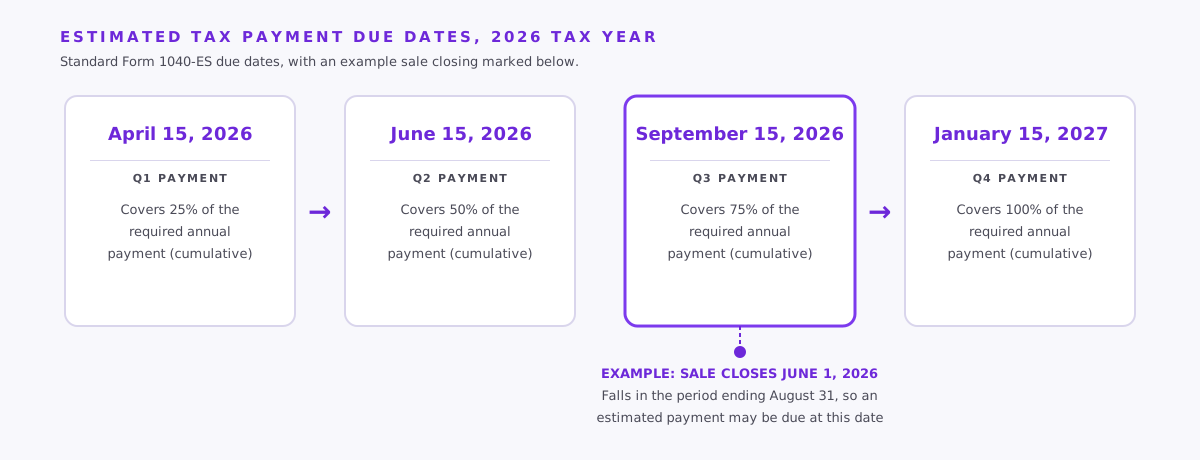
For the 2026 tax year, the standard due dates for quarterly estimated payments are April 15, June 15, September 15, and January 15, 2027 (these can shift a day or two for weekends or holidays, so check the current Form 1040-ES instructions for the exact date in a given year). Each payment is generally supposed to cover 25%, 50%, 75%, then 100% of your required annual payment, cumulatively, by each of those dates.
The underpayment penalty is not a flat percentage tacked onto your bill. It's interest, charged on the amount you underpaid, for the number of days it stayed underpaid. The rate is set by the IRS every quarter and equals the federal short-term rate plus 3 percentage points, compounded daily. You can check the current rate on the IRS's quarterly interest rates page. As of this writing, the 2026 underpayment rate for individuals has run 6% to 7% depending on the quarter, so this is a real but usually modest cost, not a punishing one, assuming the underpayment itself isn't huge.
The standard safe harbor math assumes your income arrives evenly across the year. A home sale doesn't work that way; it's a lump sum on one specific closing date. The IRS's own instructions for Form 2210 address exactly this: if your income varied during the year, for example because of a large capital gain that happened later in the year, you may be able to lower or eliminate one or more required installments by using the Annualized Income Installment Method, filed on Schedule AI of Form 2210.
Schedule AI breaks the year into four cumulative windows: January 1 to March 31, January 1 to May 31, January 1 to August 31, and the full year. You calculate your required payment for each window based on the income you'd received by that point, annualized. If your sale closed in July, for instance, the gain doesn't need to be counted in the first two windows at all, because it hadn't happened yet. That can wipe out an underpayment penalty for the quarters before the sale, even though the regular method might otherwise have required a bigger payment in those earlier quarters based on your full-year total.
Schedule AI is a real calculation with its own worksheets (IRS Publication 505 walks through them), and it isn't always a clean win; it can also flag a quarter you didn't expect. A CPA can run both the regular and annualized versions and tell you which one comes out ahead for your specific numbers.
Here's a seller who sells a rental property with a closing date of June 1, 2026. The household: married, filing jointly. 2025 (prior year) adjusted gross income was $130,000, under the $150,000 threshold, so the 100% rule applies, not 110%. 2025 total tax liability was $12,000. 2026 W-2 withholding from day jobs is $9,000 for the year, which roughly matches their tax on wages alone.
The sale: the rental sells for $400,000, with selling costs of $24,000 and an adjusted basis (after depreciation) of $220,000, for a total gain of $156,000. Of that, $40,000 is depreciation recapture (unrecaptured Section 1250 gain), taxed at a maximum 25% federal rate. The remaining $116,000 is standard long-term capital gain; this example assumes the 15% federal rate, which is the bracket that covers this income level for most sellers. Actual brackets depend on total taxable income and should be checked against the current year's rate schedule or a CPA, not assumed.
| Item | Amount |
|---|---|
| Depreciation recapture tax: $40,000 × 25% | $10,000 |
| Long-term capital gains tax: $116,000 × 15% | $17,400 |
| Tax generated by the sale | $27,400 |
| Tax on wages (roughly matches withholding) | $9,000 |
| Total 2026 tax liability | $36,400 |
Checking the safe harbor: 90% of current-year tax is $32,760. 100% of prior-year tax (AGI under $150,000) is $12,000. The required annual payment is the smaller of the two, $12,000. Actual 2026 withholding is $9,000, so the shortfall for the year is $3,000.
Because the safe harbor is based on last year's much smaller tax bill, this seller only needs to have paid in $12,000, not $32,760, even with a $156,000 gain. They're short by $3,000 for the year, not by the full tax on the sale. Spread over four regular-method installments, that's a required $3,000 per quarter against $2,250 of withholding per quarter (withholding counts evenly across the year), or a $750 shortfall each quarter.
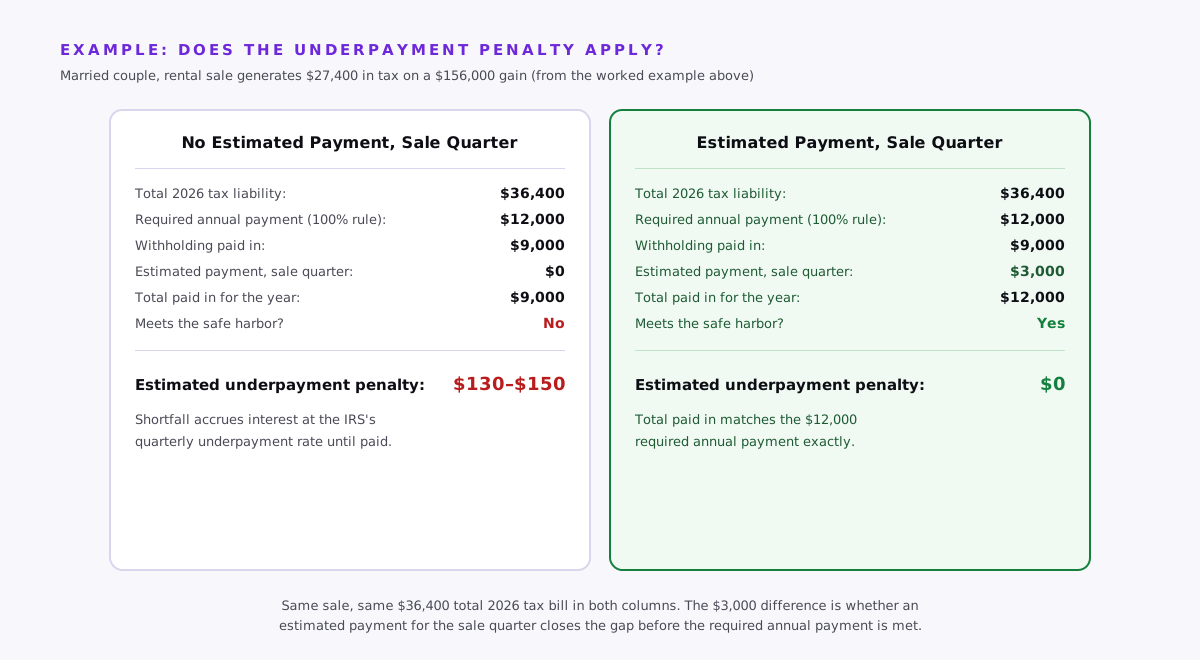
Applying an approximate 7% annual underpayment rate to each quarter's $750 shortfall, for the days it stayed unpaid until the following April 15 return deadline, works out to roughly $130 to $150 in total penalty for the year. Form 2210 computes this to the day, using the exact quarterly rate in effect at the time (6% to 7% across 2026), so the real number will differ slightly, but the order of magnitude is right: this seller owes a real penalty, and it's small compared to the $27,400 the sale generated in tax.
A faster closing doesn't reduce the tax owed. The gain is the gain, and the IRS taxes it the same whether the sale took three weeks or six months. What a faster closing changes is how much runway you have to plan for the payment, and which required-installment window the gain lands in.
A cash sale that closes June 1, 2026 lands in window (c), January 1 through August 31, with the estimated payment due September 15, 2026, giving about 3.5 months to set aside the $27,400 and make the payment. A listed sale where financing falls through once and re-closes in October 2026 lands in the full-year window (d), with the payment due January 15, 2027: still the same tax owed and the same 2026 tax year, but less time to plan before the last installment. A listed sale that slips past December 31 into January 2027 resets the entire calculation to the 2027 tax year, with the first payment due April 15, 2027: the whole tax bill, the prior-year safe harbor base, and every due date move a full year later, which is a bigger shift than just missing a quarter.
The straight read: this is a timing and planning issue, not a tax-savings issue. A faster, more certain closing date gives you more lead time to talk to a CPA, run the Schedule AI numbers if they help, and get an estimated payment in before a deadline instead of scrambling. A sale that drags for months on an uncertain buyer can push the closing into a later quarter, or even a different tax year entirely, which changes your planning window but not what you ultimately owe.
Make an estimated payment for the quarter the sale closes in. Don't wait for April 15 if you know a sale created a real tax bill this quarter. Ask a CPA whether Schedule AI, the annualized method, lowers or eliminates a penalty for the quarters before the sale closed; it depends on your specific numbers. If you're still working a W-2 job, consider increasing your withholding for the rest of the year. Withholding counts as paid evenly across all four quarters no matter when it's taken out of your paycheck, so a bump in the fourth quarter can retroactively cover an earlier shortfall in a way an estimated payment can't. Treat this as separate from the decision of how to sell. Whether you sell for cash or list the house is its own question about price, timeline, and certainty. The tax timing question sits on top of that decision, not inside it.
This isn't tax advice. The safe harbor math, the Schedule AI decision, and your actual required payment depend on your full tax picture. Confirm the numbers with a CPA before you decide what to pay and when.
We buy houses as-is for cash. Send the address and you'll have a written offer within 24 hours, no repairs, no commissions, and you pick the closing date. A closing date you control is a closing date you can plan a tax payment around. If listing would net you more once the dust settles, we'll tell you that too.
All guides · Capital gains tax when you sell your house · Depreciation recapture when selling a rental · When do you get your money after closing
Step 1 of 5
No obligation, no fees, no repairs. We respond the same day.
You’ll talk to Trevor McAmis, Owner & Acquisitions Lead
(313) 710-6129
Takes about two minutes. Your address is never shared.
