Every market page publishes the numbers behind its offer. See the math
Home › Guides › Depreciation Recapture When Selling a Rental: The Real Number
Guide
Depreciation Recapture When Selling a Rental: The Real Number
Depreciation recapture when selling a rental is the tax bill that surprises landlords who thought they understood their numbers. Every year you owned the property you took a deduction against your rental income. When you sell, the IRS collects on those deductions, at a rate that can be higher than the one on the rest of your gain. This page works the whole thing to a number on one property, and then shows the part almost nobody realizes: the recapture bill is nearly identical whether you sell fast for cash or list at full retail.
Takes about two minutes. Or call
(313) 710-6129 — we answer.
Educational only. This explains how these situations generally work. It is not legal, tax or financial advice, and the rules differ by state — talk to an attorney or CPA about your own situation before you act on any of it.
Depreciation recapture when selling a rental: the short answer
Depreciation you took reduced your cost basis, so it comes back as gain when you sell. That slice is taxed as unrecaptured section 1250 gain at your ordinary rate, capped at 25%, rather than at the lower long-term capital gains rates that apply to the rest of your profit.
This is educational information about how the rules generally work, not tax advice about your situation. Depreciation, basis and gain calculations depend on facts specific to your property and returns, and state tax is on top of everything here. Talk to a CPA before you sell — on a number this size, the fee is trivial next to the exposure.
Where the number comes from
Residential rental property is depreciated over 27.5 years under the IRS's general depreciation system, using a mid-month convention — property placed in service or disposed of during a month is treated as though that happened at the midpoint of the month. The rules are set out in IRS Publication 527.
Land is not depreciable, so the first step is always splitting the purchase price between land and building. Only the building portion gets depreciated.
Then comes the sentence that costs unprepared landlords the most money. Publication 527 requires you to decrease your basis by depreciation you “deducted or could have deducted.” Allowed or allowable. If you owned a rental for twelve years and never claimed a cent of depreciation — because you did not know you could, or your preparer missed it — the IRS still treats your basis as though you had. You owe the recapture either way. If that describes you, talk to a CPA about whether a change in accounting method can recover the deductions you missed, because simply ignoring it means paying tax on a benefit you never received.
Working it through on one property
A single-family rental bought in January 2014 and sold in September 2026.
Step
Amount
Purchase price
$135,000
Less land allocation (not depreciable)
− $27,000
Depreciable basis
$108,000
Annual depreciation ($108,000 ÷ 27.5)
$3,927
2014, placed in service in January (11.5 months)
$3,764
2015 through 2025, eleven full years
$43,200
2026, disposed of in September (8.5 months)
$2,782
Total depreciation taken
$49,745
Adjusted basis ($135,000 − $49,745)
$85,255
That $49,745 is the number that gets recaptured. It is not a penalty and it is not double taxation — you deducted it against rental income over twelve years, and now the IRS is collecting on the deferral. But it is real money arriving at a moment when most sellers have already spent it in their heads.
The two rates, and how they stack
Your gain does not get taxed at one rate. It gets split.
The depreciation slice is unrecaptured section 1250 gain. IRS Topic no. 409 states that this portion “is taxed at a maximum 25% rate.” Maximum is the operative word: it is taxed at your ordinary income rate, but capped at 25%. A landlord in the 24% bracket pays 24% on it; one in the 35% bracket pays 25%.
The remainder — gain above what you depreciated, i.e. genuine appreciation — is ordinary long-term capital gain at 0%, 15% or 20% depending on your taxable income.
On top of both, the net investment income tax adds 3.8% on the lesser of your net investment income or the amount your modified adjusted gross income exceeds the threshold — $250,000 for married filing jointly, $200,000 for single filers. Sellers forget this one constantly, because a large gain is exactly what pushes an ordinary income into NIIT territory for a single year.
The whole thing is reported on Form 4797, and the form's instructions walk through the sale of business property.
The comparison landlords actually need: cash versus listing
Now the practical question. Our example landlord is married filing jointly with $210,000 of other taxable income, and the rental needs about $14,000 of work to show at full retail. Two routes.
Sell for cash
Repair and list
Sale price
$159,000
$205,000
Commission
—
− $10,250
Seller closing costs
− $2,900
− $4,100
Buyer concession
—
− $2,500
Amount realized
$156,100
$188,150
Adjusted basis
$85,255
$99,255
Total gain
$70,845
$88,895
Unrecaptured section 1250 at 24%
− $11,939
− $11,939
Remaining long-term gain at 15%
− $3,165
− $5,872
Net investment income tax at 3.8%
− $1,172
− $1,858
Total federal tax
$16,276
$19,669
Repairs paid out of pocket
—
− $14,000
Holding costs while repairing and selling
—
− $3,760
In hand after federal tax
$139,824
$150,721
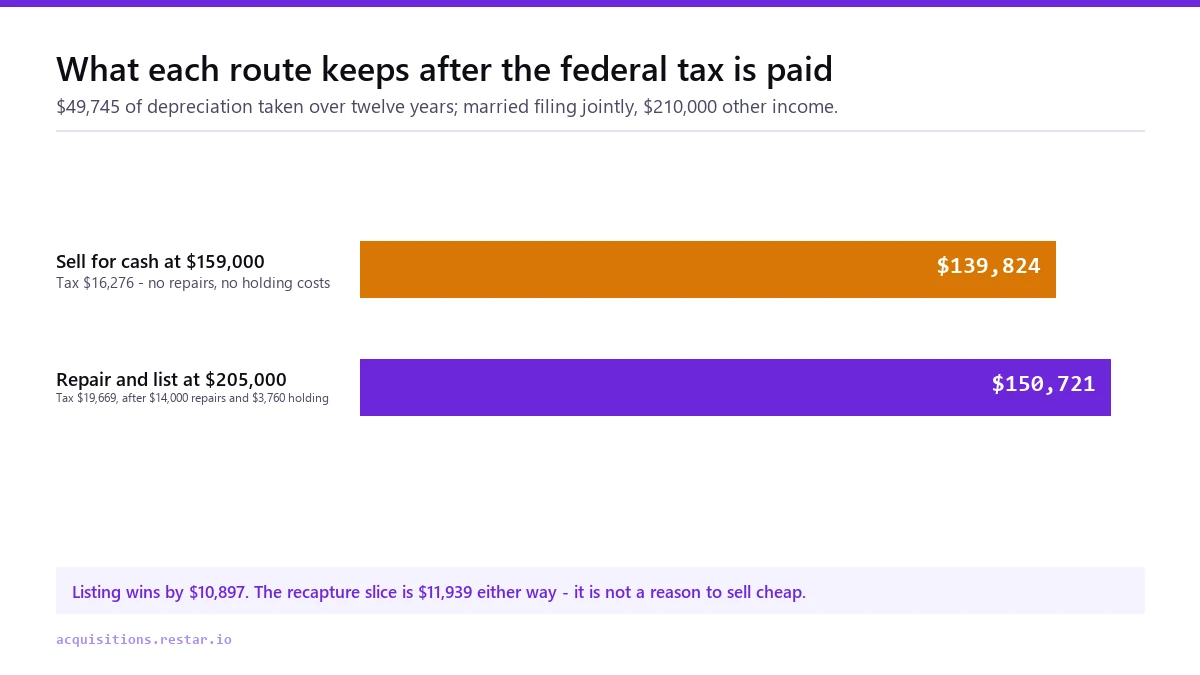
What each route keeps after the tax is paidRestar Acquisitions · worked example from this page
A worked illustration on one hypothetical property, ignoring state income tax, which applies on top in most states. Not a quote, not tax advice, and not a formula we apply to offers.
Listing wins by $10,897 after tax. That is the honest result on this property, and it is the result on most rentals in ordinary condition. If you can fund $14,000 of work, carry the property for a few months, and tolerate the uncertainty, the open market pays you more than we will.
The insight buried in that table
Look at the recapture line on both routes. $11,939 either way. Identical.
That is not a coincidence, and it matters more than anything else on this page. Unrecaptured section 1250 gain is the lesser of the depreciation you took or your total gain. As long as your gain exceeds your accumulated depreciation — which it does on both routes here — the recapture slice is fixed at the depreciation number regardless of what you sell for.
So the whole tax difference between selling at $159,000 and selling at $205,000 is only $3,393, while the pre-tax difference between the routes is $14,290. Taxes absorb less than a quarter of the gap.
The practical conclusion: do not let the recapture bill push you toward a fast, cheap sale. Selling for less does not meaningfully reduce it until your total gain falls below your accumulated depreciation, and at that point you have taken a far larger hit on price than you saved in tax. Landlords talk themselves into discounted sales on the theory that they are avoiding a tax problem. The arithmetic does not support it.
What genuinely does change the tax answer
If the recapture bill is the thing standing between you and a sale, these are the levers that actually move it — and every one of them needs professional advice before you rely on it.
A 1031 like-kind exchange. Defers the gain, including recapture, by rolling into other investment real estate. The IRS's like-kind exchange guidance confirms it applies only to real property held for business or investment — not a home you live in. It runs on strict statutory deadlines under 26 U.S.C. § 1031, requires a qualified intermediary engaged before closing, and it is a deferral, not forgiveness. It also does not help if what you want is to stop owning rental property.
An installment sale. Spreading the payments across years can keep you in lower brackets and under the NIIT threshold. Publication 537 covers it — note that depreciation recapture on section 1250 property does not necessarily spread the way the rest of the gain does, which is a CPA question.
Timing the sale into a lower-income year. The recapture rate is your ordinary rate capped at 25%, and NIIT depends on your MAGI. Retiring, or a year with lower income, genuinely changes the bill.
Making sure your basis is complete. Every capital improvement over the years — the roof, the furnace, the addition — raises your basis and lowers your gain. Dig out the receipts. This is the most commonly missed money on the whole calculation.
What this means for your decision
For most landlords with a rental in ordinary condition, the honest answer is: fix what needs fixing and list it with an agent, then plan for the tax bill rather than trying to dodge it. Set the money aside at closing so it is not a shock in April.
A cash sale earns its place on a narrower set of facts: the property needs more work than you can fund, a tenant situation makes a retail listing impractical, the house is vacant and costing you every month, or you have a deadline. Those are real, and they are why people call us. Our guide to selling with tenants in place covers the occupancy side, the tired landlord page covers the wider decision, and the net-proceeds comparison works both routes on two other houses. What none of those cases is, is a tax strategy.
Common questions
What is depreciation recapture when selling a rental property?
It is the tax on the depreciation deductions you took while you owned the property. Those deductions reduced your cost basis each year, so when you sell, that amount comes back as gain and is taxed as unrecaptured section 1250 gain rather than at the lower long-term capital gains rates.
What rate is depreciation recapture taxed at?
IRS Topic no. 409 states that unrecaptured section 1250 gain is taxed at a maximum 25% rate. It is actually taxed at your ordinary income rate with 25% acting as a ceiling, so a landlord in the 24% bracket pays 24% and one in a higher bracket pays 25%. State income tax applies separately on top.
Do I owe depreciation recapture if I never claimed depreciation?
Generally yes. Publication 527 requires basis to be reduced by depreciation you deducted or could have deducted, so the recapture is calculated on what was allowable whether or not you claimed it. If this applies to you, ask a CPA about correcting it, because otherwise you pay tax on a deduction you never actually received.
Does selling my rental for less reduce the depreciation recapture?
Barely, until the price drops a long way. Unrecaptured section 1250 gain is the lesser of your accumulated depreciation or your total gain, so as long as the gain still exceeds the depreciation, the recapture slice does not change. In the example on this page, selling for $46,000 less changed the total tax by only $3,393.
Can a 1031 exchange avoid depreciation recapture?
It defers it rather than avoiding it. A properly executed like-kind exchange into other investment real estate postpones the gain including recapture, but it requires a qualified intermediary engaged before closing, runs on strict statutory deadlines, and only works if you actually want to own investment real estate afterwards.
Is depreciation recapture the same as capital gains tax?
No, they are separate slices of the same sale. The portion equal to your accumulated depreciation is unrecaptured section 1250 gain capped at 25%; the profit above that is ordinary long-term capital gain at 0%, 15% or 20%. The net investment income tax of 3.8% can apply on top of both.
Whatever you decide, you need a real figure for the cash column rather than a guess. Send us the property and we will tell you within 24 hours what we would pay and when we could close, so your CPA has something concrete to work from.
Send us the property here. On the worked example below, listing wins by $10,897 — and if your numbers say the same thing, we will tell you so.
Every offer on this site is underwritten by a person, not a form. If the
numbers do not work for you, say so and I will tell you what would.
Also from Restar
Want the data behind all of this?
Restar Acquisitions is the acquisitions arm of Restar — a housing-market analytics
platform tracking 180+ metrics across every U.S. market, with composite scores and 12-month
price forecasts. The numbers on this page come from the same work.