Every market page publishes the numbers behind its offer. See the math
Home › Guides › When Do You Get Your Money After Closing a House Sale?
Guide
When Do You Get Your Money After Closing a House Sale?
When do you get your money after closing is the question sellers ask last and worry about most, usually somewhere around four in the afternoon on closing day with the documents signed and nothing in the account. The signing is not the payment. Between the two sit three separate events that happen in order, a federal wire system with a hard cutoff, and a settlement agent who is legally barred from paying you money it has not actually collected. Here is the sequence, the clock that governs it, and the one mistake that costs sellers the entire proceeds.
Takes about two minutes. Or call
(313) 710-6129 — we answer.
Educational only. This explains how these situations generally work. It is not legal, tax or financial advice, and the rules differ by state — talk to an attorney or CPA about your own situation before you act on any of it.
When do you get your money after closing: the short answer
In most states you are paid the same day you sign, once the settlement agent confirms all funds are in and disburses. In a handful of escrow states the file must record first, so payment usually lands one to two business days later.
General educational information about how closings are funded, not legal or financial advice. State practice, contract terms and individual settlement agents vary. Confirm the disbursement timing for your own closing with your title or escrow company before signing.
Signing is not funding, and funding is not disbursement
Almost all the confusion about when do you get your money after closing comes from treating three events as one. They are three, they happen in order, and each can stall independently.
1. Signing. You execute the deed and the settlement statement. Nothing has moved. Your signature is a precondition for the money, not a trigger for it.
2. Funding. The buyer's money actually arrives in the settlement agent's account — either the buyer's own wire, or the lender's wire, which is released only after the lender's final review of the signed package. On a financed purchase this is the step that most often runs late, because it depends on a person at a lender clearing a queue.
3. Disbursement. The settlement agent pays everyone: your mortgage payoff, the county for recording, the agents, and you. Only now does money leave for your account.
The gap that surprises people is between 2 and 3, and it is not discretionary. Settlement agents operate under state good-funds rules that bar them from disbursing money they have not collected. Arizona's is a clear example: A.R.S. 6-843 permits an escrow agent to disburse only when deposits previously made are at least equal to the disbursements, with a narrow carve-out allowing up to $500 per transaction. A settlement agent that pays you before the buyer's wire lands is not being helpful, it is breaking the law.
Wet closings and dry closings
Most of the country runs what the industry calls a wet closing: once funding lands, the agent disburses the same day, and recording follows. Sign in the morning, and a same-day wire is realistic.
A minority of states run dry closings, where the documents must be recorded before the agent may disburse. Recording depends on the county recorder's office and its hours, which is why a dry-state closing routinely pays out one or two business days after signing. Arizona, one of the markets we buy in, works this way in practice, and the good-funds statute above is part of why.
Neither is better or worse for you. What matters is knowing which one you are in before you plan around the money. If you have a moving truck, a deposit on a new place, or a payment due the day after closing, ask your settlement agent for the expected disbursement date in writing at least a week ahead. They will tell you, and it costs nothing to ask.
The wire clock, and why Friday afternoon is a trap
Once the agent disburses, the money moves through Fedwire, and Fedwire has hours.
The Federal Reserve states that the Fedwire Funds Service business day begins at 9:00 p.m. eastern time on the preceding calendar day and ends at 7:00 p.m. ET, Monday through Friday, excluding designated holidays, and that the deadline for initiating transfers for the benefit of a third party, such as a bank's customer, is 6:45 p.m. ET.
That sounds generous. It is not, because your settlement agent's own bank imposes a cutoff hours earlier — frequently mid-afternoon — and the agent has to get the instruction in before that. Add the sequence above and the practical rule is unglamorous:
A morning closing usually pays the same day.
A late-afternoon closing frequently does not, because funding arrived after the agent's bank cutoff.
A late-afternoon Friday closing routinely means Monday, and a Friday before a federal holiday means Tuesday. Fedwire does not run weekends or designated holidays.
If the timing matters to you, the single most effective thing you can do is ask to close in the morning, earlier in the week. It costs nothing and it removes the most common cause of a weekend spent wondering.
The five things that actually delay your money
1. The lender funds late in the day. The most common cause by a wide margin, and entirely outside your control. It is also the one a cash sale removes.
2. The payoff figure is wrong or expired. A payoff quote is good through a stated date, and per diem interest accrues daily until the funds arrive. If closing slips past the good-through date the agent has to request a new statement and wait for it. Our guide to the mortgage payoff statement covers how to avoid this specific delay.
3. A lien or release is missing. An old second mortgage never released, a paid judgment never discharged, a solar or HVAC financing filing nobody remembered. These surface in title work and each one needs a document from a third party.
4. A figure nobody chased. An HOA estoppel or payoff letter, a municipal water final read, or a tax proration that the parties have not agreed on. Our page on who pays property taxes when you sell a house covers that last one, which is a more frequent source of last-minute disagreement than its size suggests.
5. Your own bank holds the deposit. If you take a cheque rather than a wire, your bank's funds-availability policy applies on top of everything above. Ask for a wire.
Four of those five are prevented by the same habit: ask for the preliminary settlement statement three days before closing and read every line. Everything on that list is visible there before it becomes a delay.
The one that costs you everything
This is the part of the page we would keep if we could keep only one paragraph.
Closing wire fraud works by sending you, or your settlement agent, convincing wiring instructions from an address that looks right. The CFPB has warned about mortgage closing scams and reported that these attempts rose more than tenfold between 2015 and 2017, with close to $1 billion lost in 2017 alone. Sellers are targeted as well as buyers, because a seller's proceeds are among the largest payments in the transaction and they go out only once.
The CFPB's advice is specific and it works:
Never act on wiring instructions that arrive by email alone.
Verify account details by telephone, using a number you already confirmed in person, not one contained in the email.
Agree a code phrase in advance with your settlement agent for verifying identity.
Never email financial information, and treat unsolicited calls asking for it with suspicion.
If it happens, act within minutes — contact your bank immediately and request a wire recall, and file with the FBI's Internet Crime Complaint Center at ic3.gov.
Instructions that change at the last minute are the signature of this fraud. A genuine settlement agent will never mind you ringing to confirm.
What a cash sale actually changes, and what it costs
A cash purchase removes step 2's dependency on a lender, which is the single most common cause of a late-day wire. It does not remove title work, the payoff, recording, good-funds rules, or the Fedwire clock. Anyone promising you money the same hour you sign is describing something that does not exist.
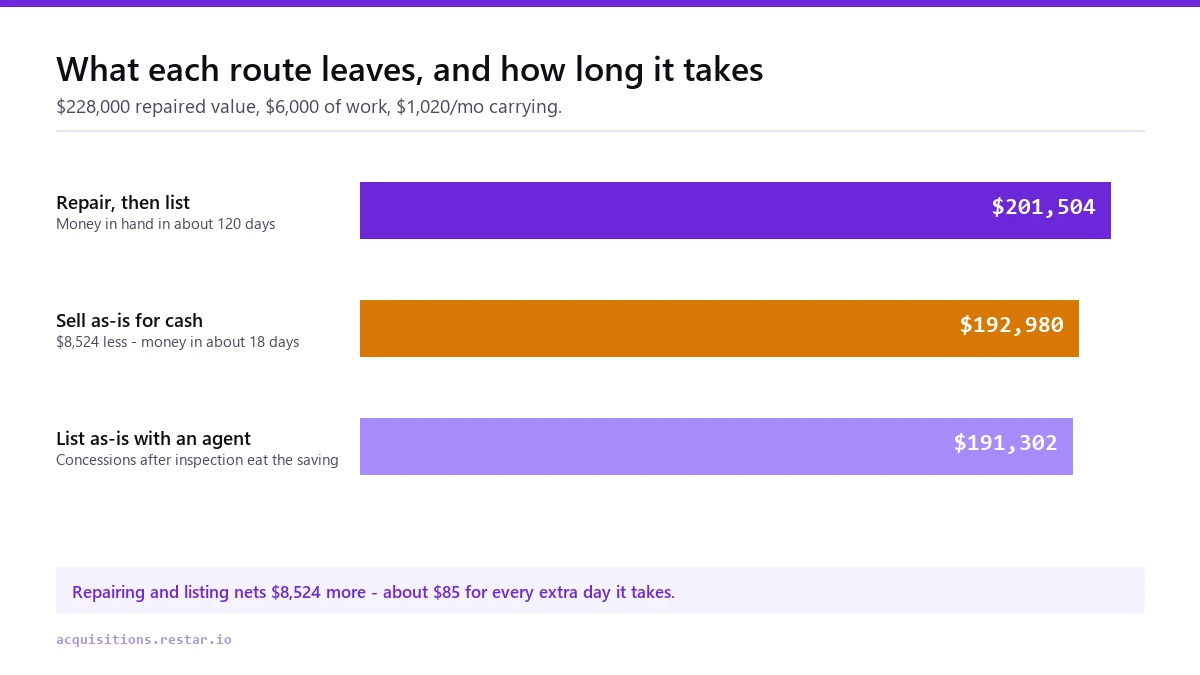
And the speed is not free. Here is the same house both ways: $228,000 repaired value, $6,000 of work needed, carrying costs of $1,020 a month.
Line
Repair, then list
List as-is
Cash as-is
Price
$228,000
$214,000
$194,000
Repairs
−$6,000
—
—
Commission at 5%
−$11,400
−$10,700
—
Seller settlement costs
−$2,736
−$2,568
—
Carrying costs
−$4,080 (4 mo)
−$4,080 (4 mo)
−$1,020 (1 mo)
Buyer concession
−$2,280
−$5,350
—
Net to you
$201,504
$191,302
$192,980
Money in hand
about 120 days
about 110 days
about 18 days
What each route leaves, and how long it takesRestar Acquisitions · worked example from this page
Repairing and listing nets $8,524 more than selling to us, and takes about 100 days longer. That is roughly $85 for every extra day you wait. Put that way the decision is usually easy: for most sellers with a house in this condition, you should list it with an agent. If $85 a day is not worth it to you — because the house is empty, because a date is fixed, because the repair money does not exist — then it is not, and that is a legitimate answer rather than a failure.
When do you get your money after closing depends on your state. In a wet-closing state it is usually the same day you sign, once the buyer's funds have landed and the settlement agent disburses. In a dry-closing state the documents must record first, so payment typically arrives one to two business days later. A late-afternoon or Friday signing frequently pushes it to the next business day either way.
Why have I not received my money after signing the closing documents?
Signing is not payment. The buyer's funds must arrive with the settlement agent, and only then may the agent disburse. State good-funds rules prohibit paying out money that has not been collected, so a lender funding late in the day is the usual reason nothing has moved by the time you get home.
Can I get paid the same day I close?
Often, yes, if you sign in the morning earlier in the week and the buyer's funds arrive before your settlement agent's bank cutoff. Fedwire's business day ends at 7:00 p.m. ET with a 6:45 p.m. ET deadline for customer transfers, but the agent's own bank cutoff falls hours before that, which is the constraint that actually binds.
Is a wire or a cheque faster for closing proceeds?
A wire. A cheque adds your own bank's funds-availability hold on top of everything else, which can be several business days. Ask for a wire, and verify the account details by telephone using a number you confirmed in person.
What is the most common cause of delayed closing proceeds?
The buyer's lender funding late in the day. Other frequent causes are an expired mortgage payoff statement, a missing lien release, an unresolved HOA or tax figure, and taking a cheque instead of a wire. Reading the preliminary settlement statement three days early catches most of them.
How do I protect my closing proceeds from wire fraud?
Never act on wiring instructions received by email alone. Confirm account details by telephone using a number you verified in person, agree a code phrase with your settlement agent in advance, and treat any last-minute change of instructions as fraudulent until proven otherwise. If money is sent wrongly, contact your bank within minutes to request a recall and file with the FBI at ic3.gov.
If a firm, knowable disbursement date matters more to you right now than the last few thousand dollars, tell us the address and the date. Within 24 hours we will tell you what we would pay and when you would be paid — and if the arithmetic says listing nets you more, as it does in the example above, we will tell you that too.
Every offer on this site is underwritten by a person, not a form. If the
numbers do not work for you, say so and I will tell you what would.
Also from Restar
Want the data behind all of this?
Restar Acquisitions is the acquisitions arm of Restar — a housing-market analytics
platform tracking 180+ metrics across every U.S. market, with composite scores and 12-month
price forecasts. The numbers on this page come from the same work.