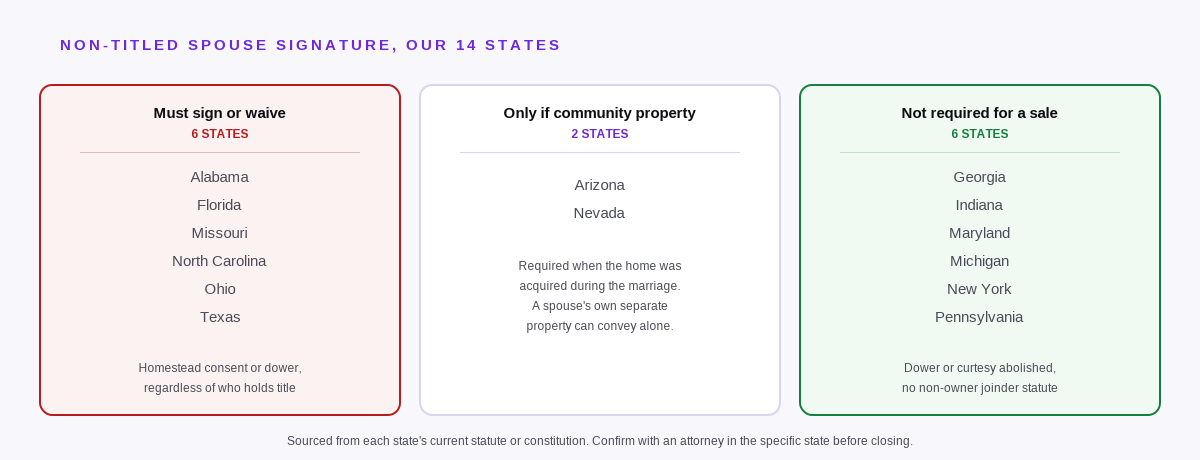
In Alabama, Florida, Missouri, North Carolina, Ohio and Texas, a spouse who isn't on the deed or the mortgage still has to sign closing documents, or a waiver, before a sale can close. Arizona and Nevada require it only when the home is community property. The other six of our 14 states don't require it at all.
Step 1 of 5
Tell us about the property and the situation. We'll give you a straight read on what it's worth and what has to happen before any sale can close.
You’ll talk to Trevor McAmis, Owner & Acquisitions Lead
(313) 710-6129
Takes about two minutes. Your address is never shared.
Educational only. This explains how these situations generally work. It is not legal, tax or financial advice, and the rules differ by state. Talk to an attorney or CPA about your own situation before you act on any of it.
That split is exactly why a non-titled spouse may still have to sign at closing in some of our markets and not in others, and it catches sellers off guard because it has nothing to do with whose name is on the deed or who's making the mortgage payment. It's a separate layer of marital property law sitting on top of the title.
If you've seen our guide on selling a house with a co-signer on the mortgage, this is a different mechanic entirely. A mortgage co-signer is liable for a debt but has no ownership interest and no say over the sale. A non-titled spouse, by contrast, can hold no debt obligation and no ownership interest at all, and still have a legal veto over the sale, because certain states protect a married person's primary residence independent of whose name is on the paperwork.
Three separate legal mechanisms can require a spouse who holds neither title nor mortgage debt to sign at closing:
None of these three show up in a title search the way a lien does. A title company will catch an unreleased mortgage. Whether this specific house, in this specific state, needs a signature from a spouse who was never on the deed is a question about the seller's marital status and the state's family-property law, not about the chain of title, and it's easy for that to surface late.
| State | Non-titled spouse must sign/waive? | Why | Source |
|---|---|---|---|
| Alabama | Yes, for the homestead | Homestead consent statute | Ala. Code § 6-10-3 |
| Arizona | Only if community property | Community property joinder | Ariz. Rev. Stat. § 25-214 |
| Florida | Yes, for the homestead | Constitutional homestead protection | Fla. Const. Art. X, § 4(c) |
| Georgia | No | Dower/curtesy abolished, no homestead-joinder statute | O.C.G.A. § 53-1-3 |
| Indiana | No | Dower/curtesy abolished | Ind. Code § 29-1-2-11 |
| Maryland | No | Dower/curtesy abolished | Md. Est. & Trusts § 3-202 |
| Michigan | No | Dower abolished in 2017 | Mich. Comp. Laws § 558.30 |
| Missouri | Yes, for the homestead | Homestead joinder statute | Mo. Rev. Stat. § 513.475 |
| Nevada | Only if community property | Community property joinder | Nev. Rev. Stat. § 123.230 |
| New York | No | Curtesy abolished 1930, dower survives only for pre-1930 marriages | N.Y. Real Prop. Law § 189 |
| North Carolina | Yes | Statutory marital-interest joinder | N.C. Gen. Stat. § 39-7 |
| Ohio | Yes | Dower still in effect | Ohio Rev. Code § 2103.02 |
| Pennsylvania | No, except tenancy by the entirety | Dower/curtesy abolished | No current inchoate dower/curtesy |
| Texas | Yes | Constitutional homestead joinder | Tex. Const. Art. XVI, § 50; Tex. Fam. Code § 5.001 |
Six states (Alabama, Florida, Missouri, North Carolina, Ohio, Texas) require it outright for a primary residence, including the Florida constitutional homestead protection, Ohio's still-active dower statute, and the Texas Family Code homestead joinder requirement. Two (Arizona, Nevada) require it conditionally, only when the house is community property rather than one spouse's separate property. Six (Georgia, Indiana, Maryland, Michigan, New York, Pennsylvania) don't require it at all for an ordinary lifetime sale.
Michigan is worth calling out specifically, because it used to be a dower state and isn't anymore. Michigan abolished dower by statute effective April 6, 2017. If you're working from an old closing checklist, a memory of how a past sale went, or something an AI chatbot told you, that's exactly the kind of fact that goes stale without anyone noticing. The current rule, confirmed against the statute itself, is that a Michigan seller's non-titled spouse does not need to sign a sale deed on this basis anymore (a separate rule still applies to mortgage refinances on a homestead, which isn't the same transaction as a sale).
An attorney licensed in the seller's specific state is the right person to confirm which of these rules applies to a specific house and marriage, since facts like separation status, when the property was acquired, and whether it's truly the primary residence can change the answer.
Example: A house is worth $245,000 retail, with a $140,000 mortgage payoff remaining.
Listing it retail and selling at full value: subtract a 6% agent commission ($14,700), 2% seller-side closing costs ($4,900), and roughly six weeks of holding costs while it sits on the market and moves through escrow (about $1,700). That nets $223,700 before the mortgage payoff, and $83,700 to the seller after it.
Selling as-is for cash: a typical as-is cash offer on a house like this runs around $196,000, with no commission and no seller-side closing costs. After the same $140,000 payoff, that nets $56,000 to the seller, usually inside two to three weeks.
| List retail | Sell as-is for cash | |
|---|---|---|
| Starting value | $245,000 | $245,000 |
| Agent commission (6%) | −$14,700 | $0 |
| Seller closing costs (~2%) | −$4,900 | $0 |
| Holding costs, ~6 weeks | −$1,700 | $0 |
| As-is cash offer | n/a | $196,000 |
| Net before payoff | $223,700 | $196,000 |
| Mortgage payoff | −$140,000 | −$140,000 |
| Net to seller | $83,700 | $56,000 |
The difference is real. Listing nets $27,700 more in this example, in the clean scenario where nothing holds up closing.
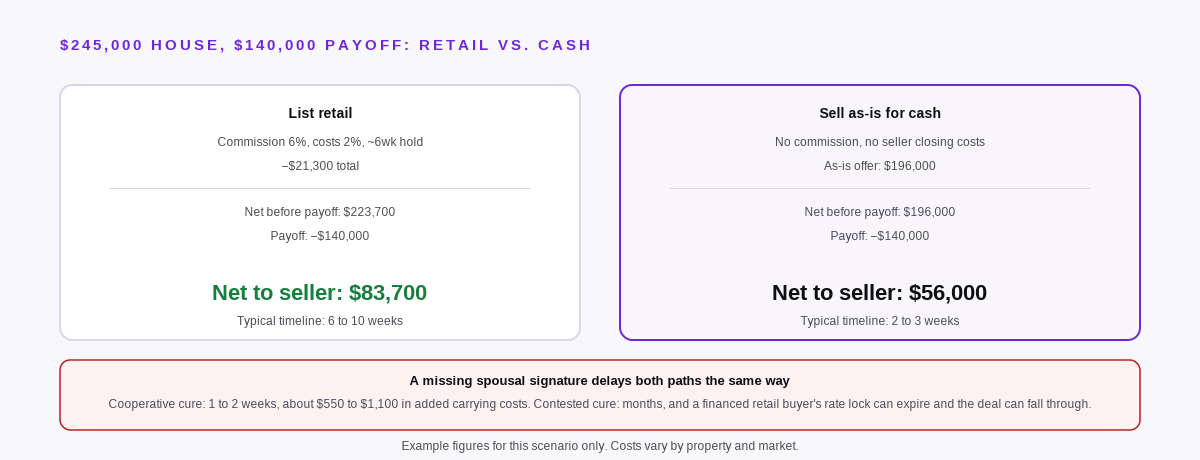
Now add the signature problem, because it changes the math on both sides. Say this seller is married, the spouse never went on the deed, and the house is in a state where homestead consent or dower applies. If that gets caught late, during the retail escrow, curing it means locating the spouse and getting a notarized signature or waiver on file. If the spouse cooperates, that's a one-to-two-week delay, costing roughly $550 to $1,100 in extra carrying costs (mortgage interest, taxes, insurance, utilities) at this property's rate of about $1,100 a month. If the marriage is contested, separated, or heading toward divorce and the spouse won't sign, curing it can take months and may require resolving it through the divorce case itself rather than a simple signature.
On the retail side, that delay carries a second cost beyond carrying expenses: a financed buyer's rate lock and mortgage approval usually run 30 to 60 days, and a signature dispute that drags past that window risks the buyer walking, which can mean re-listing from zero and losing weeks already spent in escrow. On the cash side, the legal requirement to get the signature or waiver doesn't go away just because the buyer isn't financing. What changes is that there's no rate-lock deadline or mortgage contingency to blow through while it gets resolved, so the downside of a delay is carrying costs only, not the whole deal collapsing.
Neither path makes the legal requirement disappear. The signature or waiver has to happen either way before the sale can record. The question that matters is how much a delay costs if the issue surfaces late, and that's a timeline-risk question as much as a price question.
Get the signature or a waiver. In most cases this is a short conversation and a notarized form, not a legal fight. A title company or closing attorney in the seller's state can tell you exactly which document applies.
If the marriage is intact but the spouse is unreachable or unwilling, an attorney can advise on a court order compelling joinder in some states, though this varies by jurisdiction and isn't guaranteed.
If the marriage is ending, the signature issue often gets resolved inside the divorce case rather than the real estate transaction. Our guide on buying out a spouse vs. selling the house in a divorce covers the two paths divorcing co-owners usually choose, and our divorce situations page covers the broader timeline.
If the dispute is truly contested and no one will sign anything, a partition action is the legal route for a co-owner, but a non-titled spouse without an ownership interest typically doesn't have standing to bring one. In that case the resolution runs through the divorce or family court, not through real estate law.
A title company or closing attorney should flag this during title work, but a seller shouldn't assume it's been caught:
If a signature issue like this is holding up a sale, or you'd rather not find out about it during the final week of a retail escrow, we can make this simpler. Send us the property and we'll give you a written cash offer within 24 hours, as-is, with no commissions. You pick the closing date. If listing it would net you more once everything is accounted for, we'll tell you that directly.
Get your offer here and we'll walk through what your specific state requires before you commit to anything.
All guides · Buying out a spouse vs. selling the house in a divorce · Selling a house with a co-signer on the mortgage · Sell my house fast
Step 1 of 5
No obligation, no fees, no repairs. We respond the same day.
You’ll talk to Trevor McAmis, Owner & Acquisitions Lead
(313) 710-6129
Takes about two minutes. Your address is never shared.