Every market page publishes the numbers behind its offer. See the math
Home › Guides › Who Pays Realtor Fees When Selling a House? The Actual Math
Guide
Who Pays Realtor Fees When Selling a House? The Actual Math
Who pays realtor fees used to be a question with one answer, and nobody questioned it: the seller paid, out of the proceeds, and the listing agent split the money with whoever brought the buyer. Since the middle of 2024 that arrangement has been unbundled, and the honest answer to who pays is now it depends, and you should negotiate. This page puts real numbers on the difference. On a $300,000 house, the fee structure alone is worth about $3,942 to a seller, which turns out to be roughly two thirds the size of the entire discount a cash buyer would ask for.
Takes about two minutes. Or call
(313) 710-6129 — we answer.
Educational only. This explains how these situations generally work. It is not legal, tax or financial advice, and the rules differ by state — talk to an attorney or CPA about your own situation before you act on any of it.
Who pays realtor fees: the short answer
The seller still pays the listing agent from the sale proceeds. Since 2024 the buyer's agent fee is separately negotiated, and it can be paid by the buyer, by the seller as a concession, or split. Commission rates are not set by law and never have been.
General information, not legal advice. Practices vary by state and brokerage. Your state real estate commission publishes consumer guidance on what agents must disclose to you.
What changed in 2024
Two practical changes took effect across most of the country in August 2024, and both changed who pays realtor fees on an ordinary sale.
First, offers of buyer-agent compensation can no longer be advertised on the MLS. Previously a listing broadcast to every buyer's agent exactly what they would be paid for bringing a buyer, and that number was effectively standardized in each market. Now it is not published there, so it has to be negotiated deal by deal.
Second, buyers working with an agent must sign a written representation agreement before touring homes, and that agreement states what their agent will be paid. This is why buyers now arrive at the negotiating table with a fee obligation of their own, and frequently ask the seller to cover it as a closing concession.
What did not change is more important than what did. Commission rates were always negotiable. They are not fixed by statute, they are not a legal requirement, and any agreement between competitors to set them would run into ordinary antitrust law. The going rate in a market was a convention, not a rule. The change in 2024 mostly made that fact impossible to ignore.
Your state regulator is the authority on what your agent owes you here — the Texas Real Estate Commission and the Ohio Division of Real Estate are examples of the bodies that publish plain-language consumer guidance and take complaints.
What the fee actually costs on a $300,000 sale
Asking who pays realtor fees is only half of it. The other half is how much, and percentages are hard to feel in a way dollars are not.
Structure
Total commission
Versus 6%
6% covering both sides (the old default)
$18,000
—
5.5% covering both sides
$16,500
$1,500 better
5% covering both sides
$15,000
$3,000 better
2.5% listing side only
$7,500
$10,500 better
Flat-fee listing
~$3,500
$14,500 better
That bottom row is not free money and you should be suspicious of anyone who presents it that way. A flat-fee listing typically buys you MLS entry and little else: you handle showings, negotiation, disclosures and the path to closing yourself. For an experienced seller with a house that shows well, that can be an excellent trade. For someone selling an inherited house from three states away, it usually is not.
And the 2.5% row hides the real question. If you are not paying the buyer's agent, somebody is — and that somebody is bidding on your house with less money available.
Why moving the fee does not fully move the cost
This is the part that gets glossed over in almost everything written about the 2024 changes, and it is the difference between a useful expectation and a disappointment.
A buyer who must pay their own agent 2.5% out of pocket has that much less to put into the price, and they know it when they write the offer. So the fee does not vanish when it moves off your side of the settlement statement. Part of it comes back at you as a lower bid.
How much comes back depends on the market. In a market with more buyers than houses, sellers keep most of the saving. In a slow market, buyers push most of it back. A reasonable middle assumption — and the one used below — is that a buyer funding their own agent bids about 1.5% less on a house they would otherwise have paid full price for.
So on a house that would have sold for $300,000 with the seller covering both sides, the same buyer paying their own agent bids around $295,500. You save $9,113 of commission and give back $4,500 in price. You are still ahead, but by roughly half of what the headline suggests. Anyone promising you the full 2.5% is selling something.
The full comparison, including selling for cash
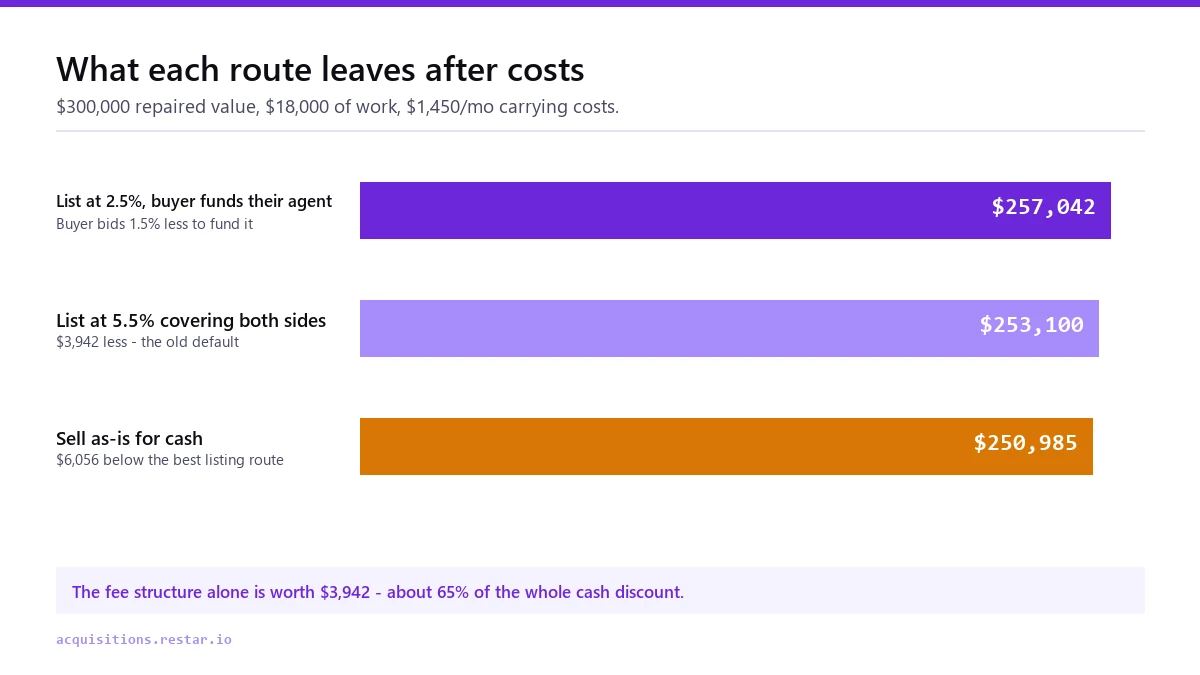
Here is the same house all the way to net proceeds. Worth $300,000 repaired, needing $18,000 of work, carrying about $1,450 a month.
What each route leaves after costsRestar Acquisitions · worked example from this page
Three things fall out of this table, and the first two are inconvenient for us.
One: listing wins. On a $300,000 house that needs only $18,000 of work and can be shown, the best listing route nets $6,056 more than our cash offer. If you have the money for repairs and four months to spare, list it. That is the honest answer and it is the answer for most houses in this condition.
Two: the fee structure is worth $3,942 — the gap between the two listing rows. That is about 65% of the entire cash discount, earned by a conversation with your agent before you sign the listing agreement. Sellers spend weeks agonising over whether to take a cash offer and about four minutes on the commission line. The four minutes are worth more per minute.
Three: the gap is smaller than the percentages imply. A cash offer at $252,000 sounds like 16% below value. After $18,000 of repairs, $7,388 to $16,500 of commission, closing costs, a concession and months of carrying costs, the actual difference in what reaches your bank account is 2% to 2.4% of the house. That is the number to decide on. See cash offer vs listing net proceeds for the same comparison run several ways.
What else comes out of the proceeds
Who pays realtor fees is the biggest question on the settlement statement but not the only one, and sellers routinely forget the rest when comparing offers.
Title and settlement fees, transfer tax and recording. Roughly 1% to 2% of the price in most states, though who pays what is regional custom and negotiable. Our guide to seller closing costs breaks these out.
Prorated property taxes. You pay for the days you owned it. In arrears states this can be a surprisingly large debit.
Buyer concessions. Repair credits after inspection, or help with the buyer's closing costs. Budget for something even on a good house.
Mortgage payoff, plus any liens. The payoff figure includes interest to the closing date and is not the same as your last statement balance.
Holding costs while it sits. The line everybody omits. Four months of taxes, insurance, utilities and upkeep on this house is $5,800, which is more than a third of the commission.
The document that lays all of this out is the closing disclosure, and the CFPB publishes a plain-language walkthrough of it. The federal rules governing settlement statements sit in Regulation X if you want the source.
How to actually negotiate it
Ask what the listing-side fee covers, then ask for it separately from the buyer side. These are now two decisions. Treating them as one number is how sellers overpay.
Interview three agents. The single highest-value hour in the whole process. You are comparing marketing plans and net-proceeds estimates, not just rates.
Ask for a written net sheet from each. A good agent will produce one without being asked. Compare the bottom lines, not the percentages.
Ask what happens if the agent brings the buyer themselves. Some agreements pay the full combined fee to one agent in that case. Fix it in the agreement.
Decide your buyer-concession position early, and put it in the listing conversation. Offering to cover a buyer's agent can widen your buyer pool; refusing outright can narrow it in a slow market.
Check the length and cancellation terms. A shorter agreement with a clear exit costs nothing and keeps everyone honest.
Do not pay a commission twice. If you sell directly to a cash buyer while a listing agreement is live, a protection clause may still entitle your agent to a fee. Read that clause before signing anything with anyone.
Alternatives to consider
Full-service listing, negotiated rate. Best net for most sellable houses. The rate is the negotiation, not the service level.
Listing-side-only agreement. Works well in a market with more buyers than inventory. Expect part of the saving to come back as a lower bid.
Flat-fee MLS. Real savings for a confident seller with a clean, attractive house. Poor fit for probate, out-of-state or distressed sales.
Sell to a buyer you already have. A neighbor, a tenant or a family member. No commission on either side, but get an attorney to paper it and read your listing agreement first.
Sell as-is for cash. No commission and no repairs, at a lower gross price. Sensible when the repair number is large, the timeline is short, or the house cannot be financed. Our guide to how cash buyers calculate offers shows where the discount comes from.
Rent it out instead of selling. No commission at all, though it is a different job rather than a cheaper sale. Our guide on renting versus selling runs that arithmetic.
The seller pays their own listing agent from the proceeds. Since the 2024 rule changes the buyer's agent fee is negotiated separately and may be paid by the buyer, by the seller as a concession, or split between them. There is no legal default, which is exactly why it needs to be settled in writing before you list.
Are realtor commissions negotiable?
Yes, and they always have been. Rates are not set by law or by any regulator, and agreements between competitors to fix them would raise antitrust problems. What changed in 2024 is that buyer-agent compensation is no longer advertised on the MLS, so the number is now visibly negotiated rather than quietly conventional.
How much do I save if the buyer pays their own agent?
Less than the full percentage. A buyer funding their own agent has that much less to bid with, so part of the saving comes back to you as a lower offer. On a $300,000 house, saving roughly 2.5% of commission while giving back about 1.5% in price left the seller in our example about $3,942 ahead rather than $7,500.
Do I pay a commission if I sell to a cash buyer?
Not to a listing agent you never hired, no. But check any listing agreement you have already signed. Most contain a protection period clause that can entitle your agent to a fee if you sell to a buyer they introduced, and sometimes to any buyer, within a set window after the agreement ends.
What is a fair commission rate now?
There is no fair rate, only the rate you negotiate against what is offered. Listing-side fees commonly quoted run from a flat fee up to around 3%, with the buyer side handled separately. The useful comparison is not the percentage but the written net sheet each agent produces, because service levels differ as much as rates do.
Is listing always better than selling for cash?
No, but it usually nets more for a house that can be repaired and shown, as it did in the example on this page by about $6,056. Cash tends to win when the repair bill is large or unknowable, the house cannot be financed in its current condition, the timeline is short, or nobody is available to manage a listing from out of state.
The comparison on this page only works if you have a real as-is number to put next to the net sheet. We will give you one in writing, at no cost, with no obligation and no follow-up pressure.
And interview three agents anyway. On the example above, the best listing route beat us by $6,056 — we would rather you knew that than found out later. Send us the property here.
Every offer on this site is underwritten by a person, not a form. If the
numbers do not work for you, say so and I will tell you what would.
Also from Restar
Want the data behind all of this?
Restar Acquisitions is the acquisitions arm of Restar — a housing-market analytics
platform tracking 180+ metrics across every U.S. market, with composite scores and 12-month
price forecasts. The numbers on this page come from the same work.