<b>Studies and industry data show cash offers commonly run roughly 8% to 15%+ below a comparable financed/retail sale price, depending on the type of cash buyer and the home's condition, with investor and flipper offers on heavily distressed homes running lower still.</b> There is no single universal percentage — the size of the gap should track real repair costs, risk, and speed, not an arbitrary rule of thumb. Here's where that range actually comes from, and the honest math behind it.

Step 1 of 5
Tell us about your property and we'll send a written cash offer within 24 hours, with the comps and condition factors behind it. No repairs or commissions required.
You’ll talk to Trevor McAmis, Owner & Acquisitions Lead
(313) 710-6129
Takes about two minutes. Or call (313) 710-6129 — we answer.
Educational only. This explains how these situations generally work. It is not legal, tax or financial advice, and the rules differ by state — talk to an attorney or CPA about your own situation before you act on any of it.
People searching for what percentage below market value cash home buyers pay are usually trying to compare apples to oranges without realizing it. “Cash buyer” covers at least four distinct categories of buyer, each pricing a house differently for different reasons. Lumping them into one percentage is where most of the confusion — and most of the misleading marketing — comes from.
1. The academic baseline: cash vs. mortgage buyers on the same house. A University of California, San Diego study comparing sale prices for cash purchases against mortgage-financed purchases of comparable properties found that mortgage buyers paid roughly 8% to 11% more than cash buyers paid for similar homes. Flip that around and a cash sale often prices roughly 8% to 11% below what a financed buyer pays for the same property — structurally, independent of any specific company or brand. This is the cleanest baseline because it isn't about distress or repairs; it's just the price difference between a cash transaction and a financed one, all else equal.
2. iBuyers: an offer discount, and then a separate fee. Large institutional instant-offer companies (iBuyers) have been reported paying a median of around 8% below a home's market value, with a broader reported range of roughly 8% to 14% below fair market value depending on the company and the market cycle. That's the offer discount — but it isn't the whole story. iBuyers typically also charge a service fee of roughly 5% to 9% of the sale price on top of that discount, which means final net proceeds after fees can land 10% to 15% or more below what a competitive retail listing would have netted. Treat these as two different numbers: what they offer, and what you actually keep.
3. Investors and flippers: the ARV-minus-repairs formula. Individual real-estate investors and house flippers commonly use a formula that offers roughly 60% to 70% of after-repair value (ARV) minus the cost of needed repairs — the “maximum allowable offer” (MAO) math used on the wholesaling and flipping side of the industry. Once you account for real repair costs, that formula often works out to roughly 15% to 30%+ below a home's current, as-is market value, sometimes more on a heavily distressed property. This is explicitly not the same thing as a retail-condition home's market-value discount; the gap widens as the repair scope grows and narrows on a lightly distressed house.
4. The individual cash buyer in a hot retail market. Not every cash buyer is pricing in distress. An individual buyer competing for a move-in-ready house in a competitive, low-inventory market might offer as little as 2% to 5% below asking — because they're competing against financed buyers for a house that doesn't need repairs, not pricing in risk, repairs, or speed. This is the smallest of the four ranges because the least is actually being removed from the transaction.
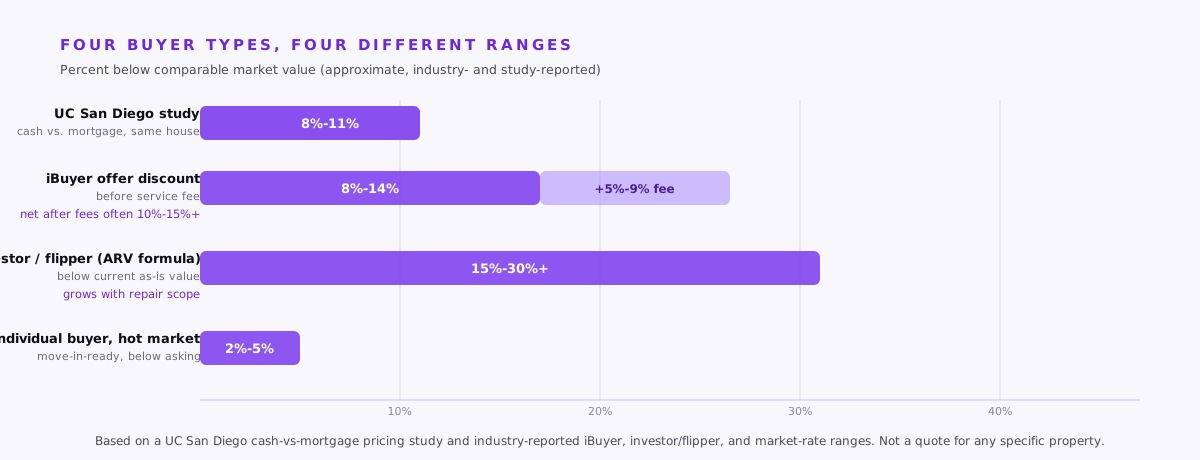
This distinction matters enough to call out on its own: an “offer discount” is the gap between a buyer's offer and the home's market value. “Net proceeds” is what actually lands in your account after every cost — commission, fees, closing costs, repairs — is subtracted. A company can advertise a modest offer discount and still leave you with a worse net number than a competitor, if it charges a transaction fee on top. That's the iBuyer math above: an 8% offer discount plus a 5% to 9% service fee is not an 8% outcome.
It's a true, verifiable structural fact — not a price promise — that Restar Acquisitions doesn't charge a service or transaction fee the way a marketplace iBuyer does. We're a direct principal buyer: we buy the house ourselves, so there's no separate fee layered on top of the number in our written offer. That doesn't mean our offer equals any specific percentage of market value — it varies by property, exactly like the categories above — only that there isn't a second deduction hiding behind the first one.
The honest mechanical reason a cash/as-is offer sits below a comparable retail sale price is that the buyer is pricing in four things a financed retail sale doesn't require the buyer to absorb:
The size of a legitimate discount should track the actual size of what's being removed — the real repair bill, the real risk, the real time saved — not a flat number pulled from an ad. That's exactly why a single universal percentage would be a misleading answer to this question.
The following is an illustrative example only — not a quote, not an offer, and not a prediction for any specific property. Figures are drawn from the published ranges above and standard transaction-cost assumptions.
Take a house with a $250,000 as-is market value that needs about $20,000 in repairs and updates — the kind of deferred maintenance a conventional or FHA lender's inspection and appraisal process would likely require before a financed buyer could close. For simplicity, assume those repairs add roughly dollar-for-dollar to resale value once finished, bringing the repaired retail value to about $270,000. That's a reasonable planning assumption for necessary repairs, not a guarantee for every house.
| (a) Repair, then list retail | (b) List as-is, credit at closing | (c) Sell as-is to a cash buyer | |
|---|---|---|---|
| Sale / contract price | $270,000 | $270,000 | $210,000 |
| Repair cost | -$20,000 | $0 (buyer handles after close) | $0 |
| Buyer credit at closing | $0 | -$25,000 | $0 |
| Agent commission (5.6%) | -$15,120 | -$15,120 | $0 |
| Seller closing costs (2%) | -$5,400 | -$5,400 | -$500 |
| Carrying costs during repair/marketing | -$2,700 (~3 months) | -$1,800 (~2 months) | $0 |
| Net to seller | ~$226,780 | ~$222,680 | ~$209,500 |
| Typical timeline | ~12–14 weeks | ~8–10 weeks | ~1–2 weeks, certain close |
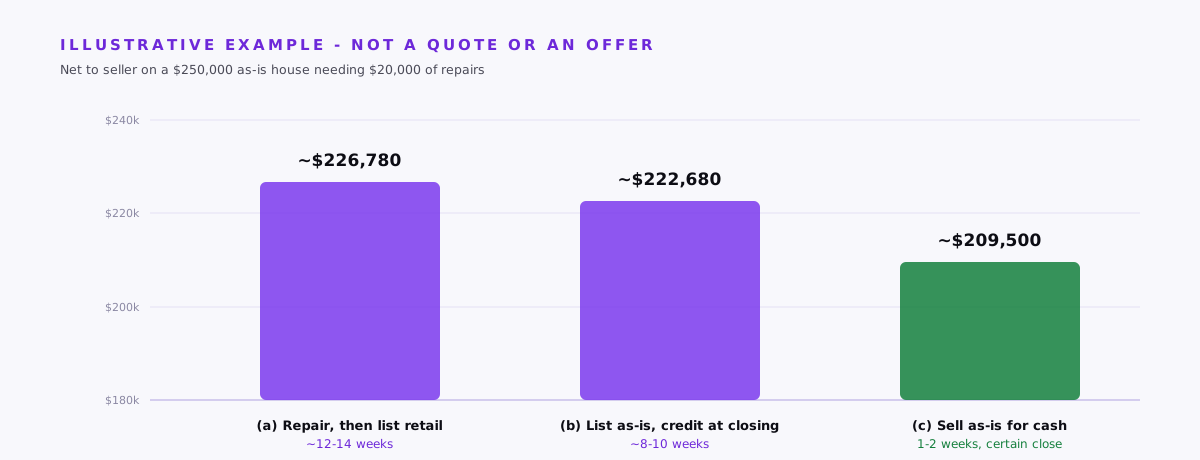
For illustration only, a cash offer pricing in the repair cost plus some risk and speed premium might land in the area of $205,000 to $215,000 on this example house — not a quote, and not every house will land in this range; condition, location, and buyer all change the number. Note what this table actually shows: the retail paths net more dollars, and the cash path nets fewer dollars in exchange for roughly three months less time and no financing-fall-through risk. Both retail paths also carry a real, unquantified risk this table can't show in a dollar figure — an appraisal gap, a loan denial, or a buyer walking after inspection can add weeks and sometimes force a price renegotiation partway through the process. That's the actual tradeoff: money versus time and certainty, not a free upgrade either way.
These figures are illustrative only, drawn from published industry and academic research as of 2026 — not a quote or an offer. Get your own comps and a real offer in writing before deciding.
For the deeper process mechanics behind these numbers, see cash offer vs. listing net proceeds, how cash home buyers calculate offers, and iBuyer vs. cash home buyer net proceeds.
Restar Acquisitions buys houses as-is for cash in the markets we serve. We give a written offer within 24 hours, no repairs or commissions required, and you pick the closing date. We're a direct buyer, not your real estate agent, and we don't represent you in the transaction — and unlike a marketplace iBuyer, we don't charge a service or transaction fee on top of our offer.
These figures are illustrative only, drawn from published industry and academic research as of 2026 — not a quote or an offer. Get your own comps and a real offer in writing before deciding.
For general consumer background on closing costs, see the CFPB’s closing disclosure explainer and its broader owning-a-home resource hub.
We'll explain how we arrived at our number — the comps and the condition factors — rather than just handing you a figure.
You'll get a written offer within 24 hours, no repairs or commissions required, and you pick the closing date. Unlike a marketplace iBuyer, we don't charge a service or transaction fee on top of our offer.
All guides · Cash offer vs. listing net proceeds · How cash home buyers calculate offers · iBuyer vs. cash home buyer net proceeds
Step 1 of 5
No obligation, no fees, no repairs. We respond the same day.
You’ll talk to Trevor McAmis, Owner & Acquisitions Lead
(313) 710-6129
Takes about two minutes. Or call (313) 710-6129 — we answer.