Every market page publishes the numbers behind its offer. See the math
Home › Guides › iBuyer vs Cash Home Buyer: How the Net Math Really Differs
Guide
iBuyer vs Cash Home Buyer: How the Net Math Really Differs
Comparing an iBuyer vs cash home buyer offer comes down to what happens after the number you're first shown. An iBuyer's initial offer is algorithmic and can be adjusted twice — once for a disclosed service fee, once for a repair estimate after the company's own inspection. A local cash buyer's offer is priced once, as-is, with no second look.
Takes about two minutes. Or call
(313) 710-6129 — we answer.
Educational only. This explains how these situations generally work. It is not legal, tax or financial advice, and the rules differ by state — talk to an attorney or CPA about your own situation before you act on any of it.
iBuyer vs cash home buyer: the short answer
Opendoor and Offerpad — the two national iBuyer programs still operating after Zillow and Redfin exited — typically charge a service fee of 5% to 8% of the sale price, then often deduct a post-inspection repair estimate before closing. A cash buyer like Restar makes one offer that reflects as-is condition, with no service fee and no second price cut after inspection.
This is educational information about how these offer types are typically structured, not financial or legal advice about what any specific offer will net you. Fee schedules and repair-deduction practices vary by company, market, and property — confirm current terms directly with any iBuyer or cash buyer before signing anything.
Zillow shut down its iBuying program, Zillow Offers, in November 2021. Redfin closed RedfinNow in November 2022. That leaves Opendoor and Offerpad as the two national companies still making instant, algorithmic cash offers at scale — a fact confirmed by researchers who tracked both companies' transaction data through 2025 (see Sources below). Both remain legitimate options for a seller whose house fits their buying box. But an algorithmic iBuyer offer and a local cash buyer's offer aren't the same product wearing different labels — they're built on different math, with different numbers hidden at different stages. The rest of this guide walks one example house through all three real paths a seller has: a fully prepped retail listing, an iBuyer offer, and a local cash buyer offer like Restar's.
How an iBuyer's offer actually gets adjusted
An iBuyer's first number comes from an automated valuation model, not a person walking the property — it's built from recent comparable sales and public records, generated within hours of entering an address. On top of that estimated value, the company discloses a service fee. Offerpad publishes a flat 5% service fee on its own site. Opendoor doesn't publish a fixed percentage; its help center states the service charge "varies by market and property" and is disclosed only in your specific offer breakdown (see Opendoor: What is Opendoor's service charge?). Independent reporting puts the documented range for iBuyer service fees at roughly 5% to 8% of the sale price — on top of, not instead of, standard closing costs (see NerdWallet: What Is an iBuyer?).
That fee isn't the last adjustment. After you accept the initial offer, the iBuyer sends its own inspector, and any repairs that inspector flags get priced — often through the company's own contractor network rather than an independent bid — and deducted from your proceeds before closing. This is a separate line item from the service fee, and you don't see the number until after you've already accepted the offer and, in most cases, taken your house off the market. If the estimate comes in close to what you'd expect, the deal closes near the number you agreed to. If it comes in high, your net can drop well below what the initial offer implied.
There's a structural reason the initial number tends to sit below what a comparable house would list for. Researchers at Stanford, Northwestern, and Columbia who studied Opendoor and Offerpad transaction data found that iBuyers purchase homes at roughly a 3.1 percentage point discount compared to similar listed homes — the spread the model needs to make a fast, no-negotiation purchase pencil out given the risk of holding and reselling the house itself (see NBER Working Paper 28252: Why is Intermediating Houses so Difficult? Evidence from iBuyers).
Why not every house qualifies for an iBuyer offer
Eligibility is narrower than "get an instant offer" marketing suggests. Opendoor's own published buying criteria exclude mobile and manufactured homes, properties with five or more units, vacant land, and homes with major structural damage, serious foundation problems, or extensive fire or water damage — conditions the company says fall outside a normal condition adjustment to the offer. Both companies also cap lot size, set minimum and maximum price bands that vary by market, and only buy in a defined list of metro areas, not nationwide.
The same research that measured the 3.1-point discount found the underlying pattern: iBuyers concentrate in market segments that are relatively liquid and easy to value — more standardized, higher-turnover suburban homes where an algorithm's pricing error is smallest — and pull back from segments where that error grows, avoiding houses with less than roughly a 50% probability of reselling within three months. That's a rational business decision for an intermediary reselling at scale; it also means a seller with an older home, a rural property, a unique layout, or real deferred maintenance may not get an iBuyer offer at all, regardless of price.
A local cash buyer doesn't run eligibility through an automated valuation model with a hard cutoff. Restar buys as-is across 30 markets in Alabama, Arizona, Florida, Georgia, Indiana, Maryland, Michigan, New York, North Carolina, Ohio, and Texas, and the offer is built from the property's actual condition rather than a comparable-sales algorithm — see how cash home buyers calculate offers for the line-by-line version of that math. That doesn't mean the number will be higher; it means condition and age aren't a gate that keeps the house out of consideration in the first place.
The arithmetic: one house, three real paths
Take one house: a 2008-built, 3-bedroom, 2-bath home in a standard suburban subdivision, comparable to homes listing around $300,000 in market-ready condition. It needs about $8,000 in cosmetic and deferred-maintenance work — paint, flooring, a few fixtures — nothing structural. Here's what each path actually nets once every real cost is counted, not just the headline number.
Net proceeds, same house, three pathsRestar Acquisitions · worked example, $300,000 comparable home
Line item
Retail listing
iBuyer offer
Local cash buyer
Starting value / offer
$299,000 sale price
$291,000 initial offer
$250,000 as-is offer
Pre-listing repairs
−$8,000
$0 upfront
$0
Agent commission (5.5%)
−$16,445
—
—
Service fee
—
−$14,550 (5%)
$0
Post-inspection repair deduction
—
−$9,500
$0
Other closing costs
−$8,970
−$2,910
−$500
Buyer concessions
−$1,500
—
$0
Holding costs
−$2,600 (~2 months)
—
−$300 (~2 weeks)
Net proceeds
$261,485
$264,040
$249,200
Approx. time to closed funds
10–14 weeks
3–5 weeks
2–3 weeks
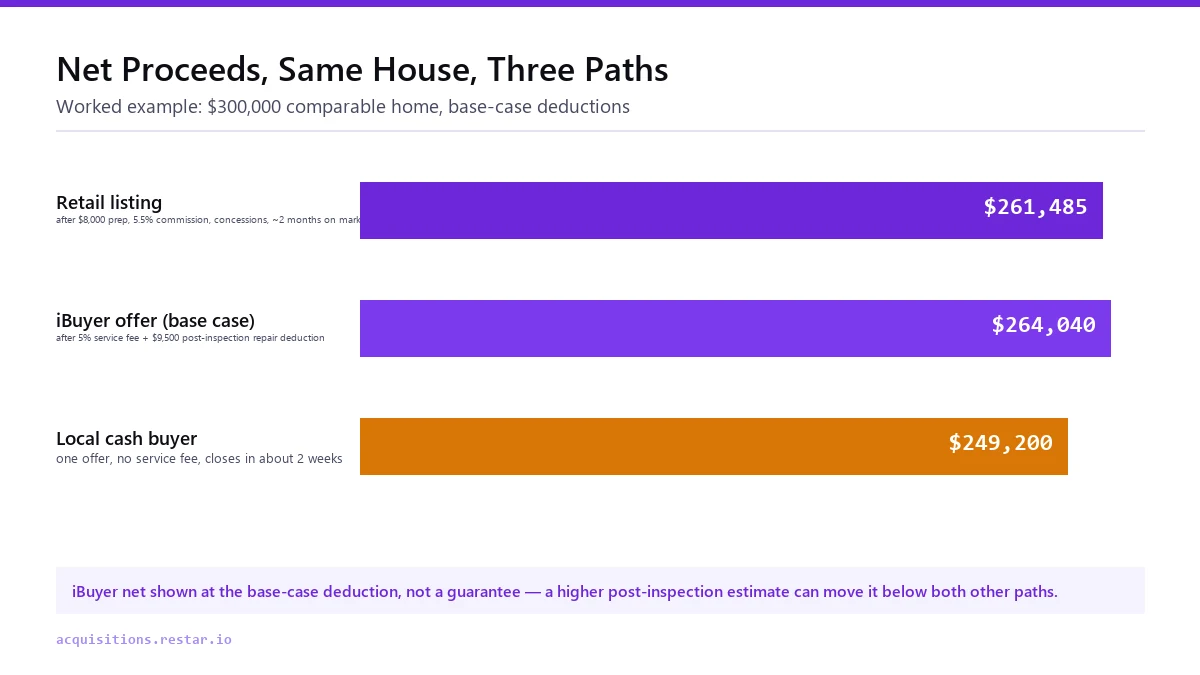
Sold retail at $299,000 after $8,000 in upfront repairs, a 5.5% agent commission, closing costs, a small post-inspection concession, and two months of holding costs, the seller nets $261,485. The iBuyer path starts lower — a $291,000 initial offer, roughly 3% under the retail comparable — then loses a 5% service fee, a $9,500 post-inspection repair deduction, and closing costs, netting $264,040 in this base case. The local cash buyer's offer already reflects the home's as-is condition at $250,000; with no service fee and no post-inspection deduction, and only minimal closing costs and about two weeks of holding time, it nets $249,200.
In this base case, the retail listing and the iBuyer land within about $2,500 of each other, and both net more than the cash offer — roughly $12,000 to $15,000 more. That's the honest number, and it's the reason a seller with the time, the repair budget, and a house that survives inspection intact should seriously weigh a prepped retail listing or a direct iBuyer quote before assuming a cash offer nets the most (see cash offer vs listing net proceeds for the same math without an iBuyer in the mix). The trade a cash buyer sells is speed and certainty on a single number, not necessarily a higher one.
What the base case doesn't show you
The iBuyer's $264,040 is the base case, not a guarantee — and the two numbers most likely to move are the two the seller doesn't control. If the post-inspection repair estimate came in at $16,000 instead of $9,500 — plausible when it's priced through the company's own contractor network rather than an independent bid — net drops to $257,540, below the retail listing. Stack a fee at the top of the documented 5%-to-8% range with that same higher repair estimate, and the iBuyer's net falls to roughly $248,810 — below even the cash offer. None of that requires anything unusual to happen; it's the same offer, priced with the two adjustable inputs at the higher end of what's documented instead of the lower end.
The retail number carries its own real risk that doesn't show up in the arithmetic either: $8,000 has to be spent before a buyer is even found, the house sits on the market for an unknown number of weeks, and if the buyer is financing the purchase, the sale is contingent on that buyer's loan closing — a risk covered in more detail in seller closing costs. A cash offer removes that financing contingency and both adjustable iBuyer line items entirely, in exchange for a lower starting number.
Which path actually fits your sale
None of these three paths is correct for every seller, and the honest answer depends on what you have more of: time and repair budget, or certainty and speed. A fully prepped retail listing can net the most, as it does in the base case above, if the house is in good enough shape to survive a buyer's inspection without a repricing fight and you can carry two to three months of holding costs. An iBuyer is worth getting a real, current quote from if your house fits its published eligibility criteria and price band — treat the first number as a starting point, not a final one, until you see the post-inspection adjustment in writing. A local cash buyer is the option built for a house that doesn't fit either box: needs real repairs, doesn't meet an iBuyer's condition or price criteria, or a seller who values one written number and a closing date they pick over the possibility of a larger, less certain one.
Restar makes one offer, sent within 24 hours of learning about your property, and doesn't charge a service fee or send a second inspector to renegotiate after you've accepted. We can't tell you in advance whether that number will beat a retail listing or an iBuyer's — the math above shows real cases where it doesn't — only that it's the number you'll actually receive.
What's the real difference between an iBuyer and a local cash home buyer?
An iBuyer — Opendoor or Offerpad are the two national companies still operating at scale — makes an algorithmic offer, then typically charges a service fee of 5% to 8% of the price and often deducts a second, post-inspection repair estimate before closing. A local cash buyer like Restar makes one offer that already reflects the property's as-is condition, with no service fee and no post-inspection repricing.
How much does an iBuyer actually charge?
Documented service fees run roughly 5% to 8% of the sale price, on top of standard closing costs. Offerpad publishes a flat 5% fee; Opendoor discloses its fee, which varies by market and property, only in your specific offer breakdown. Neither fee includes the separate repair deduction applied after the company's own inspection.
Can an iBuyer lower its offer after I've already accepted?
Yes, through the post-inspection repair deduction, which is separate from the service fee and isn't disclosed until after you've accepted the initial offer. It's often priced through the company's own contractor network rather than an independent bid, so it can come in higher than a seller expects.
Does every house qualify for an iBuyer offer?
No. Published eligibility criteria typically exclude mobile and manufactured homes, larger multi-unit properties, homes with major structural or fire/water damage, and properties outside a set list of metro markets and price bands. iBuyers concentrate on standardized, easy-to-value homes where their pricing model performs best.
Does a local cash buyer like Restar charge a service fee?
No. Restar doesn't charge a service fee, and the written offer already reflects the home's as-is condition, so there's no separate repair deduction after acceptance. That doesn't mean the offer will be higher than an iBuyer's or a retail listing's net — only that the number you accept is the number you close on.
We don't charge a service fee, and we don't send a second inspector out after you've accepted to renegotiate the price — the number in our written offer already reflects your property's as-is condition. That's a statement about how our offer is structured, not a promise that it will be higher than an iBuyer's or a retail listing's net; the worked example above shows real cases where each path can come out ahead.
We buy houses as-is across 30 markets in Alabama, Arizona, Florida, Georgia, Indiana, Maryland, Michigan, New York, North Carolina, Ohio, and Texas, regardless of price band, age, or condition.
Every offer on this site is underwritten by a person, not a form. If the
numbers do not work for you, say so and I will tell you what would.
Also from Restar
Want the data behind all of this?
Restar Acquisitions is the acquisitions arm of Restar — a housing-market analytics
platform tracking 180+ metrics across every U.S. market, with composite scores and 12-month
price forecasts. The numbers on this page come from the same work.