Every market page publishes the numbers behind its offer. See the math
Home › Guides › State Transfer Tax Costs Compared: What Sellers Actually Pay
Guide
State Transfer Tax Costs Compared: What Sellers Actually Pay
Transfer tax is one of the few closing costs that swings from nothing to real money depending purely on which state your house sits in — and it has nothing to do with financing. Whether you sell for cash or to a financed buyer, the tax is calculated the same way, off the sale price. Here's what it actually costs, state by state, with real dollar figures rather than vague percentages.
Takes about two minutes. Or call
(313) 710-6129 — we answer.
Educational only. This explains how these situations generally work. It is not legal, tax or financial advice, and the rules differ by state — talk to an attorney or CPA about your own situation before you act on any of it.
State transfer tax compared: the short answer
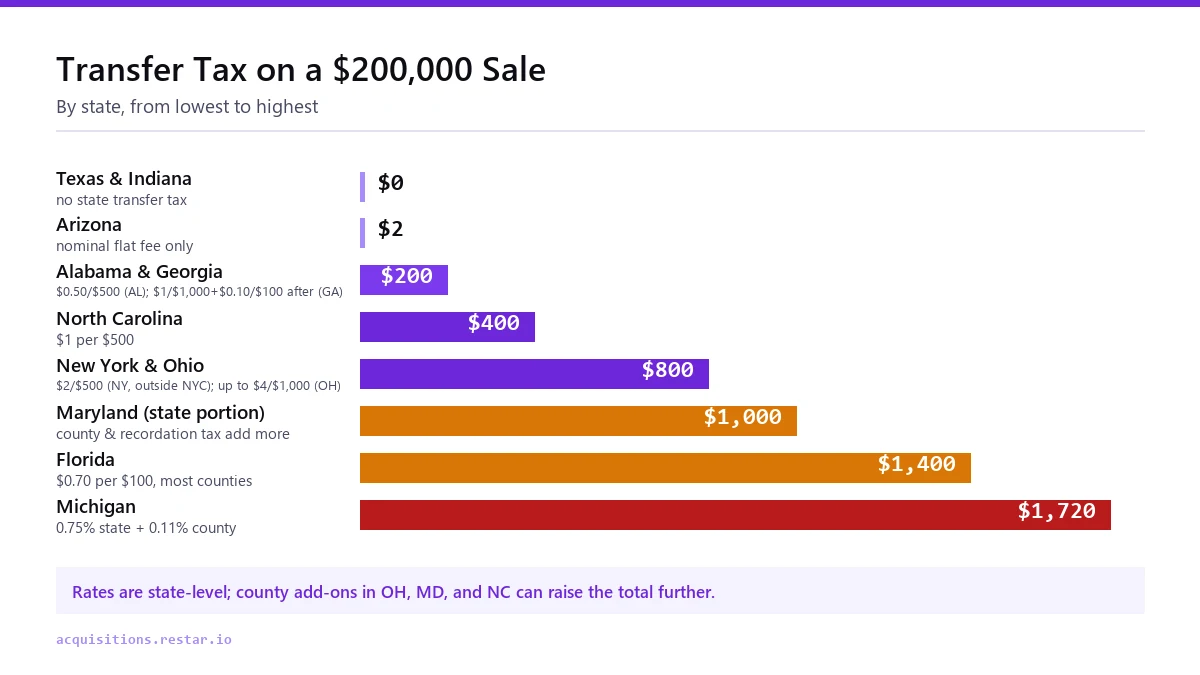
Real estate transfer tax ranges from $0 in states like Texas, Arizona, and Indiana to roughly 0.86% in Michigan, 0.7% in Florida, and over 1% total in parts of Maryland once county and recordation taxes stack on top of the state rate. On a $200,000 sale that's a swing from $0 to well over $2,000, and it applies the same way whether your buyer pays cash or finances.
This is educational information, not tax or legal advice. Transfer tax rates and who customarily pays them vary by state and county, and change by legislation — confirm the current rate for your specific county with your title company or closing attorney before you price anything.
What transfer tax actually is
Real estate transfer tax (sometimes called a deed tax, conveyance fee, documentary stamp tax, or excise tax depending on the state) is a tax your state or county charges when the deed to a property changes hands. It's calculated as a rate applied to the sale price, collected when the deed is recorded, and it's separate from your property tax bill, your mortgage payoff, and your agent's commission. Some states charge nothing at all; others layer a state rate on top of a county rate on top of a separate recordation tax.
What sellers actually pay, state by state
State
Rate
On a $200,000 sale
Texas
No state transfer tax
$0
Arizona
No state transfer tax (nominal flat fee only)
~$2
Indiana
No state transfer tax
$0
Alabama
$0.50 per $500
$200
Georgia
$1 per $1,000 + $0.10 per $100 after
~$200
North Carolina
$1 per $500
$400
New York (outside NYC)
$2 per $500 (0.4%)
$800
Ohio
Up to $4 per $1,000, most counties (0.1%–0.4%)
Up to $800
Florida
$0.70 per $100 (0.7%), most counties
$1,400
Michigan
0.75% state + 0.11% county (0.86%)
$1,720
Maryland
0.5% state, plus county transfer and recordation taxes that vary widely by county
$1,000 for the state portion alone; the full total is commonly several times higher once county transfer and recordation taxes are added — get an exact figure from a title company
Transfer tax on a $200,000 sale, by stateRestar Acquisitions · rates from state revenue departments, current as of this writing
Ohio and North Carolina rates vary somewhat by county because of permissive add-on taxes counties can levy on top of the state minimum; the figures above reflect the typical maximum most counties actually charge. Georgia's Department of Revenue, New York's Department of Taxation and Finance, North Carolina's Department of Revenue, and Florida's Department of Revenue publish the current official rates for each state.
Who actually pays it
In most of these states, transfer tax is customarily paid by the seller, but that's a local custom baked into standard purchase contracts, not a fixed legal requirement in every case — it's negotiable between buyer and seller unless your state's law specifically assigns it. Maryland is the clearest exception: transfer and recordation taxes there are often split between buyer and seller by local custom, and the split varies by county. Confirm the customary practice for your specific county with your title company or closing attorney rather than assuming.
Why a cash sale doesn't change this number
Transfer tax is calculated off the sale price and triggered by recording the deed — it has nothing to do with how the buyer is paying. A cash sale at $180,000 in Ohio owes the same transfer tax as a financed sale at $180,000 in Ohio. Where a cash sale actually changes your net proceeds is everything transfer tax isn't: no 5–6% agent commission, no repair credits negotiated after inspection, no months of carrying costs while a financed deal works through underwriting. Transfer tax is real money, but in every state on this list except Maryland, it's a smaller line item than commission alone.
Common questions
Which of our markets has the highest transfer tax?
Maryland, once you account for the state rate plus county transfer and recordation taxes, which combined typically run well above the 0.5% state rate alone and vary significantly by county. Texas, Arizona, and Indiana have no state transfer tax at all.
Is transfer tax the same as property tax?
No. Transfer tax is a one-time charge when the deed changes hands, calculated on the sale price. Property tax is an ongoing annual tax based on assessed value, prorated between buyer and seller at closing.
Does transfer tax apply to a cash sale?
Yes. Transfer tax is triggered by recording the deed and calculated on the sale price, regardless of whether the buyer pays cash or finances the purchase.
Can transfer tax rates change?
Yes, state and county governments can and do adjust rates through legislation or county resolution. Confirm the current rate for your county with your title company or closing attorney before you rely on any figure, including the ones on this page.
Is transfer tax negotiable between buyer and seller?
In most states it's assigned by local custom in the purchase contract rather than fixed by law, which means it can be negotiated as part of the deal. Maryland's split between buyer and seller varies by county custom.
Are there exemptions to transfer tax?
Some states offer reduced rates or exemptions for specific situations, such as Maryland's reduced rate for certain first-time homebuyers. These are typically buyer-side exemptions and vary by state; ask your closing attorney whether any apply to your sale.
Transfer tax doesn't change with a cash sale — but it's rarely the biggest number
A cash sale doesn't reduce or waive transfer tax; it's owed on the sale price regardless of how the buyer pays. What a cash sale changes is everything else — no commission, no repair negotiations, no financing contingency, no months of carrying costs while you wait. Send us the address and we'll show you the real side-by-side, transfer tax included.
If your local transfer tax is high and your equity is thin, run the full net-proceeds math before you list — it's a bigger factor in some counties than sellers expect.
Every offer on this site is underwritten by a person, not a form. If the
numbers do not work for you, say so and I will tell you what would.
Also from Restar
Want the data behind all of this?
Restar Acquisitions is the acquisitions arm of Restar — a housing-market analytics
platform tracking 180+ metrics across every U.S. market, with composite scores and 12-month
price forecasts. The numbers on this page come from the same work.