You can sell a rental property while a non-paying tenant is still in it. You do not need to evict first. What changes is price and timeline, not whether a sale is possible: evict the tenant and list vacant for a higher number, or sell now to a cash buyer who takes the tenant and the eviction off your hands at a lower, as-is price.
Step 1 of 5
Tell us what's going on with the tenant. We'll build it into a written offer instead of asking you to resolve it first.
You’ll talk to Trevor McAmis, Owner & Acquisitions Lead
(313) 710-6129
Takes about two minutes. Your address is never shared.
Educational only. This explains how these situations generally work. It is not legal, tax or financial advice, and the rules differ by state. Talk to an attorney or CPA about your own situation before you act on any of it.
Yes. Nothing in landlord-tenant law requires a house to be vacant before you can sell it. What requires vacancy is a buyer who wants to move in themselves, and most retail, owner-occupant buyers want exactly that, which is why most agents will tell you to get the tenant out first. A cash or investor buyer is a different audience. They routinely buy rentals with a tenant, paying or not, still living in them, because they underwrite the eviction as part of the deal instead of asking you to finish it first.
That split is the whole decision: wait and sell vacant at a higher number, or sell now, occupied, at a lower one.
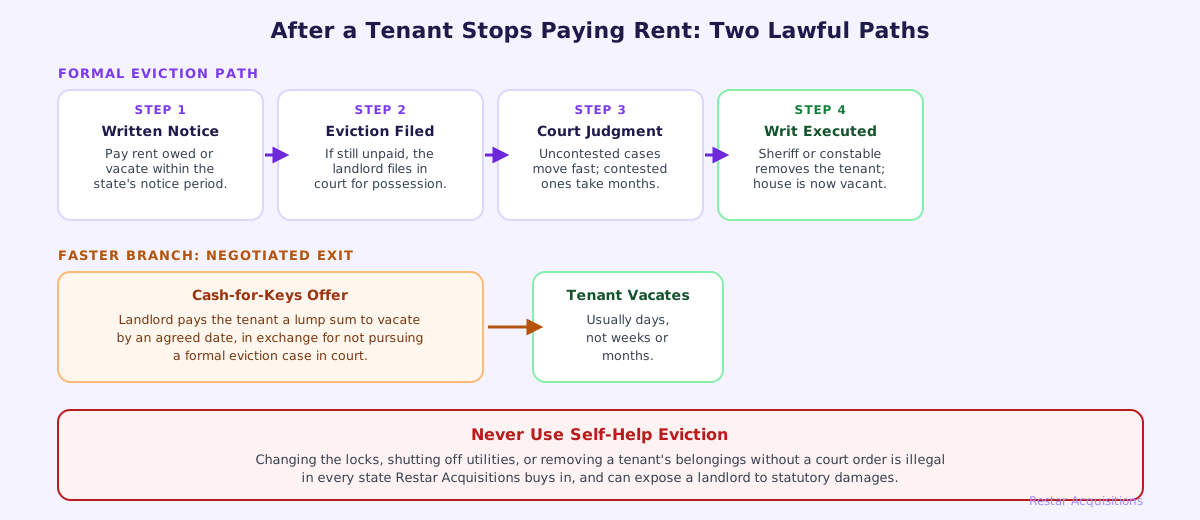
Before anything else happens, in every state we buy in, nonpayment of rent starts with a written notice giving the tenant a set number of days to pay what is owed or move out. You cannot skip straight to changing the locks, shutting off utilities, or removing the tenant's belongings. Every state we operate in treats that kind of self-help eviction as illegal, and most set statutory damages a tenant can collect from a landlord who tries it, on top of whatever the eviction case was already worth. The notice period and exact phrasing are set by your state's statute, and getting it wrong (serving the wrong number of days, the wrong form, the wrong delivery method) is one of the most common reasons a landlord loses time in court restarting the case from day one.
The specifics vary. Florida gives a tenant 3 days, not counting Saturdays, Sundays, or court-observed holidays, to pay the rent or vacate under Florida Statute 83.56(3), before the landlord can terminate the rental agreement. Texas requires at least 3 days' written notice to vacate before a landlord can file a forcible detainer suit under Texas Property Code Chapter 24, Section 24.005, unless the lease itself sets a different number. Other states we buy in (Alabama, Arizona, Georgia, Indiana, Maryland, Michigan, Missouri, Nevada, New York, North Carolina, Ohio, Pennsylvania) each set their own notice period and court process, and some run considerably longer than Florida's or Texas's, especially where court backlogs stretch a filed case out for months. Confirm your state and county's actual notice period and current court timeline before you plan around a specific date, and if your case gets contested, a local landlord-tenant attorney can keep a notice technicality from costing you a restart.
Every week a tenant stays without paying costs you in more than one way:
Lost rent. The rent you are not collecting while notice periods run, a case moves through court, and (if it comes to that) a sheriff or constable executes a writ of possession.
Filing and service costs. Court filing fees and process-server or sheriff service typically run in the low hundreds of dollars, varying by county.
Attorney fees, if contested. An uncontested case is often handled without a lawyer in states with simplified eviction dockets. A tenant who answers, counterclaims, or raises a defense can turn a two-week process into a two-month one, and attorney fees scale with that. Nationally, landlords filed about 1.26 million eviction cases in 2024, an overall rate near 8 percent of renter households, according to Princeton University's Eviction Lab tracking project, so a case that gets contested and takes months is a routine outcome, not a rare one.
Make-ready costs after move-out. Non-payment situations end with a wider range of unit condition than a normal move-out. Budget for cleaning, patching, and sometimes replacing damaged flooring or fixtures before the house is sale-ready.
Cash-for-keys, as a faster alternative to a full court case. Paying a tenant a lump sum to vacate voluntarily, commonly a few hundred to a few thousand dollars depending on the market and how many months of carrying cost it saves, can resolve the situation in days instead of the weeks or months a contested filing takes. It is a negotiated exit, not a legal substitute for proper notice if the tenant refuses and you still need the court's authority to remove them.
1. Serve notice, complete the eviction, then list vacant. This gets you access to the full retail buyer pool and the highest likely sale price, once the house is repaired and shown. It also means carrying the property, unpaid, through the entire court process, plus make-ready costs, before a traditional sale even starts its own 30-to-60-day timeline.
2. Negotiate cash-for-keys, then sell vacant. A middle path. You pay the tenant to leave on a set date instead of waiting on the court calendar, which is usually faster and cheaper than a contested case, then sell the vacant house however you choose, cash or listed.
3. Sell occupied, as-is, to a cash buyer who takes on the tenant situation. The fastest path and the one that puts the eviction, the make-ready, and the carrying cost on someone else's books instead of yours. It comes at a lower price than a vacant, retail-ready sale, because the buyer is pricing in the time, cost, and uncertainty of resolving the occupancy themselves.
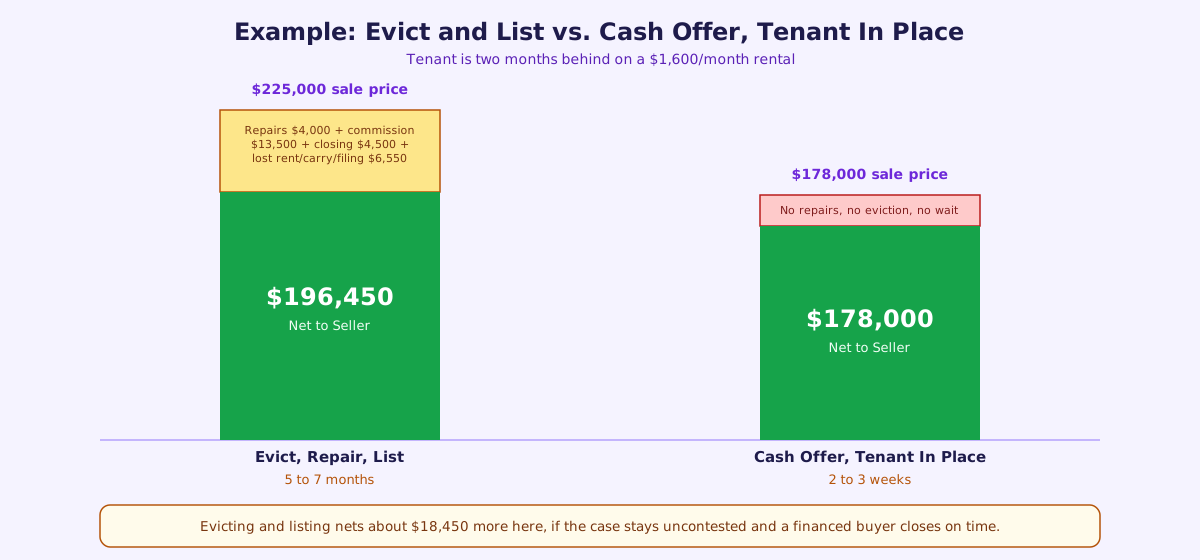
Example: a landlord owns a single-family rental renting for $1,600 a month. The tenant has stopped paying and is already two months behind. Comparable vacant, move-in-ready homes nearby sell for around $225,000. The unit needs about $4,000 in cleaning and minor repairs once the tenant is out.
| Evict, Repair, List | Cash Offer, Tenant In Place | |
|---|---|---|
| Sale price | $225,000 | $178,000 |
| Make-ready repairs | -$4,000 | $0 |
| Agent commission (6%) | -$13,500 | $0 |
| Closing costs / concessions (2%) | -$4,500 | $0 |
| Lost rent during the eviction (2 more months) | -$3,200 | $0 |
| Filing, service, and court costs | -$650 | ~$0 |
| Carrying costs while vacant and listed (3 months) | -$2,700 | ~$0 |
| Net to seller | $196,450 | $178,000 |
| Timeline | 5 to 7 months | 2 to 3 weeks |
Evicting first and listing nets about $18,450 more in this example, if the case goes uncontested, the repairs stay on budget, and a financed buyer closes on schedule. Every one of those is a real risk, not a formality: a contested filing can run the timeline past 7 months, a tenant who damages the unit on the way out can push repairs well past $4,000, and a financed retail buyer's deal can still fall through after months of waiting. If you cannot carry an empty property that long, or the eviction case in your county is backed up, the smaller, certain number can be worth more than the larger, uncertain one.
A short repayment plan, if the non-payment is a temporary hardship like a job loss and the tenant has a track record of paying on time otherwise. Getting current, even on a plan, can be cheaper than an eviction case and a sale.
Your own mortgage relief, if the missed rent has put you behind on the mortgage yourself. Talk to your loan servicer about forbearance options before a late rent payment turns into a late mortgage payment.
Handing the property to a property manager, if the real problem is that you do not have the time or systems to manage collections and notices, not that you want out of being a landlord entirely.
Rental assistance resources, both for you and for a tenant facing genuine hardship, through the Consumer Financial Protection Bureau's help-for-renters page, which can sometimes connect a tenant to emergency rental assistance that gets you paid without a court filing at all.
If none of those fit, see our guide on selling a house with an eviction already in progress for what changes once a case is filed, our broader guide on selling a rental property with tenants for what transfers at closing, and our guide on the cost of evicting a tenant before you sell for a closer look at eviction costs alone.
We buy rental properties with a tenant still in place, paying or not. Tell us what's going on and we'll give you a written offer within twenty-four hours, factoring in the occupancy instead of asking you to resolve it first. No repairs required, no commissions, and you pick the closing date. If the math says an eviction and a retail listing nets you more, this guide shows you that math too.
Send us the property here and we'll look at the tenant situation and the numbers before you decide anything.
All guides · Selling a house with an eviction already in progress · Selling a rental property with tenants · The cost of evicting a tenant before you sell
Step 1 of 5
No obligation, no fees, no repairs. We respond the same day.
You’ll talk to Trevor McAmis, Owner & Acquisitions Lead
(313) 710-6129
Takes about two minutes. Your address is never shared.