<b>You can legally sell a house with an eviction in progress, but the sale doesn't end the case — if it closes before judgment, you lose authority to evict and the buyer typically inherits the tenant.</b> If you're a landlord who has already filed against a tenant and now need or want to sell, the real question isn't whether you're allowed to. It's what selling actually does to the case, the timeline, and the price. Here's how each path — finishing the eviction, cash-for-keys, or selling to a cash buyer who takes on the pending case — actually works, and the honest math on what each one costs.
Step 1 of 5
Tell us about the property and the tenant situation and we'll send a written cash offer within 24 hours, priced for the case as it stands today. No lender approval needed, no commissions.
You’ll talk to Trevor McAmis, Owner & Acquisitions Lead
(313) 710-6129
Takes about two minutes. Or call (313) 710-6129 — we answer.
Educational only. This explains how these situations generally work. It is not legal, tax or financial advice, and the rules differ by state — talk to an attorney or CPA about your own situation before you act on any of it.
Yes — a landlord can sell a property while an eviction case is pending in court. What the sale does not do is end or transfer that case automatically. The eviction lawsuit is tied to whoever has legal authority to evict at the moment a judgment is entered, and that authority comes from ownership.
That timing matters more than almost anything else in this situation. If the sale closes before a judgment of eviction is obtained, the seller — the old landlord — loses the legal standing to evict, because they're no longer the owner. The buyer typically steps into the seller's position as the new landlord, and in most states must honor the existing lease. A change of ownership is not, by itself, legal grounds to end a tenancy. In plain terms: under most state and local law, “I want to sell this house” is not a legal reason to evict a tenant who isn't otherwise breaching the lease.
That's why timing the closing relative to the judgment matters so much. If you want the sale to resolve the tenant situation, closing before judgment generally hands the unresolved case — and the tenant — to whoever buys the house. If you want to hand over a vacant property, you generally need the eviction to run its course (or the tenant to leave voluntarily) before you close.
Sellers should disclose any pending eviction or related legal action to a prospective buyer, and buyers should review pending litigation on a property before they commit to buying it — this is true whether you're selling to a retail buyer, an investor, or a cash buyer. If the property has multiple units or other tenants who aren't part of the eviction, the considerations in selling a rental property with tenants apply alongside everything here.
This is general education, not legal advice. Eviction procedure, notice requirements, and what counts as valid grounds for termination vary by state and even by county court — talk to a landlord-tenant attorney about your specific situation and your state's eviction law before you make a decision based on timing.
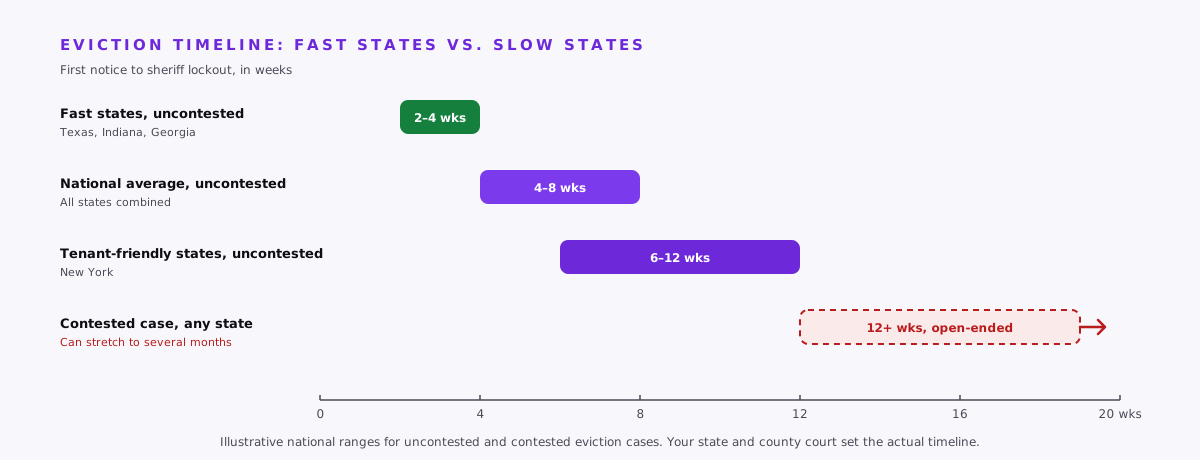
Timing drives almost every decision in this guide, so it's worth being specific about it. Nationally, an uncontested eviction — one where the tenant doesn't fight the case — typically runs about 4 to 8 weeks from the first notice to a sheriff-enforced lockout.
That range moves a lot by state. Landlord-friendly states with streamlined eviction courts — Texas, Indiana, and Georgia, all states where we buy — can run as fast as 2 to 4 weeks uncontested. Tenant-friendly states, including New York (also a state where we buy), commonly run 6 to 12 weeks uncontested, and can stretch to several months once a tenant contests the case, requests a hearing, or raises a defense.
The clock usually starts with a pay-or-quit (or similarly named) notice for nonpayment, and the required notice period before you can even file varies widely — from essentially 0 days in states like West Virginia to as long as 30 days in states like New Jersey, with most states landing somewhere between 3 and 14 days. If you're mid-case already, you've likely cleared that first step; what's left is the court timeline for your specific state and whether your tenant is contesting.
Once a case is filed and you decide you also need to sell, there are three paths worth understanding — not three equally good options, just three real ones with different tradeoffs.
Finish the eviction, then list vacant with an agent. This is the cleanest path for a typical retail or financed buyer, because it hands over a vacant, dispute-free property. It's also the slowest and most expensive: you're carrying the property (and usually not collecting rent) through however many more weeks the case takes in your state, plus whatever attorney and court costs remain, before you even start a normal multi-week listing-to-close process.
Sell to a cash buyer who will assume the pending case. This is specifically something cash buyers can do that financed retail buyers typically can't. A property with an active eviction and disputed possession is a financing red flag — many mortgage programs won't close on a non-owner-occupied unit with contested occupancy, and most retail buyers' lenders simply won't underwrite it. A cash buyer who doesn't need lender approval can price and underwrite that occupied, mid-litigation risk directly, which is the main reason this path exists at all. Restar Acquisitions is a direct buyer — not your real estate agent, and we don't represent you or the tenant in the transaction — so we can evaluate a property in this condition and give you a written offer within 24 hours, with no repairs or commissions required and you pick the closing date.
Negotiate cash-for-keys, then sell vacant. Cash-for-keys is a real, common, and legal practice: you pay the tenant a lump sum — commonly reported in the $500 to $3,000-plus range depending on your market and how many months of litigation it saves — in exchange for a signed, dated move-out agreement and the keys back by an agreed date. It's generally faster than finishing a contested case in court, and once the unit is vacant you can sell it to either a retail buyer or a cash buyer.
In a genuine hardship case — where the tenant's nonpayment stems from a temporary job loss, a medical event, or a similar setback rather than an unwillingness to pay — it's also worth checking whether local tenant-assistance or rental-assistance funds could cover the back rent and resolve the nonpayment entirely, avoiding the eviction altogether. CFPB's renter help resources and the USA.gov housing help page both point toward this kind of assistance. We mention this neutrally — Restar Acquisitions is not a tenant-assistance program, and this path is about resolving the tenant's situation, not selling the house.
Finishing a case, especially a contested one, isn't free, and the costs compound the longer it runs. Filing fees commonly run $50 to $400 depending on the county. Add process server or sheriff fees for serving notice and eventually enforcing the lockout. If the case is contested, attorney fees commonly run $500 to $3,000 or more. On top of all of that, there's lost rent for the entire remaining eviction window — the tenant who's being evicted for nonpayment generally isn't paying during that stretch — plus whatever property damage turns up once you regain possession.
Under the National Conference of State Legislatures' overview of state eviction processes, the common statutory grounds (nonpayment, lease breach, holdover) and the court procedure around them vary by state, which is part of why cost and timeline ranges are wide rather than fixed. Landlords dealing with a tenant who stopped paying for reasons other than a dispute — job loss, illness, or a lease violation — sometimes find the timeline and cost math similar whether the case is over nonpayment or a holdover situation; the legal mechanics above apply either way.
Worked example, illustrative only: a rental house worth $180,000 vacant and retail-ready, renting for an illustrative $1,400 a month, where the tenant stopped paying and a contested nonpayment case still needs about 10 more weeks to reach judgment and lockout — toward the slower end of the national range because the case is contested.
| Finish eviction, list vacant | Cash-for-keys, then list vacant | Sell to a cash buyer now, case pending | |
|---|---|---|---|
| Time to possession/close | ~10 wks to finish case + ~12 wks to turn, list, and close vacant = ~22 weeks | ~3 wks to negotiate move-out + ~12 wks to turn, list, and close vacant = ~15 weeks | ~1–3 weeks, property sold occupied/mid-case |
| Rent/legal cost | −$2,000 remaining attorney fees, −$3,200 lost rent during the 10-week wait | −$1,500 cash-for-keys payment, −$300 legal/admin to finalize the move-out agreement | $0 (buyer assumes the case and the tenant relationship) |
| Commission/closing cost | −$10,080 agent commission (5.6%), −$2,700 closing costs, −$1,800 carrying costs while vacant/marketing | −$10,080 agent commission (5.6%), −$2,700 closing costs, −$1,800 carrying costs while vacant/marketing | $0 commission; minimal title/escrow-only closing costs |
| Sale price | $180,000 | $180,000 | Below the $180,000 retail value — reflects occupied/litigation risk and speed; exact gap depends on your market and the buyer's risk pricing |
| Certainty | Depends on the tenant not contesting further and a retail buyer closing normally | Depends on the tenant actually signing and vacating on schedule | High — buyer accepts the property and the pending case as-is |
| Net to seller | ~$160,200, ~22 weeks | ~$163,600, ~15 weeks | Below both nets above, delivered faster and with more certainty — the size of the gap is market- and risk-specific, not a fixed number |
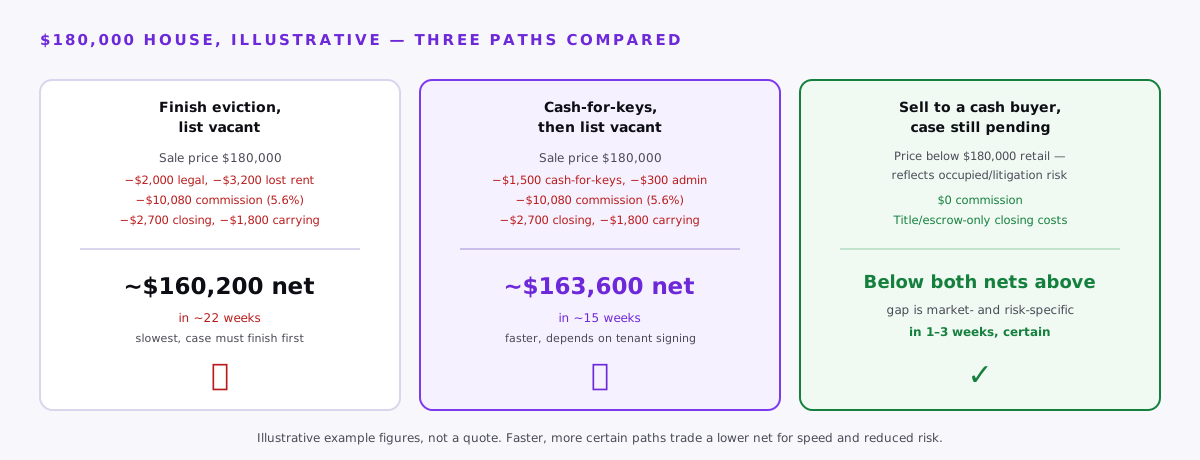
Two things are worth being honest about. First, cash-for-keys usually beats finishing a contested case on paper, because it trades a relatively small negotiated payment for weeks of lost rent and legal fees — but it only works if the tenant actually signs and moves. Second, selling to a cash buyer with the case still pending will typically net less than either retail path above, because the buyer is pricing in occupied and litigation risk along with speed and certainty — we won't put a universal percentage on that gap, because it depends on your market, your case, and the buyer's own risk pricing.
Alternatives worth checking before you decide:
Restar Acquisitions buys houses as-is for cash in Alabama, Arizona, Florida, Georgia, Indiana, Maryland, Michigan, Missouri, New York, North Carolina, Ohio, and Texas. We give a written offer within 24 hours, no repairs or commissions required, and you pick the closing date. We're a direct buyer, not your real estate agent, and we don't represent you or the tenant in the transaction. If you'd rather see the arithmetic laid out side by side before deciding anything, cash offer vs. listing net proceeds walks through that comparison in more depth, and the tired landlord situation guide covers the broader decision of whether to keep managing a rental at all.
This article is for general education only and isn't a quote or a substitute for a licensed attorney's advice. Eviction timelines, notice periods, and what a landlord can and can't do while a sale is pending vary significantly by state — confirm your own state's current eviction procedure with a landlord-tenant attorney before you make a decision based on anything in this guide.
We can evaluate a property with an active eviction and disputed possession directly, without needing lender approval the way a financed retail buyer would.
You'll get a written offer within 24 hours, no repairs or commissions required, and you pick the closing date. We're a direct buyer, not your real estate agent, and we don't represent you or the tenant in the transaction.
All guides · Tired landlord situation guide · Selling a rental property with tenants · Cash offer vs. listing net proceeds
Step 1 of 5
No obligation, no fees, no repairs. We respond the same day.
You’ll talk to Trevor McAmis, Owner & Acquisitions Lead
(313) 710-6129
Takes about two minutes. Or call (313) 710-6129 — we answer.