Every market page publishes the numbers behind its offer. See the math
Home › Guides › The Cost of Evicting a Tenant Before You Sell
Guide
The Cost of Evicting a Tenant Before You Sell
A non-paying tenant doesn't just cost you the rent you're not collecting. It costs you the weeks or months it takes to legally remove them, the turnover to get the unit rentable again, and the vacancy before someone new moves in — all before you've fixed anything or listed the house. Here's the real math, state by state, next to what selling with the tenant still in place actually looks like.
Tell us about the tenant situation — how far behind, what state, how long it's been going on. We'll tell you honestly whether selling as-is nets you more than pushing through an eviction first.
Takes about two minutes. Or call
(313) 710-6129 — we answer.
Educational only. This explains how these situations generally work. It is not legal, tax or financial advice, and the rules differ by state — talk to an attorney or CPA about your own situation before you act on any of it.
The cost of evicting a tenant before you sell: the short answer
Between lost rent, filing and service fees, attorney costs, turnover, and vacancy before re-renting, a routine eviction commonly runs $5,000–$11,000 in a fast-court state, and more where courts move slowly — on top of back rent already owed that's often uncollectible. Selling with the tenant in place skips all of it, at a discount reflected in the offer.
This is educational information, not legal advice. Eviction procedure, notice periods, and timelines vary significantly by state and by court — confirm the current process for your property with a landlord-tenant attorney or your local court's self-help resources.
How long eviction actually takes, and why the state matters more than you'd think
The process is the same shape everywhere — notice, filing, service, hearing, judgment, then a writ or warrant to physically remove the tenant — but how long each step takes swings enormously by state.
Georgia requires only a 3-business-day notice for nonpayment before filing, and an uncontested case can move from filing to a writ of possession in roughly 3–5 weeks; contested cases run 5–8 weeks.
Texas and Florida both use a 3-day notice, with hearings set 10–21 days after filing and writs typically executed within days of judgment — a realistic total of 3–6 weeks.
Ohio requires a 3-day notice under Ohio Revised Code §1923.04, with filing to hearing running roughly two weeks and judgment to removal about five more days — a total of about 4–6 weeks.
New York is the outlier in our markets. State law (RPAPL §711) requires a 14-day written rent demand before you can even file, and the officer executing the final warrant must give the tenant another 14 days' notice before physically removing them — both confirmed by statute. What isn't set by statute is the court scheduling backlog in between, which commonly stretches the realistic total to 2–4-plus months, even for a straightforward nonpayment case outside New York City.
The gap between a 4-week state and a 4-month state isn't a rounding error — it's the difference between one extra month of lost rent and four.
What it actually costs, line by line
Court filing fee: commonly $50–$500 depending on the county and court — Georgia's dispossessory filings, for example, run roughly $79–$104 across different counties.
Service and lockout fees: sheriff or process-server fees for serving the summons and executing the final lockout commonly total $150–$500, based on actual county sheriff fee schedules, though the exact figure varies by jurisdiction.
Attorney fees, if you use one: a routine, uncontested eviction commonly runs a flat $500–$800; a contested case can run $1,000–$5,000+, or $150–$400/hour. Not legally required in most eviction cases, but often worth it if the tenant contests.
Lost rent during the process: the largest cost, and it's simple arithmetic — your monthly rent times however many months the timeline above actually takes, since a nonpaying tenant isn't contributing anything while the case moves through court.
Turnover and make-ready: industry estimates (not a government dataset) put typical turnover costs at roughly $1,000–$5,000 per unit, with one cited industry study averaging around $3,872 — cleaning, minor repairs, and sometimes a full repaint if the unit was left in poor condition.
Vacancy before you re-rent or list: private market-data firms (not a government source) put average time-to-lease at roughly 30–45 days nationally. The Census Bureau's Housing Vacancy Survey puts the national rental vacancy rate at 7.3% as of Q2 2026 — a related but different measure that confirms vacancy is a real, ongoing cost across the rental market, not just this one unit.
One more thing worth naming plainly: a court judgment for the back rent already owed is often difficult or impossible to actually collect if the tenant has no assets or income to garnish. There's no reliable published data on typical collection rates, but landlord-side legal commentary consistently describes an eviction judgment as "a piece of paper" more often than a real recovery — treat any back rent already owed as money you're unlikely to see again, eviction or not.
Two worked examples
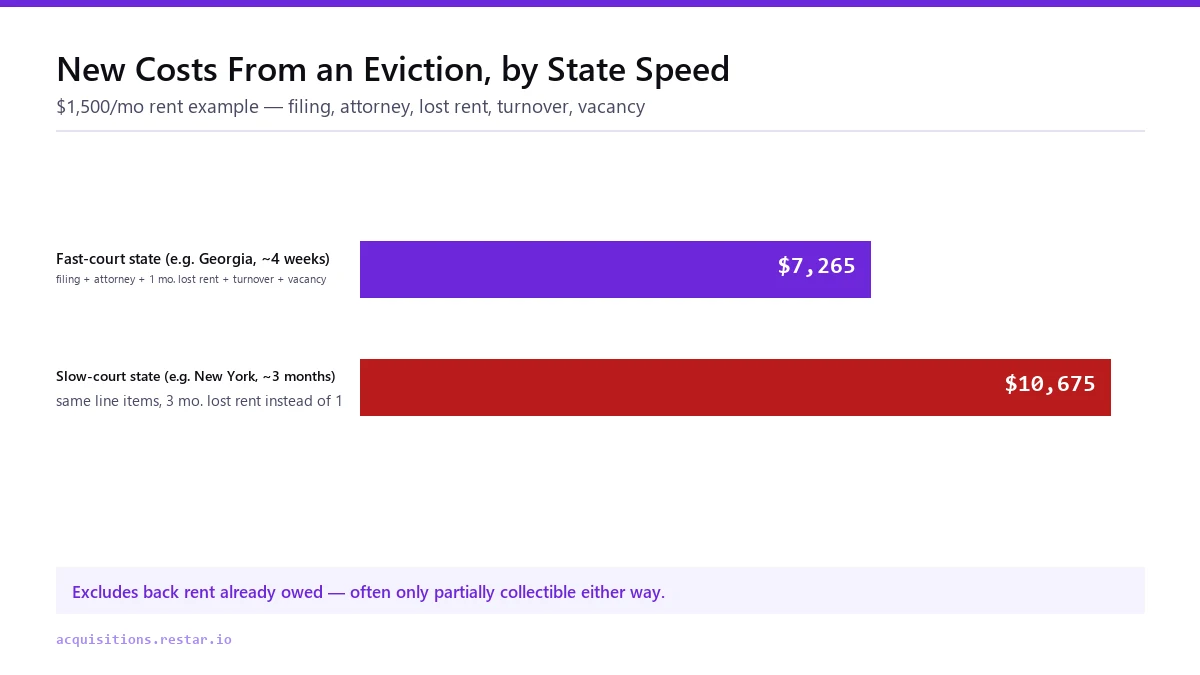
Take a common scenario: $1,500/month rent, tenant already two months behind ($3,000 owed). Here's what pushing an eviction through looks like in a fast state versus a slow one, on top of that $3,000 that's likely gone either way:
Georgia (fast, ~4 weeks)
New York (slow, ~3 months)
Filing + service fees
~$240
~$300 (varies by court)
Attorney (uncontested flat fee)
~$650
~$1,000
Lost rent during the process
~$1,500 (1 month)
~$4,500 (3 months)
Turnover / make-ready
~$3,000 (industry estimate)
~$3,000 (industry estimate)
Vacancy before re-rent
~$1,875 (industry estimate)
~$1,875 (industry estimate)
New costs from the eviction itself
~$7,265
~$10,675
Plus the $3,000 already owed (likely uncollectible)
~$3,000
That's roughly $10,000–$14,000 in total exposure before you've fixed a single thing or listed the house — and it assumes an uncontested case with no surprises. A contested eviction, an unusually backed-up court, or a unit that needs more than light turnover work pushes these numbers higher.
New costs from an eviction, by state speedRestar Acquisitions · worked example, not a quote.
The alternative: sell with the tenant in place, or pay them to leave
In nearly every state, a lease survives a sale — the new owner takes the property subject to the existing lease, not free of it. That's the legal mechanic that makes tenant-occupied sales possible at all. Two routes worth knowing:
Sell to a cash or investor buyer with the tenant still there. Retail buyers and owner-occupants generally need vacant possession, so they're not a realistic option here — but investor and cash buyers routinely take tenant-occupied property and handle the occupancy situation themselves. The offer reflects that risk, but it eliminates every line item in the table above: no filing fees, no lost rent during a legal process you're funding, no turnover, no vacancy gap.
Cash-for-keys. Paying the tenant a lump sum to leave voluntarily — commonly cited in the $500–$5,000 range, often framed as one to two months' rent — can resolve occupancy in days rather than weeks or months, though it doesn't recover any back rent already owed and only works if the tenant agrees. It's frequently faster and cheaper than a full court process even when it feels like paying someone to leave your own property.
The honest tradeoff
If the tenant has real assets or income you could actually collect against, and you're not in a hurry, pushing an eviction through and re-renting or listing vacant can net more over time — you keep the option to lease at market rent or sell to a retail buyer who needs vacant possession. If the back rent is realistically uncollectible, the court timeline in your state runs long, or you just want this resolved without funding months of legal process out of pocket, selling with the tenant in place or negotiating cash-for-keys trades some of that upside for speed and a fixed, known cost instead of an open-ended one.
Common questions
How long does eviction take before I can sell the house vacant?
It depends heavily on your state — roughly 3–6 weeks in faster-court states like Georgia, Texas, Florida, and Ohio, but commonly 2–4-plus months in New York, where statutory notice periods are longer and court scheduling adds significant time on top.
Can I just sell the house with the tenant still living there?
Yes — in nearly every state, a lease survives a sale, so a new owner takes the property subject to the existing lease. Cash and investor buyers routinely purchase tenant-occupied property; retail buyers and owner-occupants generally can't, since they typically need vacant possession.
Will I ever collect the back rent that's already owed?
Often only partially, if at all. There's no reliable published data on collection rates for landlord judgments against former tenants, but it's commonly difficult to collect if the tenant has no meaningful assets or income to pursue — budget for the possibility that a court judgment doesn't translate into actual money.
Is cash-for-keys actually cheaper than eviction?
Often, yes, once you count lost rent, filing and attorney fees, turnover, and vacancy. A typical cash-for-keys payment in the $500–$5,000 range can resolve occupancy in days instead of weeks or months — though it requires the tenant's voluntary agreement and doesn't recover any back rent.
Does selling to a cash buyer mean I don't have to deal with the tenant at all?
Largely, yes — the buyer takes on the occupancy situation as part of the purchase, which is part of why the offer is priced the way it is. You won't need to file anything or manage the process yourself.
What's the single biggest cost in a typical eviction?
Lost rent during the legal process, almost always — it's simple arithmetic (your monthly rent times however many months the process takes), and it's the line item that varies most by state because it's directly tied to how long your local court takes to move a case through.
We buy rental property with the tenant still in it
You don't have to evict anyone before you sell to us. We buy tenant-occupied houses as-is, take on the occupancy situation ourselves, and close on a timeline that doesn't depend on a court date. Send us the address and we'll tell you honestly how that compares to pushing an eviction through first.
If eviction genuinely nets you more in your state and situation, we'll say that too.
Every offer on this site is underwritten by a person, not a form. If the
numbers do not work for you, say so and I will tell you what would.
Also from Restar
Want the data behind all of this?
Restar Acquisitions is the acquisitions arm of Restar — a housing-market analytics
platform tracking 180+ metrics across every U.S. market, with composite scores and 12-month
price forecasts. The numbers on this page come from the same work.