Yes — you can sell a house with water damage. Water damage and freezing are the second-most common cause of homeowners insurance claims, so it's a familiar problem to buyers, inspectors, and lenders alike. A financed sale usually requires the damage be repaired or priced into the deal; a cash sale can move forward with the damage as-is, typically at a lower price than a fully repaired retail sale. A burst pipe, a roof leak that finally found its way through the ceiling, a washing machine hose that let go while you were at work — water damage rarely announces itself politely, and it almost always shows up as a stain, a soft spot in the floor, or a musty smell before you get a real look at what's underneath. By the time you're thinking about selling, you're usually deciding between three things: fix it properly, disclose it and sell as-is, or find a buyer who doesn't need it fixed first. This guide covers what typically causes water damage, real repair cost ranges, what your insurance is and isn't likely to cover, what you have to disclose, and how the issue plays out in a financed sale versus a cash one.

Step 1 of 5
Send the address and we'll tell you honestly whether repairing it first and listing retail would net you more.
You’ll talk to Trevor McAmis, Owner & Acquisitions Lead
(313) 710-6129
Takes about two minutes. Or call (313) 710-6129 — we answer.
Educational only. This explains how these situations generally work. It is not legal, tax or financial advice, and the rules differ by state — talk to an attorney or CPA about your own situation before you act on any of it.
Water damage claims are common enough that insurers track them separately from almost every other type of loss. The Insurance Information Institute lists the usual suspects: leaky roofs, hidden or slow plumbing leaks, clogged gutters, frozen and burst pipes, faulty HVAC systems, overflowing tubs or toilets, and sump pump failures (Insurance Information Institute: Facts + Statistics, Homeowners and Renters Insurance). Frozen and burst pipes alone generate an estimated $1.4 billion a year in insurer claims, making it the third-costliest homeowner peril behind hurricanes and tornadoes.
Water damage and freezing combined accounted for roughly 22.6% of all homeowners insurance claims in 2023, the most recent year in III's tracked data — the second-largest cause of claims after wind and hail — with an average claim severity of about $15,400 across 2019–2023 (Insurance Information Institute: Facts + Statistics, Homeowners and Renters Insurance). Roughly 1 in 60 insured homes files a water or freezing claim in a given year. None of that is meant to be alarming — it's meant to make the point that water damage is a routine, well-understood problem for the people who evaluate homes for a living, not a red flag that scares off every buyer.
Restoration and repair costs scale directly with how much water got in and how long it sat there before drying out. HomeAdvisor and Angi (shared ownership, same underlying cost data) put the average total water damage restoration project at around $3,868, with a typical range of $1,383–$6,369 and a full spread of $450–$16,000 depending on severity (HomeAdvisor: Water Damage Restoration Cost).
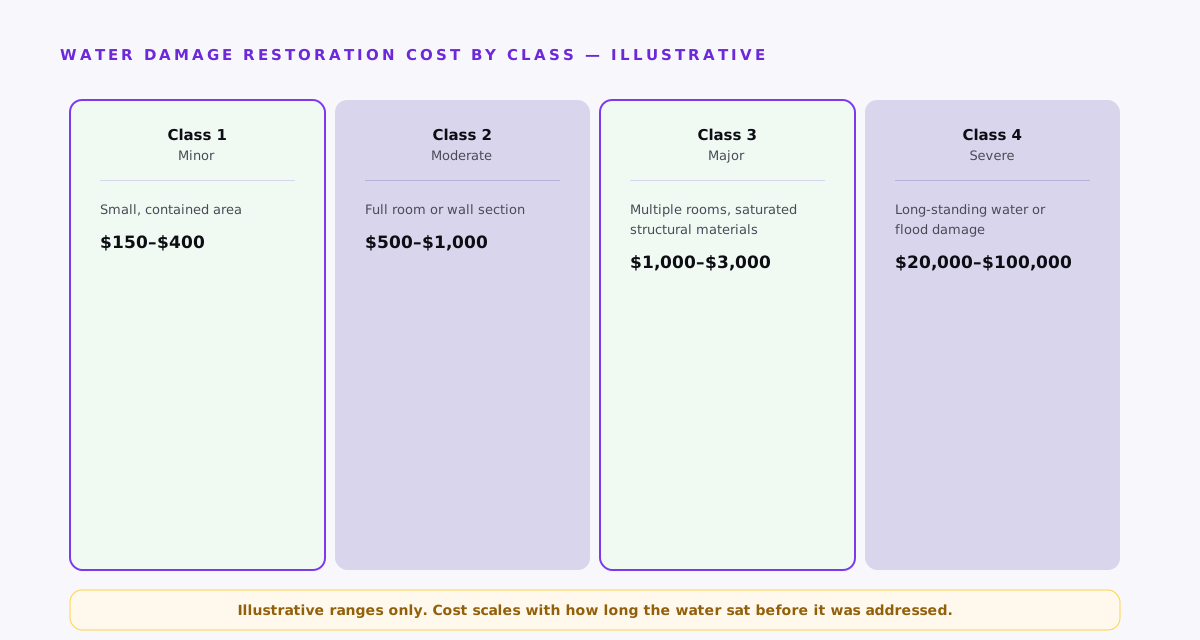
Class 1 (minor, small contained area): roughly $150–$400
Class 2 (moderate, a full room or wall section): roughly $500–$1,000
Class 3 (major, multiple rooms, structural materials saturated): roughly $1,000–$3,000
Class 4 (severe, long-standing water or flood damage): roughly $20,000–$100,000
Related line items add up fast: drywall replacement typically runs $300–$850, flooring $200–$550, and mold removal — a common downstream consequence of water damage left too long — another $1,100–$3,400. These are national averages from contractor and homeowner-reported data, not a quote for your specific property or region.
This is where a lot of sellers get an unpleasant surprise, and it's worth understanding before you assume a claim will cover the fix. Sudden, accidental water damage — a pipe that bursts, an appliance that suddenly fails — is generally the kind of loss a standard homeowners policy is built to cover. Damage from a slow, ongoing leak you could reasonably have caught and fixed, on the other hand, is generally treated as preventable maintenance, not an insurable loss, and is typically excluded.
Flood damage is its own category entirely and is categorically excluded from standard homeowners and renters policies. The Insurance Information Institute is direct about it: "Floods are not covered under homeowners and renters policies. Only a specific flood insurance policy will cover home flood related losses" (Insurance Information Institute: Facts About Flood Insurance). Flood coverage requires a separate policy, most commonly through FEMA's National Flood Insurance Program. If your house sits in or near a FEMA-designated Special Flood Hazard Area, a federally backed mortgage on it will typically require the buyer to carry flood insurance as a condition of the loan — a fact worth knowing before you list, since it can affect how buyers evaluate the property regardless of whether you've ever personally filed a flood claim.
Known water damage — a past leak, a repaired area, a history of basement flooding — generally falls under the same disclosure principle as any other known material defect: most states require you to disclose it, and hiding it can expose you to liability after closing even in seller-friendly states. Flood zone status carries its own disclosure expectation on top of that.
FEMA's own guidance on flood risk is specific on that point: "When selling a building, the owner should disclose whether the property is located in or is soon-to-be in an area designated as a Special Flood Hazard Area" (FEMA: Real Estate, Lending and Insurance Professionals). FEMA has also published a model framework noting that specific flood-risk disclosure requirements are set state by state, not by a single federal mandate for every sale (FEMA: Flood Risk Disclosure, Model State Requirements, July 2022). Confirm the exact disclosure requirement for your state with a real estate attorney or your listing agent — this is genuinely one of the more state-specific corners of a sale, and getting it wrong can follow you after closing.
A home inspector's moisture meter routinely finds water intrusion in drywall, subfloor, or framing well before it's visible to the eye, including damage from a past event you thought was long since dried out. Once it shows up in an inspection report, a lender typically wants it addressed before closing, and it can complicate approval on FHA and VA loans specifically.
An unresolved, undocumented issue can also depress an appraiser's valuation of the house, on top of whatever the lender requires directly — appraisers are trained to note visible damage and moisture staining even when a formal inspection hasn't flagged it yet. A cash sale sidesteps that entire inspection-and-lender chain, since there's no financing contingency requiring the issue be resolved first.
Repairing water damage before listing generally nets more once title is clean, but it costs money and time up front that an as-is cash sale doesn't require. The table below illustrates that tradeoff on a hypothetical $220,000 house with a documented $8,000 repair — general figures, not a quote for your property.
| Repair, Then List Retail | Sell As-Is for Cash | |
|---|---|---|
| Repair cost before sale | ~$8,000, paid up front | $0 — buyer takes on the repair |
| Typical commission | ~6% of sale price | None |
| Time before you have cash in hand | Weeks of restoration, then a typical retail listing timeline | Days to a few weeks |
| Mold risk if left unaddressed | Repair removes the risk before sale | Buyer inherits the risk and the decision |
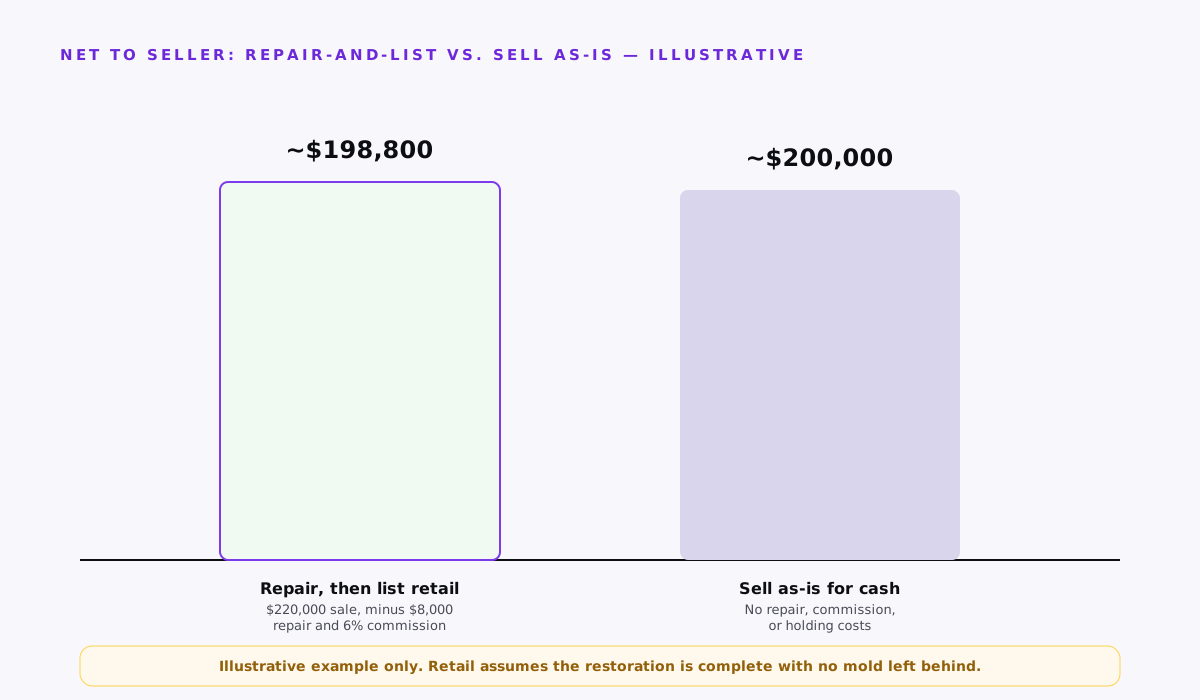
A fully repaired, retail-listed house generally nets more than an as-is cash sale once you factor in the repair cost and commission — but only if you have the cash and time to get a restoration done properly, including verifying no mold took hold in the meantime. A cash sale skips the restoration timeline and the commission entirely, but it typically prices in the unresolved damage and nets less than a repaired retail sale would. See our cash offer vs. listing net proceeds guide for how that comparison generally works, and our guide on selling a house with mold if water damage has already progressed to that stage.
An as-is cash sale isn't the only option once water damage is on the table.
Get a professional moisture assessment first. A restoration company or inspector with a moisture meter can tell you how far the damage actually spread — often further than what's visible — before you commit to a repair scope or a price.
File an insurance claim if the damage was sudden. A burst pipe or appliance failure is often covered; a slow, long-term leak usually isn't. Check your policy and talk to your insurer before assuming either way.
Repair it, then list retail. If the numbers work and you're not racing a deadline, a documented, professionally completed restoration can put the house on equal footing with an unaffected comparable.
Sell as-is to a cash buyer. If you don't have the cash or time to manage a restoration and a listing, an as-is sale lets a buyer take on the repair directly, typically at a lower price than a repaired retail sale.
Restar Acquisitions buys houses directly, as-is, for cash, in 45 markets across Alabama, Arizona, Florida, Georgia, Indiana, Maryland, Michigan, Missouri, New York, North Carolina, Ohio, and Texas. If your property is in one of those markets, we can typically give a written offer within 24 hours, and documented water damage — even damage that hasn't been restored yet — doesn't automatically take you out of consideration, because we're not relying on a lender's property condition requirements the way a financed buyer would be.
We are not real estate agents, brokers, insurance adjusters, or restoration contractors, and we do not represent you as a seller — we're a direct buyer, and our interests in a transaction are our own, not yours. A properly restored house sold retail generally nets more once the repair and commission are factored in — if you've got the cash and the time to get there, that's usually the better financial outcome, and we'll tell you that directly.
This article is for general educational purposes only and is not legal, insurance, or financial advice. Insurance coverage depends on the specific cause of damage and your individual policy, and disclosure requirements vary by state. Talk to your insurance company about coverage and a real estate attorney about your disclosure obligations before making a decision.
We'll give you a written offer within 24 hours and can work with documented water damage that would typically stall a financed retail sale — and if repairing it first and listing nets you more, we'll say so.
All guides · Selling a house with mold · Cash offer vs listing net proceeds · Cost of lender-required repairs
Step 1 of 5
No obligation, no fees, no repairs. We respond the same day.
You’ll talk to Trevor McAmis, Owner & Acquisitions Lead
(313) 710-6129
Takes about two minutes. Or call (313) 710-6129 — we answer.
