<b>The EPA's own guidance is to leave undisturbed vermiculite attic insulation alone, not remove it reflexively — and professional removal, when it is needed, typically runs $7,500 to $30,000 for a full attic.</b> If a home inspector just pulled back a hatch and found loose, pebble-like, shiny gray-brown insulation in your attic, selling a house with vermiculite insulation doesn't have to mean a surprise bill or legal exposure if you handle it in the right order. Vermiculite attic insulation, sold mostly under the brand name Zonolite from the 1920s through 1990, is a specific and well-documented problem: a large share of it is contaminated with asbestos. Here's the real mechanics, the real costs, and the honest math on removing it before you list versus selling as-is.
Step 1 of 5
Tell us about your property and we'll send a written cash offer within 24 hours, priced for the condition it's in today. No testing, no removal, no commissions.
You’ll talk to Trevor McAmis, Owner & Acquisitions Lead
(313) 710-6129
Takes about two minutes. Or call (313) 710-6129 — we answer.
Educational only. This explains how these situations generally work. It is not legal, tax or financial advice, and the rules differ by state — talk to an attorney or CPA about your own situation before you act on any of it.
Vermiculite itself is a naturally occurring mineral, not asbestos. The reason vermiculite attic insulation gets its own warning, separate from generic worry about asbestos somewhere in an old house, is where most of it came from. The EPA states plainly: “A mine near Libby, Montana, was the source of over 70 percent of all vermiculite sold in the United States from 1919 to 1990. There was also a deposit of asbestos at that mine, so the vermiculite from Libby was contaminated with asbestos.”
That mine was operated by W.R. Grace & Co., which sold the processed insulation under the brand name Zonolite — loose-fill, poured into attics (and sometimes walls) as a cheap, easy do-it-yourself insulation project for decades.
The asbestos in Libby vermiculite is the amphibole type (tremolite, winchite, richterite) rather than the more common chrysotile asbestos found in most other building materials. That distinction matters: the CDC's Agency for Toxic Substances and Disease Registry (ATSDR) notes amphibole-type exposure “may result in a higher risk of developing mesothelioma than exposure to chrysotile” asbestos. So if your attic has original loose-fill insulation from a house built or last insulated before 1990, there's a real chance it's Zonolite, and a real chance that Zonolite is asbestos-contaminated — not a certainty, but enough of one that the EPA tells homeowners to assume contamination rather than wait to confirm it.
If your house is in one of the older Rust Belt or Northeast markets where we buy — older housing stock in Michigan, Ohio, Indiana, Alabama, or New York in particular — this is simply more likely to come up than in newer construction, because the installation window (roughly the 1940s through 1990) lines up with when a lot of that housing stock was built or last re-insulated.
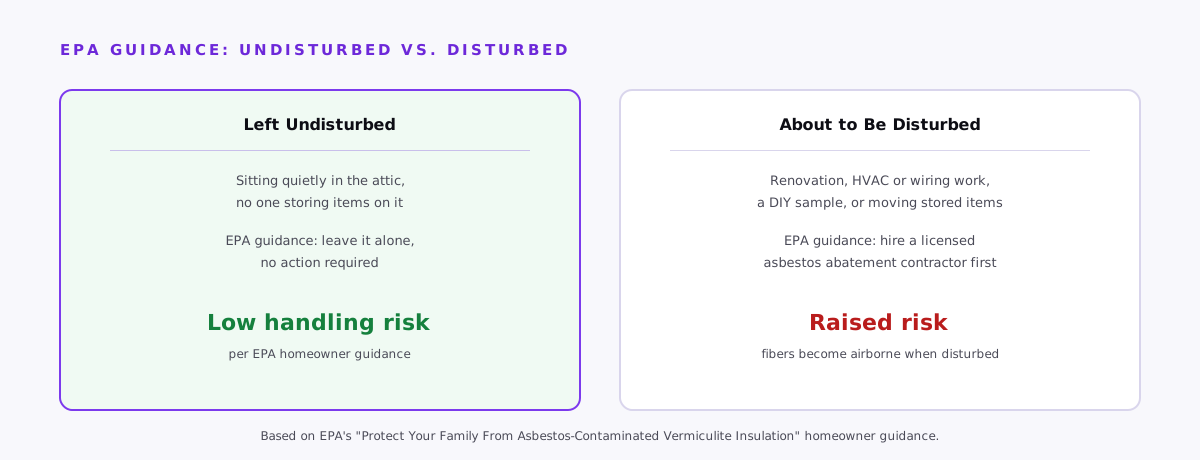
This is the single most useful thing to get right, because it's also the thing that keeps the cost from spiraling: the EPA's guidance is to leave it alone if it's undisturbed, not to remove it reflexively. Quoting the EPA's own homeowner page directly: “YOU SHOULD ASSUME THE VERMICULITE CONTAINS ASBESTOS AND DO NOT DISTURB IT!”
The agency's specific recommendations: leave vermiculite insulation undisturbed in your attic or walls; don't store boxes or other items in an attic that contains it if retrieving them would disturb the material; don't let children play in an attic with vermiculite insulation; don't attempt to remove it yourself; and hire a professional, licensed asbestos abatement contractor if you plan any remodeling or renovation work that would disturb it. The EPA also recommends that if removal does become necessary, the contractor who removes it be a different company than whoever did the initial testing, specifically to avoid a conflict of interest in the recommendation.
The practical takeaway: undisturbed vermiculite sitting quietly in an unused attic is a very different risk profile than vermiculite that's about to be disturbed by an HVAC contractor running new ductwork, an electrician pulling wire, or a buyer's inspector poking around with a flashlight and a camera. Disturbance is what turns fibers airborne and breathable — which is also why finding vermiculite doesn't automatically mean you have to remove it before you can sell.
Testing. The EPA doesn't want you collecting your own sample — disturbing the material to bag a sample is exactly the kind of disturbance the guidance warns against — so this is a job for a licensed inspector.
Industry-reported figures (Angi and HomeAdvisor data, cited via HomeGuide's cost guide) put general asbestos testing and inspection at roughly $250 to $850 for a residential visit, with professional on-site sample collection for several samples running closer to $250 to $500. These are contractor-cost-aggregator figures, not a government-set price, so treat them as a planning range rather than a quote for your specific attic.
Removal. Vermiculite is explicitly called out across contractor-cost sources as one of the more expensive asbestos-removal categories, because it's a loose granular fill rather than a solid sheet or wrapped pipe — it has to be carefully vacuumed and contained with specialized HEPA equipment rather than simply pulled off. Reported ranges run $10 to $25 per square foot, which for a full attic translates to roughly $15,000 to $30,000 on the higher end, though some sources describe smaller whole-attic jobs starting around $7,500. The honest range is wide because attic size, access, and whether the material has migrated into wall cavities or living-space ductwork all change the scope significantly.
A caveat worth knowing before you ask a contractor for “encapsulation” instead of removal: encapsulation (sealing material in place rather than removing it) is a recognized EPA alternative for some asbestos materials, like intact pipe wrap or textured ceiling, where sealing stops fibers from escaping a solid surface. It's generally not considered a viable option for loose-fill vermiculite specifically, because the material is granular and can still migrate or be disturbed even once “sealed” on top — removal is the standard remedy here, not encapsulation. If a contractor offers to encapsulate loose vermiculite instead of removing it, ask them directly how that actually contains a loose fill material rather than just covering it.
There's no federal law requiring residential sellers to disclose asbestos the way there is for lead-based paint. The one federal asbestos statute that sounds like it might apply — AHERA, the Asbestos Hazard Emergency Response Act — doesn't: it governs inspection and management requirements for public and private non-profit elementary and secondary school buildings, not private home sales. Don't confuse the two.
At the state level, this isn't usually handled through an asbestos-specific statute — it falls under each state's general seller-disclosure framework, which turns on your actual knowledge of a defect, not a duty to go test for one. In plain terms: if you don't know you have vermiculite insulation, nothing requires you to find out before selling. If you do know — because an inspector flagged it, a contractor told you, or you've simply always known the attic has that loose gray-brown fill — most states' general known-material-defect disclosure duty would cover it, the same way it covers any other known condition affecting the property.
This article is general education, not legal advice. Confirm your own state's specific disclosure form and requirements with a real estate attorney before you sign anything.
You may have seen ads or articles referencing a compensation fund tied to W.R. Grace and Libby, Montana. It's real and currently active — the W.R. Grace Asbestos Personal Injury Trust has been paying claims since 2014 and is currently paying approved claims at roughly 30% of their scheduled or assessed value.
It's worth understanding what it actually is, though: it's a disease-claim trust for people who develop a diagnosed asbestos-related illness tied to Grace/Zonolite exposure — not a payout available to any homeowner who happens to have vermiculite insulation in an attic. Simply having the material in your house, undisturbed and causing no harm, doesn't create a claim. We mention it only so you're not misled by marketing that implies otherwise.
Worked example: a $230,000 house where a pre-listing inspection finds loose-fill vermiculite in a roughly 1,100-square-foot attic. A licensed inspector confirms it ($400), and a licensed abatement contractor quotes $12,000 for full removal — toward the lower-middle of the reported range for a mid-sized, reasonably accessible attic.
| Remove, then list retail | List as-is, credit at closing | Sell as-is for cash | |
|---|---|---|---|
| Sale / offer price | $230,000 | $230,000 | $208,000 |
| Testing | −$400 | $0 | $0 |
| Removal | −$12,000 | $0 | $0 |
| Buyer credit at closing | $0 | −$13,000 | $0 |
| Agent commission (5.5%) | −$12,650 | −$12,650 | $0 |
| Seller closing costs | −$3,450 | −$3,450 | −$1,000 |
| Carrying costs during remediation/marketing | −$1,600 | $0 | $0 |
| Net to seller | ~$199,900, ~11 weeks | ~$200,900, ~8–9 weeks | ~$207,000, 1–2 weeks, certain |
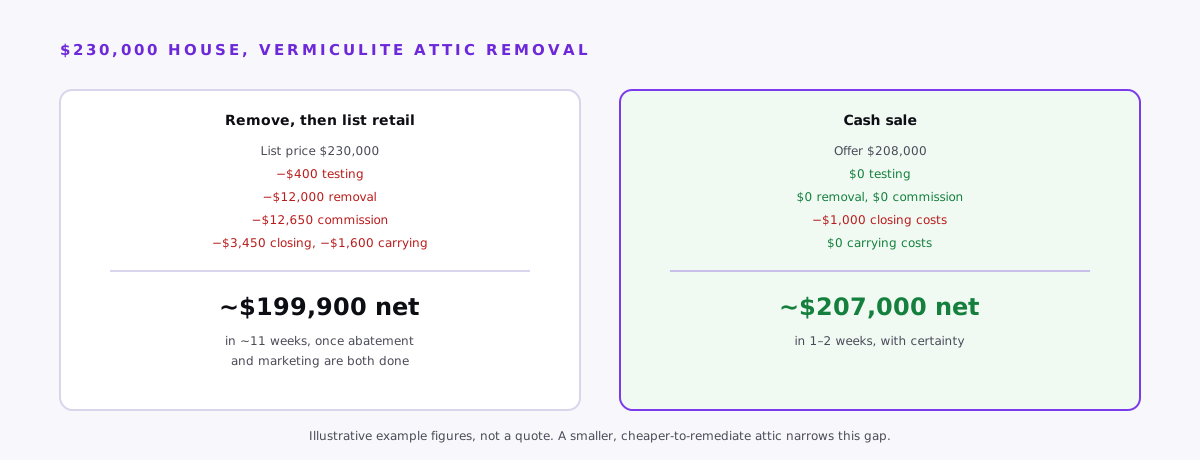
In this example, cash comes out ahead by roughly $6,000–$7,000 — not because retail is a bad option in general, but because a specialty abatement job this size eats a meaningful chunk of a retail sale's margin on top of the usual commission and closing costs. That won't always be true: a smaller or more accessible attic with a $7,500 removal quote instead of $12,000 would narrow or reverse that gap. The honest takeaway is that the math depends heavily on your specific attic's size and access, which is exactly why getting a real contractor quote before deciding matters more than any rule of thumb.
Restar Acquisitions buys houses as-is for cash in 12 states, and we price in a known defect like this the same way we'd price in any other repair item — before we give you a number, not after a buyer's inspector finds it and blows up a financed deal. We give a written offer within 24 hours, no repairs or commissions required, and you pick the closing date. We're a direct buyer, not your real estate agent, and we don't represent you in the transaction.
Alternatives worth checking before you decide:
This article is for general education only and isn't a quote, a medical opinion, a legal opinion, or a substitute for a licensed asbestos professional's assessment. Costs vary by region, attic size, and accessibility. Disclosure rules vary by state and change over time — confirm your own state's current requirement with a real estate attorney before you sign anything.
We factor a known issue like vermiculite insulation into our offer the same way we factor in any other repair item — before we give you a number, not after a buyer's inspection blows up a financed deal.
You'll get a written offer within 24 hours, no testing, removal, or commissions required, and you pick the closing date.
All guides · Selling a house with mold · Cost of asbestos abatement before selling a house · Cash offer vs. listing net proceeds
Step 1 of 5
No obligation, no fees, no repairs. We respond the same day.
You’ll talk to Trevor McAmis, Owner & Acquisitions Lead
(313) 710-6129
Takes about two minutes. Or call (313) 710-6129 — we answer.