Vapor intrusion is when chemical vapors from contaminated soil or groundwater nearby, often from an old dry cleaner, gas station or factory, rise through the ground and into a home's indoor air. The house itself was never the source. Sellers usually hear about it from an environmental database hit, a title search or a state notice. You can still sell, but it changes how you test, disclose and price the house.

Step 1 of 5
Tell us about the property and we'll send a written cash offer within 24 hours. No testing, no mitigation, no commissions.
You’ll talk to Trevor McAmis, Owner & Acquisitions Lead
(313) 710-6129
Takes about two minutes. Your address is never shared.
Educational only. This explains how these situations generally work. It is not legal, tax or financial advice, and the rules differ by state. Talk to an attorney or CPA about your own situation before you act on any of it.
The EPA defines vapor intrusion as volatile chemicals moving from contaminated soil or groundwater into the indoor air of buildings above or near them (EPA vapor intrusion program). The usual culprits are chlorinated solvents like PCE (perchloroethylene, used in dry cleaning) and TCE (trichloroethylene, an industrial degreaser), plus petroleum compounds from old fuel leaks.
ATSDR, the CDC's environmental health agency, describes the same path: chemicals that leaked into soil or groundwater evaporate, move upward, and get into a building through foundation cracks, sump pits, floor drains or utility openings (ATSDR, Overview of Vapor Intrusion).
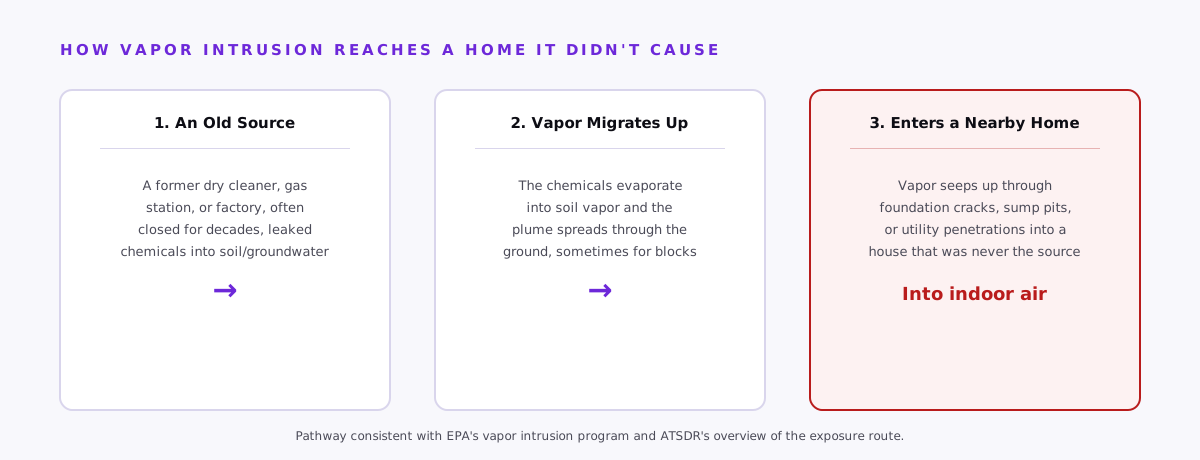
What matters for a seller is the pathway, not where the contamination started. Your house never has to have stored a chemical or had a spill. A dry cleaner that closed decades ago two blocks away, or an old leaking tank at a gas station down the street, can be the source, with the vapor showing up under homes that had nothing to do with it. That's different from owning the contaminated site yourself. If your property is the source, see our guide on selling a house on a former brownfield site.
Most sellers find out one of a few ways. None of them means the air in your house is unsafe right now. They mean someone needs to check whether vapor is actually getting from a known or suspected source into your home.
An environmental database search. Title companies and due-diligence firms check state contamination and cleanup databases, more and more often on home sales near known plumes.
A notice from a state environmental agency. Ohio, Michigan, Indiana and North Carolina all run active vapor intrusion programs and usually notify owners inside an investigation area directly.
A neighbor's cleanup. Drilling rigs, sampling equipment or a mitigation system at a nearby house is often tied to the same plume.
An earlier disclosure in your own chain of title, from a past sale or refinance where testing was already done.
Testing follows a standard protocol. Indiana's environmental agency describes it like this: steel canisters (called SUMMA canisters) collect paired samples, one from the air just under the foundation slab and one from inside the living space, so investigators can compare the two and see whether vapor is actually getting in (Indiana Department of Environmental Management, Vapor Intrusion Sampling fact sheet).
A few practical points from the same guidance. Installing a sub-slab sampling port is minor, usually under an hour, and it's sealed afterward. Indoor air sampling usually runs 24 hours; sub-slab sampling runs anywhere from under an hour to 24 hours. Two rounds are usually needed, one in summer and one in winter, because vapor movement changes with the seasons. Lab results can take up to 30 days per round. If a responsible party has been identified for the contamination, that party is often required to pay for testing instead of you, so ask your state program.
Between two seasons of sampling and lab time, just finding out whether you need mitigation can take four to eight months.
If testing shows vapor getting in above the level your state considers safe, the standard fix is a sub-slab depressurization (SSD) system. It works like a radon system: a fan pulls air from under the foundation and vents it above the roof before it can get inside. The difference is that it's designed and checked for the specific chemicals found, not just radon.
No government agency publishes a standard homeowner price, so these numbers come from contractor cost data. Residential sub-slab depressurization runs about $2 to $4 per square foot installed, so a modest house often lands at $3,000 to $7,000 for the system, plus a round of follow-up sampling (UST Contractors, vapor intrusion mitigation cost data). That's more than a radon-only system, which usually runs $800 to $2,800, because a chemical mitigation system typically needs agency sign-off and documented performance testing (Peerless Environmental, radon mitigation cost data). Commercial systems cost far more. A peer-reviewed study of eight commercial installations found install plus first-year operating costs of about $47,000 to $66,000 per building (Lutes et al., PMC/NIH).
In most states, a documented vapor intrusion finding counts as a known material condition and belongs on your residential disclosure form if you know about it. The exact statute, what triggers it and the penalties differ from state to state, and we buy in twelve of them (AL, AZ, FL, GA, IN, MD, MI, MO, NC, NY, OH, TX). Ask a real estate attorney in your state before you list, especially if you've received a written notice from an environmental agency.
Keeping quiet rarely works anyway. A buyer's title search or environmental database check can turn up a nearby contamination site whether you mention it or not, and a known issue that surfaces after closing is a common cause of lawsuits.
An unresolved vapor intrusion flag complicates a retail sale in a few specific ways.
Lenders. An appraiser or underwriter who sees an environmental notice, a state agency letter or a listed contamination site nearby can require it be dealt with before closing, much like other environmental hazards such as radon. Conventional, FHA and VA loans are more sensitive to this than a cash buyer, because the lender is underwriting the house as collateral.
Title insurance. A title insurer may want a clean sampling result or an agency-approved mitigation system before issuing a policy without an exception.
Buyers. Even after mitigation, some buyers are uneasy about a house that needed a vapor system. That means fewer interested buyers and more pushback on price.
Here's a worked example for a modest house in one of our Ohio, Michigan or Indiana markets near an old industrial corridor, which is where these notices tend to show up. The house is 1,500 square feet, would be worth $245,000 with no environmental issue, and sits inside a state vapor intrusion investigation area.
| Path A: Test, mitigate, disclose, list | |
|---|---|
| Value with no issue | $245,000 |
| Testing before mitigation, 2 rounds | −$4,000 |
| Sub-slab depressurization install | −$4,500 |
| Follow-up sampling | −$2,000 |
| Price concession for the history (about 8%) | −$19,600 |
| Commission and closing costs (~6%) | −$13,524 |
| Extra carrying costs (~6 months) | −$10,500 |
| Net proceeds, Path A | ~$190,900 |
| Path B: Sell as-is for cash | |
|---|---|
| Example cash offer | $178,000 |
| Testing, mitigation, commissions | $0 |
| Extra carrying costs (close in 2–3 weeks) | ~$0 |
| Net proceeds, Path B | ~$178,000 |
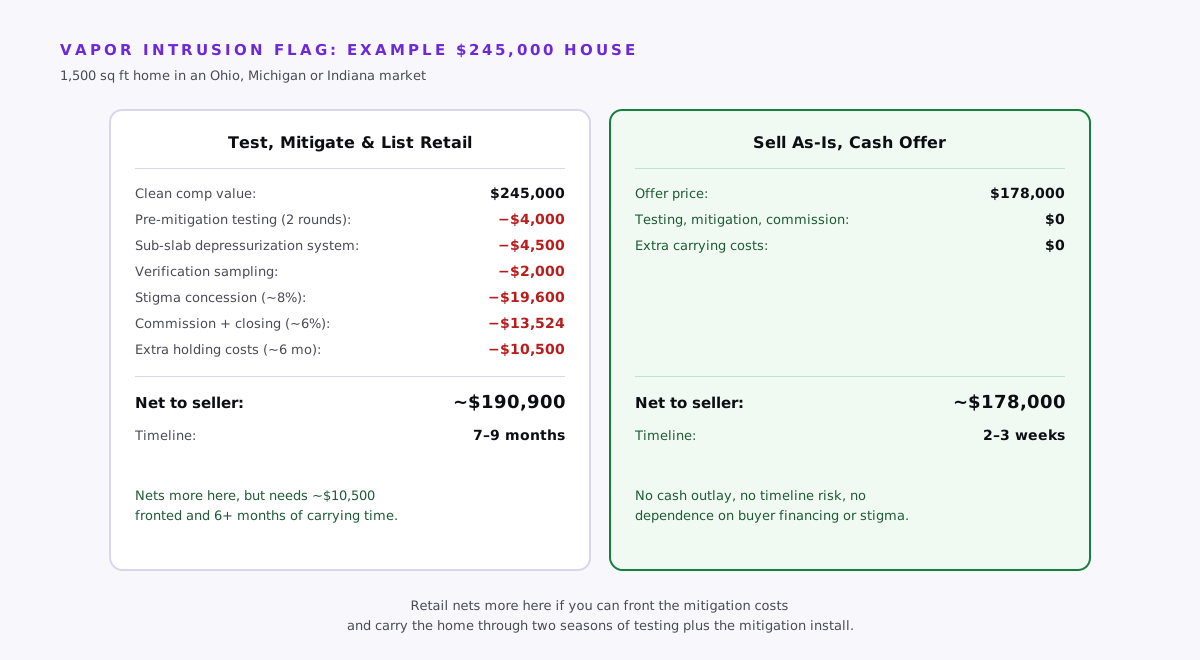
In this example, listing nets about $12,900 more. To get there you need to front about $10,500 for testing and mitigation before you sell, the price hit has to stay near 8%, the buyer's lender and title company can't balk partway through, and you have to carry the house for six-plus extra months while two seasons of testing and an install play out. The cash sale nets less but skips all of that. If a responsible party is paying for your testing, or the price hit in your area is smaller, listing looks even better.
Test, mitigate, disclose and list. Best if you can front the cost, aren't in a hurry, and buyers in your area will accept a resolved environmental history.
Disclose and list as-is, and let the buyer negotiate a credit. You don't pay for mitigation up front. The buyer takes a price credit about equal to the estimated cost and has the work done after closing.
Get one mitigation bid and credit it at closing. You don't manage the install or carry the timeline, and the buyer gets a specific, documented number.
Go after the responsible party for the cost, if one has been identified. Whether you can depends on your state's program and the facts, so raise it with a real estate or environmental attorney.
Sell for cash, as-is. No repairs, no commissions, a written offer within 24 hours, and you choose the closing date. Our sell my house fast page walks through how it works.
We buy houses as-is for cash, including ones with an open environmental flag. Send the address and you'll have a written offer within 24 hours. No testing or mitigation on your end, no commissions, and you pick the closing date. If testing and listing would net you more, we'll tell you.
All guides · Selling a house on a former brownfield site · Selling a house with a radon problem · How a cash sale works
Step 1 of 5
No obligation, no fees, no repairs. We respond the same day.
You’ll talk to Trevor McAmis, Owner & Acquisitions Lead
(313) 710-6129
Takes about two minutes. Your address is never shared.