A buyer's inspector found radon above the EPA's action level, or you tested it yourself and now you're not sure what you're required to say or do. Radon is common, well-understood, and fixable — a one-day mitigation job in most homes — but the rules on what you have to disclose vary by state, and there's no federal law telling you what to do the way there is for lead paint. Here's what radon actually means for your sale, what fixing it costs, and the honest math on doing that first versus selling as-is.
Step 1 of 5
Tell us what your test showed. We'll tell you honestly whether fixing it first or selling as-is makes more sense for your timeline.
You’ll talk to Trevor McAmis, Owner & Acquisitions Lead
(313) 710-6129
Takes about two minutes. Or call (313) 710-6129 — we answer.
Educational only. This explains how these situations generally work. It is not legal, tax or financial advice, and the rules differ by state — talk to an attorney or CPA about your own situation before you act on any of it.
Yes, you can sell a house with a known radon problem. There's no federal radon disclosure law, but several states — including Florida, Ohio, Michigan and New York — require disclosing known test results, and most buyers' lenders will want it fixed or credited before closing. A sub-slab mitigation system typically costs $800–$2,500 and brings levels below the EPA's action level in about a day.
This is general educational information, not legal advice. Radon disclosure requirements vary by state — confirm what applies to your sale with a real estate attorney or your state's standard disclosure form before relying on anything here.
Radon is a colorless, odorless radioactive gas that seeps up from soil and rock into a home's lowest level. The EPA calls it the number one cause of lung cancer among people who have never smoked, and attributes roughly 21,000 lung cancer deaths a year to it nationally, about 2,900 of them in never-smokers — a figure that traces back to a 2005 U.S. Surgeon General national health advisory and remains EPA's current published estimate (EPA: Health Risk of Radon).
The EPA's action level is 4 picocuries per liter (pCi/L) — the threshold at which it recommends fixing the home — and it recommends considering a fix even between 2 and 4 pCi/L (EPA: What is EPA's Action Level for Radon).
The American Lung Association's January 2025 Radon Action Month release puts it plainly: radon causes about 21,000 deaths a year and is “the number one cause of lung cancer in people who have never smoked” (American Lung Association, January 6, 2025).
A radon test isn't automatically part of a standard home inspection — it's an add-on a buyer requests. During a sale, it's standard practice for a buyer to order a radon test during their inspection contingency window, typically 7–15 days after the contract is signed. If you've tested the house yourself and know the result, most state disclosure laws require you to share it once asked. If you've never tested, you generally have nothing yet to disclose — but a buyer's own test during inspection will often surface it anyway, which is why many sellers test before listing rather than finding out mid-contract.
The standard fix is a sub-slab depressurization (SSD) system — a fan and pipe run from under the slab to above the roofline that draws soil gas out before it enters the living space. It reliably cuts indoor radon by 80–99%, enough to bring most homes below the 4 pCi/L action level. EPA's own cost estimate averages about $1,200, with a typical range of $800–$2,500 depending on house size and foundation type, and most installs take about a day.
Unlike lead-based paint, there's no federal law requiring radon disclosure in a home sale. States handle it individually. Four concrete examples, all in states Restar Acquisitions buys in:
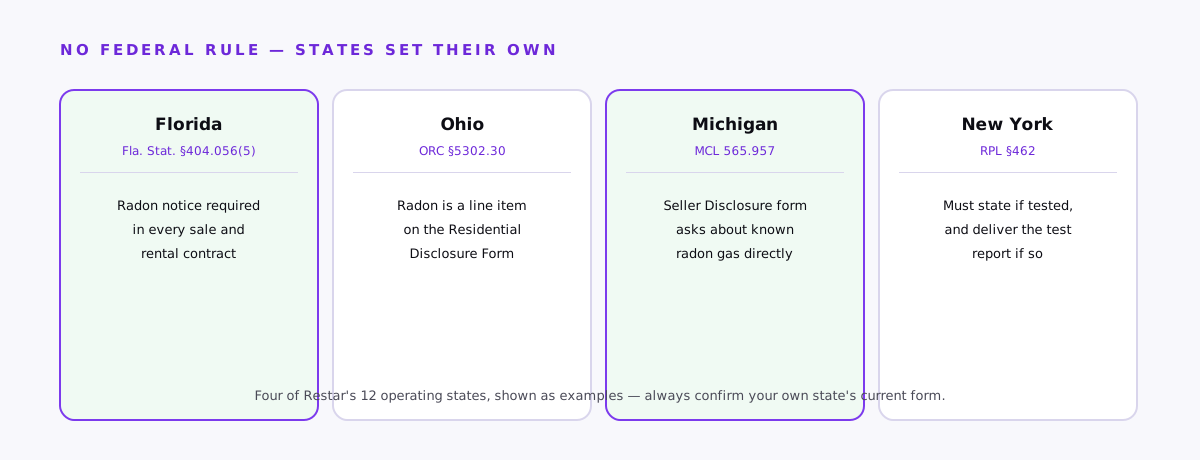
Georgia, North Carolina, Arizona, Missouri, Indiana, Maryland and Alabama don't have a radon-specific statute found in this research; talk to a local real estate attorney or check your state's standard disclosure form for what applies where you are.
Generally no, for single-family purchases. FHA doesn't require radon testing on single-family loans (HUD's multifamily program does, separately). VA stopped requiring radon testing or certification on appraisals ordered on or after May 1, 2026. Two states outside Restar's footprint — New Jersey and Illinois — have state-level rules requiring radon disclosure or testing specifically tied to real estate transactions; none of Restar's 12 operating states currently have that.
The EPA maintains Radon Zone designations by county (Zone 1 is highest potential, Zone 3 is lowest), most recently updated September 2026. Based on EPA's own zone maps, Ohio, Indiana and Missouri lean toward higher-potential zones; Florida and Texas lean toward lower-potential zones; Maryland is mixed. Check your specific county on EPA's official state radon maps rather than assuming based on the state alone.
Take a house worth $235,000 with a confirmed test result of 6.2 pCi/L, above the action level.
| Mitigate, then list retail | Sell as-is for cash | |
|---|---|---|
| Sale price / typical offer | $235,000 | 75–82% of value |
| Mitigation system | −$1,200 | Buyer absorbs it |
| Closing costs & commission (~9%) | −$21,150 | $0 |
| Net | ~$212,650 | ~$176,250–$192,700 |
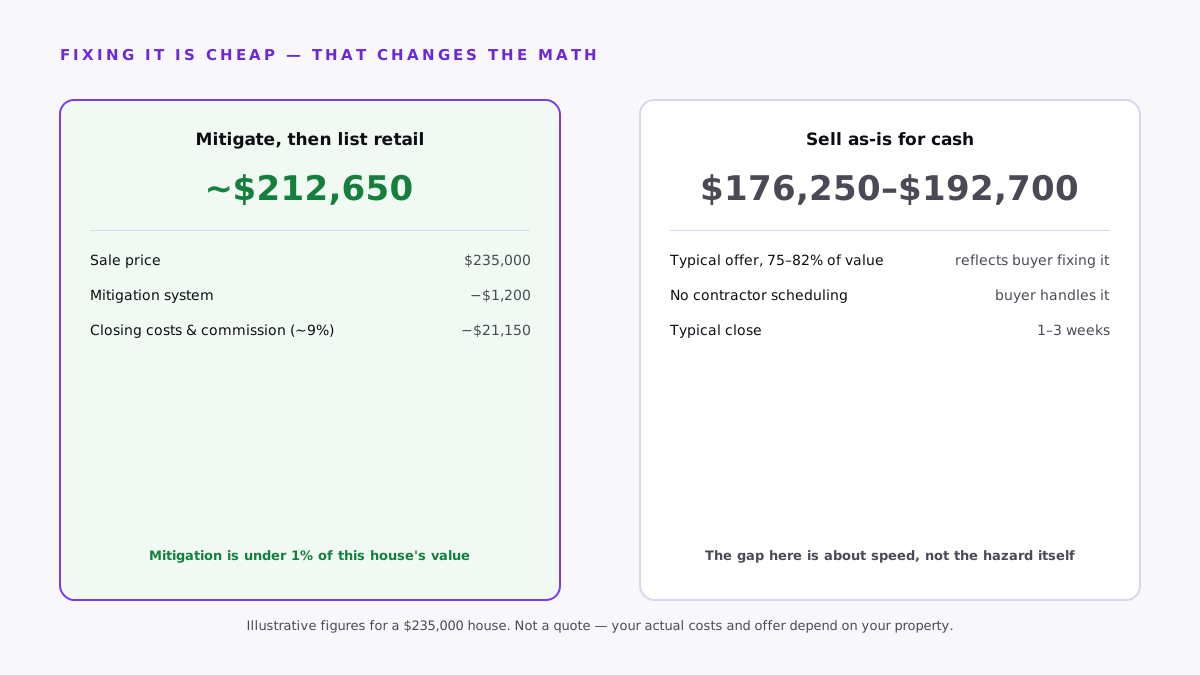
Unlike most hazard guides on this site, radon is a case where fixing it first is usually the clearly better financial move if you have the time: a mitigation system is cheap — well under 1% of most home values — and takes about a day, so the gap between the two paths above is mostly the cost of convenience and speed, not the cost of the hazard itself. The case for a cash sale here is about not wanting to schedule a contractor, wait out a test period, or risk a buyer's lender stalling the deal mid-contract — not about the dollars.
Radon is common, well-documented and genuinely fixable — it's rarely a reason a sale falls apart on its own. If you have the time and a few hundred to a couple thousand dollars, mitigating before you list is usually the better math. If you don't, a cash sale lets the buyer handle it while you move on your own timeline. Send us the address and we'll give you a straight comparison for your specific situation.
Mitigation is cheap and fast, but it still means scheduling a contractor and waiting out the work before you can close. If you'd rather skip that step entirely, we can buy the house as-is and handle the mitigation ourselves — no renegotiation, no delay.
Send us the property here and we'll walk you through both options honestly.
All guides · Should I repair before selling? · Cash offer vs listing net proceeds · Selling a house with mold
Step 1 of 5
No obligation, no fees, no repairs. We respond the same day.
You’ll talk to Trevor McAmis, Owner & Acquisitions Lead
(313) 710-6129
Takes about two minutes. Or call (313) 710-6129 — we answer.
