Selling a house on a former brownfield site is legal and can move quickly, but the deal almost always depends on who absorbs the environmental risk. A federal protection called the Bona Fide Prospective Purchaser defense lets a buyer acquire known-contaminated property without inheriting cleanup liability, as long as they complete a proper environmental review before closing — which is exactly why a buyer willing to do that work, rather than a retail buyer relying on a mortgage, is often the realistic path to a sale.

Step 1 of 5
Tell us what you know about the property's history. We'll give you a straight answer, including whether remediating first or selling as-is nets you more.
You’ll talk to Trevor McAmis, Owner & Acquisitions Lead
(313) 710-6129
Takes about two minutes. Or call (313) 710-6129 — we answer.
Educational only. This explains how these situations generally work. It is not legal, tax or financial advice, and the rules differ by state — talk to an attorney or CPA about your own situation before you act on any of it.
Under federal law, a brownfield is real property where expansion, redevelopment, or reuse "may be complicated by the presence or potential presence of a hazardous substance, pollutant, or contaminant." (42 U.S.C. §9601(39)) The definition explicitly excludes full Superfund sites already under an active cleanup order — a brownfield is the broader, more common category: a former gas station, dry cleaner, factory, or similar site with a contamination history that hasn't necessarily been fully investigated or resolved.
There's no single event that makes a property officially "a brownfield." In practice, it becomes known as one through a Phase I Environmental Site Assessment flagging the historical use during a title or records review, a listing on a state environmental agency's contaminated-sites inventory, or a search of EPA's own "Cleanups in My Community" map, which tracks EPA-funded brownfield grants and cleanup sites by location.
Federal Superfund law (CERCLA) holds a wide range of parties strictly liable for cleanup costs at a contaminated site — the current owner, any past owner or operator who owned the property at the time contamination occurred, and anyone who arranged for the disposal of the hazardous substance. (42 U.S.C. §9607(a)) Critically, liability runs to whoever owns the property at cleanup time, not just whoever caused the contamination — meaning a seller can't simply hand the problem to a new owner and walk away clean unless that owner qualifies for a real legal protection first.
That protection is the Bona Fide Prospective Purchaser (BFPP) defense. Unlike the older "innocent landowner" defense, a BFPP can qualify even if they knew the property was contaminated before buying it — which is exactly what makes a sale of known-contaminated property possible at all.
To qualify, a buyer has to complete "all appropriate inquiries" (AAI) before closing — in practice, a proper Phase I Environmental Site Assessment conducted under the current ASTM E1527-21 standard — have no business relationship with whoever caused the contamination, and after closing, stop any ongoing release, limit exposure, and cooperate with any cleanup activity. (EPA: innocent landowner & BFPP defenses) Under EPA's All Appropriate Inquiries rule, finalized in December 2022, the site-history review has to be completed or updated within 180 days of the actual purchase date to count.
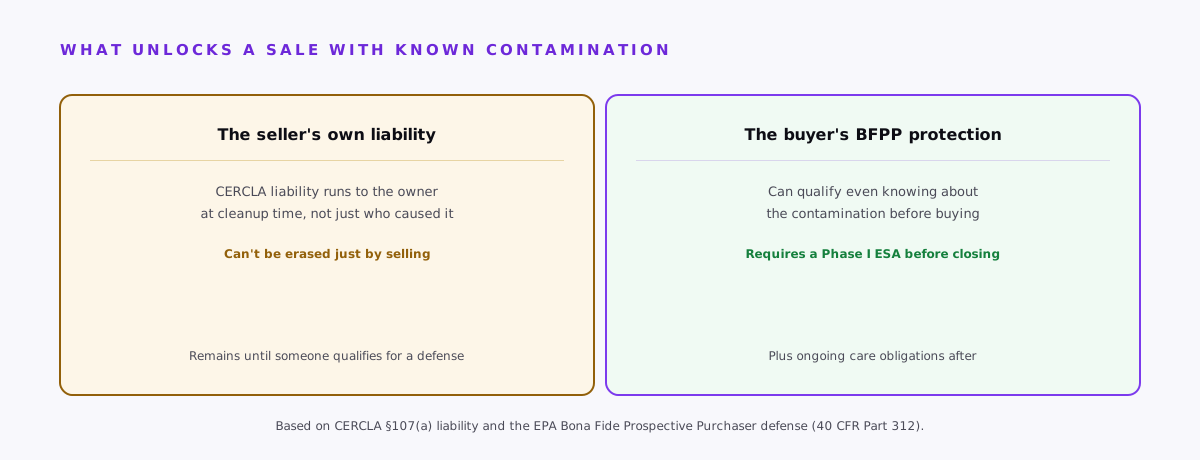
A seller can't fix their own CERCLA exposure by selling. A buyer's protection only exists if they get a real Phase I ESA done before they close, not after.
This is educational information, not legal or environmental advice. Whether a specific buyer actually qualifies for BFPP protection depends on the details of their due diligence and the property's history — an environmental attorney and a licensed environmental consultant are the right people to confirm it, not a real estate agent.
There's no general federal law requiring disclosure of soil or groundwater contamination in a residential sale — that's governed state by state, and the strength of the requirement varies sharply across the states where Restar buys houses:
| State | Does the disclosure form name contamination directly? | Notes |
|---|---|---|
| Missouri | Yes — strongest mechanism found | Knowing failure to disclose known hazardous material contamination is a class A misdemeanor (RSMo §442.055) |
| North Carolina | Yes | Statute names "hazardous material or toxic material… and other environmental contamination" directly (N.C.G.S. §47E-4(b)(6)) |
| Indiana | Yes | Hazardous-conditions and underground storage tank items on the statutory form (IC 32-21-5) |
| Maryland | Yes | Form asks about landfills, USTs, and "other contamination" (Md. Real Property §10-702) |
| Michigan | Yes | Form item names "contaminated soil" directly (MCL 565.957) |
| Ohio | Yes | Statute names hazardous materials; the official form adds underground storage tanks (ORC §5302.30) |
| Texas | Yes | Checklist covers hazardous/toxic waste and soil movement (Tex. Prop. Code Ch. 5) |
| Georgia | Yes | Beyond the general disclosure form, Georgia's Hazardous Site Response Act requires a recorded deed notice within 45 days of state notice for listed sites — the most binding transfer-specific rule found in any of the 12 states |
| Arizona | Partially | Written notice required only if the property underwent formal state-standard soil remediation — a narrow trigger, not general contamination |
| Florida | Not clearly | Relies on a generic "material facts" common-law standard rather than a named environmental item |
| Alabama | No | No statutory disclosure duty at all — common-law fraud/suppression claims only |
If you're in Alabama or Florida, don't assume silence is automatically safe — common-law fraud and concealment claims can still apply even without a named statutory duty, and CERCLA liability doesn't depend on any state disclosure rule at all. This is exactly the kind of state-specific judgment call worth running past a local real estate attorney rather than guessing from a general article.
A Phase I ESA — records review, site inspection, interviews, no soil or water sampling — typically runs $2,000 to $5,000 for a standard residential parcel, with former gas stations, dry cleaners, and industrial sites running 30% to 80% higher.
If the Phase I turns up a "recognized environmental condition," a Phase II follows, which does involve soil and groundwater sampling and typically costs $5,000 to $50,000, occasionally more on large or complex sites, and usually takes 4 to 8 weeks to complete. These figures come from environmental-consulting industry sources rather than a government rate schedule, so treat them as a planning range, not a quote.
FHA and VA loans both carry an explicit hazard-free requirement: an FHA appraiser has to confirm the property is free of known environmental and safety hazards before the loan can fund, and a VA appraiser is specifically instructed to flag underground storage tanks and other contamination sources, conditioning the loan on the problem being corrected first.
Neither program treats a known environmental issue as an automatic denial, but in practice, if remediation isn't finished before closing, the loan simply doesn't fund on schedule. No clear equivalent carve-out for conventional loans was confirmed — general appraisal marketability standards would still apply and tend to produce the same practical result.
Remediation costs vary enormously by contamination type: basic petroleum-contaminated soil can run from roughly $1,000 to $17,500 per acre depending on the method, while a full project with a groundwater plume can run from the low hundreds of thousands into seven figures for something like a former dry-cleaning solvent release. These are industry-sourced planning ranges, not government figures, and they're also exactly why a financed retail buyer often can't realistically close on a known-contaminated property without the seller funding remediation first.
Worked on a $250,000 house with a moderate petroleum-contamination issue from a decommissioned heating oil system:
| Route | Gross price | Remediation + ESA costs | Holding costs | Commission | Net to seller | Timeline |
|---|---|---|---|---|---|---|
| Remediate, confirm clean, then list with an agent | $250,000 | ~$78,000 (Phase I/II plus a mid-range petroleum remediation) | ~$3,500 (during the remediation project) | ~6% (−$15,000) | ~$153,500 | 5–8 months: remediation, re-testing, then a normal listing |
| Sell as-is to a buyer who will complete their own Phase I ESA and qualify for BFPP protection | $150,000 | $0 to the seller — buyer absorbs diligence and remediation risk | $0 | $0 | $150,000 | 3–4 weeks |
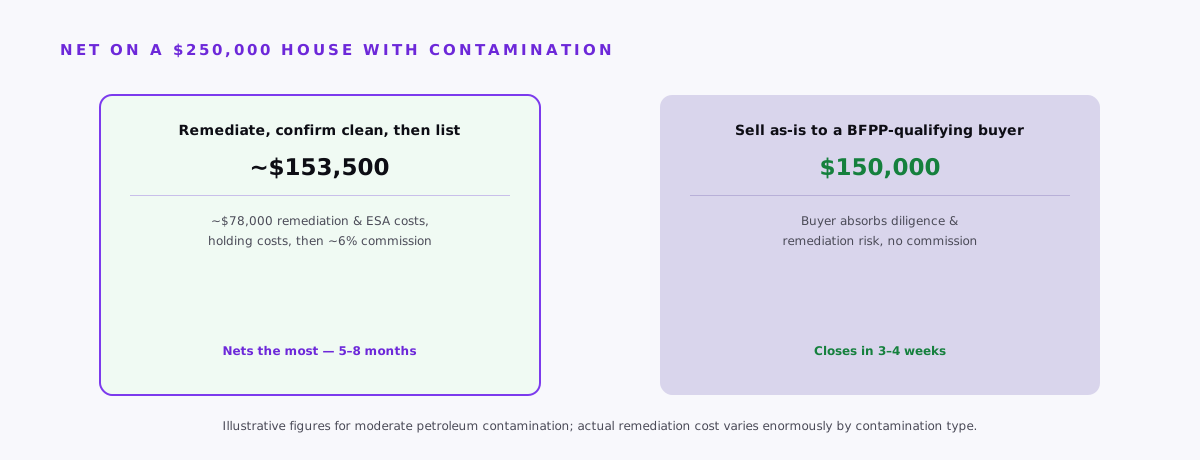
Remediating first and listing normally nets somewhat more in this example, because the house ultimately sells at full retail value once it's clean — the math only works that way when the contamination is moderate enough that remediation cost doesn't swallow the gain. An as-is cash sale makes sense specifically when the seller can't front five or six figures for remediation before knowing what a buyer will actually pay, can't carry the property through a multi-month cleanup and retest process, or is working with a contamination type severe enough that remediation costs would erase most of the retail upside anyway.
We're willing to do our own Phase I environmental review and qualify for our own Bona Fide Prospective Purchaser protection — which is exactly the thing a financed retail buyer usually can't do. That's often what makes a fast, as-is sale realistic when a mortgage-dependent buyer can't close.
Send us the address and whatever you know about the property's history, and we'll give you a written cash offer within 24 hours, with the math shown plainly next to what remediating and listing would likely net instead.
All guides · Selling a house with an underground oil tank · Selling a house with an underground propane tank · Cash offer vs listing net proceeds
Step 1 of 5
No obligation, no fees, no repairs. We respond the same day.
You’ll talk to Trevor McAmis, Owner & Acquisitions Lead
(313) 710-6129
Takes about two minutes. Or call (313) 710-6129 — we answer.