A tornado or straight-line wind claim runs through the same homeowners insurance machinery as any other wind event — but the deductible that applies can differ sharply from a hurricane claim, because it's triggered by any wind, not just a declared named storm, and several of our operating states (Texas, Maryland, New York) use a separate percentage-based wind/hail deductible instead of a flat dollar amount. If your house took tornado or wind damage and you haven't settled the claim yet, the honest options are: repair and list, negotiate a price credit for the unresolved repair, or sell as-is for cash and let the buyer handle what's left.

Step 1 of 5
Tell us what happened and where your claim stands. We'll give you a straight answer on how it affects our number.
You’ll talk to Trevor McAmis, Owner & Acquisitions Lead
(313) 710-6129
Takes about two minutes. Or call (313) 710-6129 — we answer.
Educational only. This explains how these situations generally work. It is not legal, tax or financial advice, and the rules differ by state — talk to an attorney or CPA about your own situation before you act on any of it.
If you've read anything about selling storm-damaged property, you've probably seen hurricane-specific advice: a percentage deductible that only applies to a declared, named storm, wind coverage separate from flood coverage, FEMA disaster assistance. Tornado and straight-line wind damage shares some of that machinery, but the trigger is different in a way that actually matters for your math.
Hurricane deductibles apply only to damage from a declared hurricane. Many insurers instead carry a separate wind/hail deductible that applies to any wind-driven damage — tornado, severe thunderstorm, straight-line wind, or hurricane alike (Insurance Information Institute: hurricane and windstorm deductibles). Twelve states use percentage-based wind/hail deductibles rather than a flat dollar figure, and three of them are in our footprint: Texas, Maryland, and New York. In those states, a tornado claim can carry the same 1%–5%-of-dwelling-coverage deductible structure a hurricane claim would, even though no named storm was ever declared. Texas's own insurance regulator confirms windstorm coverage there applies the same way whether the damage is from a tornado, thunderstorm, or hurricane (Texas Department of Insurance: What Is Windstorm Insurance?).
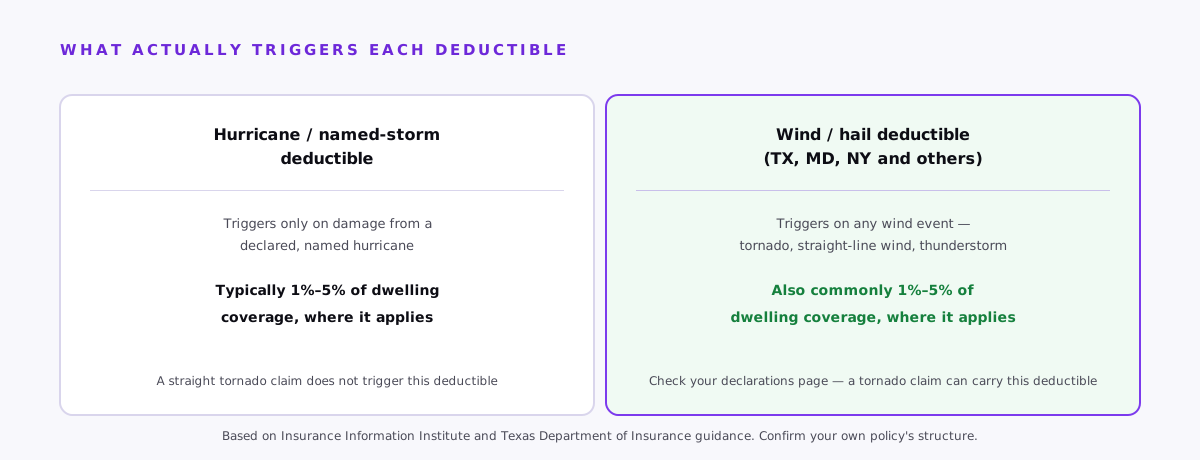
In our other nine operating states, a tornado claim more commonly falls under the standard flat-dollar, all-other-perils deductible — meaning it can actually be cheaper to clear than a comparable hurricane claim would be in a coastal state. Check your own policy's declarations page before assuming either way.
Tornado and severe-storm outbreaks regularly trigger FEMA Individual Assistance declarations in exactly the states we buy in — this isn't a hurricane-only mechanism. Recent examples include Ohio (DR-4777-OH, declared May 2024 for March 2024 tornadoes, more than $3.7 million in approved individual assistance across 481 applications) and Alabama (DR-4684-AL, declared January 2023 for January 2023 tornadoes and straight-line winds, roughly $9.5 million approved across 1,829 applications). If your home was damaged in a declared disaster, check FEMA's disaster declarations page for your event — individual assistance can help with temporary housing and some repair costs even while your insurance claim is still open, though it isn't a substitute for the insurance payout itself.
Once you're past the deductible question, how your insurer actually pays out a wind-damaged roof doesn't change based on whether a tornado or a hurricane caused it. Most policies pay actual cash value (ACV) first — the repair cost minus depreciation for the roof's age — and release the rest, called recoverable depreciation, only after you show proof the repair was actually completed. On a $10,000 roof repair with a $2,000 deductible, a replacement-cost-value (RCV) policy pays $8,000 outright; an ACV policy might depreciate a 12-year-old roof down to $7,000 of recognized value, paying out $5,000 after the deductible. That gap is exactly why you can't just cash an insurance check and walk away from a damaged roof as a seller — the remaining depreciation holdback is tied to proof of completed repair, not to you personally, and an unresolved claim is something you'll need to disclose and assign or settle before closing either way.
One genuinely tornado/hail-specific wrinkle worth knowing if you're in Texas: insurers there can, with your signed consent, exclude cosmetic hail damage to a roof — denting that doesn't cause actual water penetration or functional failure — in exchange for a premium credit on impact-resistant roofing. If your policy carries that exclusion, a hail-dented-but-still-functional roof may not be a covered claim at all, which is worth checking before you assume a full payout is coming.
Severe convective storms — the category that includes tornadoes, hail, and straight-line wind — generated more than $50 billion in US insured losses in 2025, the third consecutive year above that mark, with a record 300 tornadoes in March 2025 alone producing $8.4 billion in insured losses that month (Insurance Information Institute, April 2026). Roofs account for an estimated 70%–90% of total insured residential losses from these storms — which is exactly why a wind-damaged roof, more than almost any other component, is the thing that actually decides your numbers below.
Worked example: a house with a repaired value of $230,000 took straight-line wind damage in a tornado outbreak — a full roof replacement plus some fascia and gutter work, a contractor estimate of $19,500. The insurer's ACV payout, after a 2% wind/hail deductible ($4,600 on this policy) and roof-age depreciation, nets $9,200 up front, with the remaining $5,700 of recoverable depreciation paid only after the repair is completed and verified.
Repairing first then listing nets roughly $202,400 after the $4,600 net repair cost and commission and closing costs. A price credit while listing as-is nets roughly $202,860, plus the same $9,200 ACV check, faster but requiring the buyer's lender to accept a credit in place of a completed repair. A cash sale nets roughly $196,200 to $205,200, plus the same ACV check, fastest but discounting hardest for the unresolved claim.
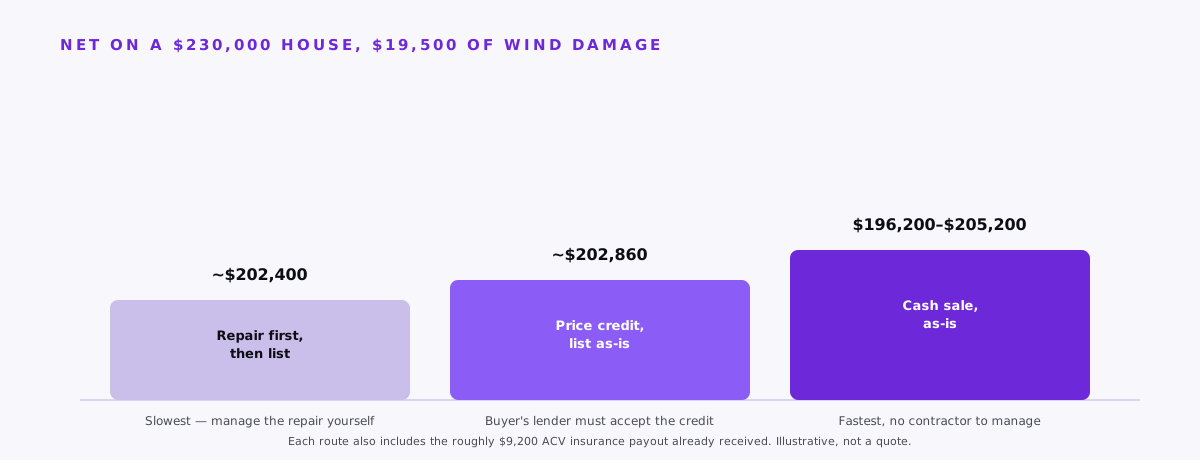
On these numbers the three routes land close together — repairing first costs you carrying time and contractor-management hassle; a price credit gets you most of the same money faster but hands the buyer, and their lender, a repair they have to actually complete before closing in many cases; a cash sale is fastest and simplest but discounts hardest for the unresolved claim. Run your own contractor estimate and your actual policy's deductible and depreciation schedule — don't assume this example's numbers are yours.
Get your own contractor estimate before accepting your insurer's number. ACV depreciation schedules vary by carrier, and a second opinion on the repair cost is the single biggest lever in this math.
Ask your insurer directly whether your policy has a wind/hail deductible separate from your standard deductible, and whether your state requires one — don't assume a hurricane-style deductible rule applies, or doesn't.
List with an agent and complete the repair if you can front the cost and the numbers favor it, which they often do when a financed buyer pool is available.
Assign the open claim to a cash buyer if you'd rather not manage the repair-and-verify process yourself — ask any buyer directly how they handle an assigned, unresolved claim before you agree to it.
If you'd rather not manage contractors, depreciation holdbacks, and a lender's repair conditions, send us the address and we'll send a written cash offer within 24 hours that accounts honestly for the damage — no obligation either way. This page is educational only and is not insurance or legal advice; confirm your own policy's deductible structure and depreciation schedule with your carrier.
If you can front the repair cost and a financed buyer pool is realistic in your market, repairing first usually nets the most — we'd tell you that on the phone.
Where a cash sale earns its place is when you'd rather not manage contractors and a depreciation holdback, or you need to close faster than a repair-contingency timeline allows. Send the address and we'll send a written offer within 24 hours that accounts honestly for the damage. No cost, no obligation.
All guides · Selling a house with hurricane damage · Cost of lender-required repairs · Cash offer vs listing net proceeds
Step 1 of 5
No obligation, no fees, no repairs. We respond the same day.
You’ll talk to Trevor McAmis, Owner & Acquisitions Lead
(313) 710-6129
Takes about two minutes. Or call (313) 710-6129 — we answer.
