Selling a house with sinkhole damage in Florida means dealing with two separate insurance coverages, a specific statutory disclosure duty if a claim was ever paid, and a buyer pool that often can't get financed because lenders and insurers treat unremediated sinkhole property as high risk. You can fully remediate and get an engineer's certification before listing, list as-is and disclose, or sell to a cash buyer now — each changes your timeline and your net proceeds differently. This guide covers what Florida law actually requires, what remediation really costs, why a paid claim keeps following the property even after you sell, and the honest math between repairing first and selling as-is.
Step 1 of 5
Send the address and we'll tell you honestly how the cash number compares to remediating first.
You’ll talk to Trevor McAmis, Owner & Acquisitions Lead
(313) 710-6129
Takes about two minutes. Or call (313) 710-6129 — we answer.
Educational only. This explains how these situations generally work. It is not legal, tax or financial advice, and the rules differ by state — talk to an attorney or CPA about your own situation before you act on any of it.
This is educational information, not insurance, legal or tax advice. Talk to your insurance agent, a licensed public adjuster, and/or a Florida real estate attorney about your specific policy, claim, and disclosure obligations before making a decision.
Florida law splits sinkhole coverage into two very different things, and mixing them up is the single most common misunderstanding sellers have. Every property insurer authorized in Florida must include coverage for “Catastrophic Ground Cover Collapse” (CGCC) in every policy, at no extra charge — but it's a narrow trigger. CGCC only pays out when there is an abrupt collapse, a visible depression in the ground, structural damage to the building including the foundation, and the structure has been condemned and ordered vacated by a government agency (Fla. Stat. § 627.706). Most real-world sinkhole activity — cracking, settling, a slowly sinking corner — never reaches that bar.
The coverage that actually pays for most sinkhole damage is optional Sinkhole Loss coverage, which insurers must offer for an additional premium but which a policyholder can decline. It covers structural damage from ground settlement or subsurface erosion without requiring condemnation, usually with a deductible of 1%, 2%, 5%, or 10% of the dwelling limit and often a pre-issuance inspection requirement (Fla. Stat. § 627.706). If your policy never carried this optional coverage, a real sinkhole event may leave you with no claim to file at all — check your declarations page, not just your memory of what you signed up for.
Under the current 2025 statute, insurers must offer sinkhole-loss deductible options of 1%, 2%, 5%, or 10% of the dwelling coverage limit, with the premium discount scaled to the deductible you pick — worth comparing against your other coverage before you assume the cheapest option is the best one.
Source: Fla. Stat. § 627.706 (Florida Senate, current statute text).
Florida imposes a specific statutory disclosure requirement that goes beyond the general rule. Under Fla. Stat. § 627.7073, if a sinkhole claim was made by the seller and paid by the insurer, the seller must disclose to the buyer before closing that a claim was paid and whether the full proceeds were used to actually repair the sinkhole damage. This is not optional and it is not a matter of judgment — it is a specific, statutory line item tied to the fact of a paid claim, separate from the general common-law duty below.
Separately, any sinkhole report a policyholder commissions gets recorded with the county and becomes a public record tied to the property — it does not create a lien or cloud title, but it is discoverable by any buyer or lender who checks.
Beyond that specific statute, Florida's general disclosure standard comes from Johnson v. Davis, 480 So. 2d 625 (Fla. 1985): a seller with actual knowledge of a fact that materially affects the property's value and isn't readily observable to the buyer must disclose it. That's an actual-knowledge standard — an owner who genuinely never knew about prior sinkhole activity (say, they inherited the house or bought it without being told) isn't liable under Johnson v. Davis for failing to guess. But if you personally filed and were paid on a sinkhole claim, § 627.7073's disclosure duty applies to you regardless of how well the repair looks today.
Sources: Fla. Stat. § 627.7073; Florida Bar Journal, on Johnson v. Davis, 480 So. 2d 625 (Fla. 1985).
A paid sinkhole claim gets logged in the Comprehensive Loss Underwriting Exchange (CLUE) database, which insurers pull during underwriting on any future policy application for that address. That history follows the property, not the person who filed it — a buyer's insurer will see the prior claim on your address even though the buyer never filed it, and price or decline coverage accordingly. You're entitled to one free CLUE report per property per year under the Fair Credit Reporting Act, and pulling it yourself before you list is a reasonable way to know exactly what a buyer's insurer will see.
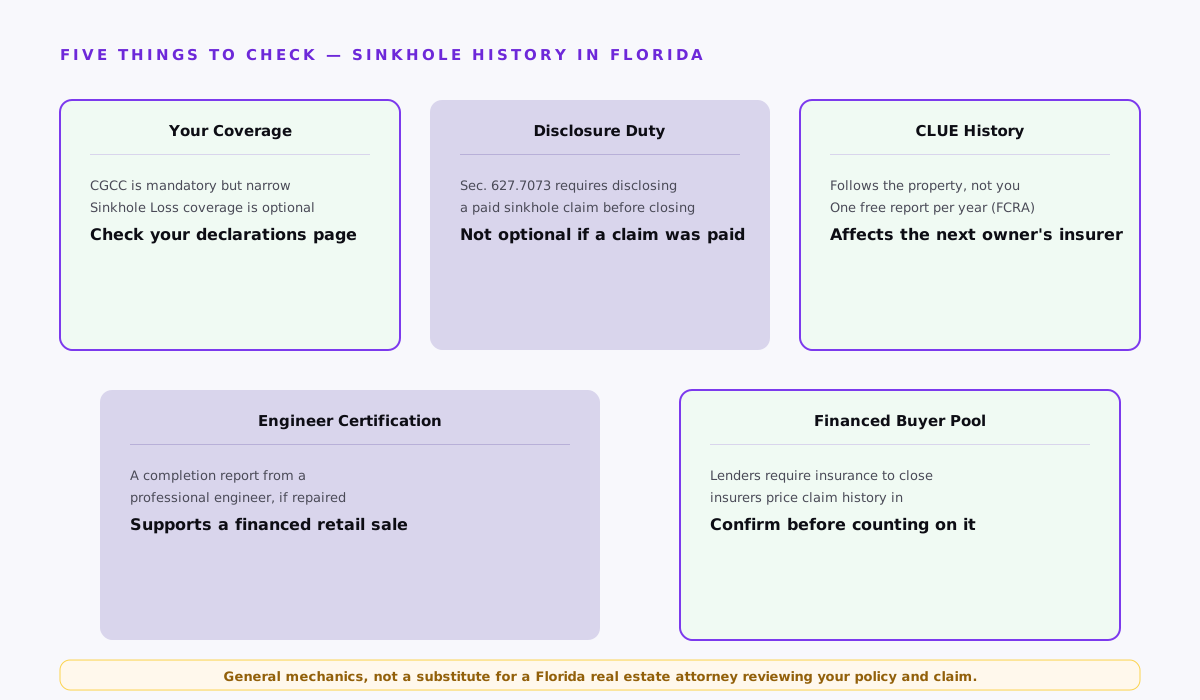
This is the practical reason sinkhole-affected homes are harder to sell to a financed buyer even years after a repair: it isn't the crack in the driveway that scares off a conventional or FHA lender, it's that the buyer often can't get the hazard insurance the lender requires as a closing condition, because the property's claim history makes it expensive or impossible to insure. A full remediation with a professional engineer's completion certification (which § 627.7073 also governs) improves this, but some insurers and lenders still ask for additional geotechnical review even after certification — a real, non-hyped reason the buyer pool for these houses skews toward cash.
Worth knowing if you're hoping a disaster-assistance program covers this: FEMA has denied appeals for sinkhole-related disaster assistance on the grounds that Florida sinkholes result from pre-existing karst geology, not the disaster event being declared — so this generally isn't a FEMA-reimbursable loss.
Full engineered remediation — typically compaction grouting or grout injection to fill the subsurface void — is the only way to get a clean engineer's certification that supports a financed retail sale. Industry contractor data (not an official state cost study; no such FL DFS-published figure appears to exist) puts landscaping-only voids at roughly $1,500–$5,000, driveway or slab repair around $3,500–$10,000, and full structural compaction grouting at $20,000 to $100,000 or more depending on the void's size and depth. A moderate structural case with a documented completion report commonly lands around $35,000–$40,000.
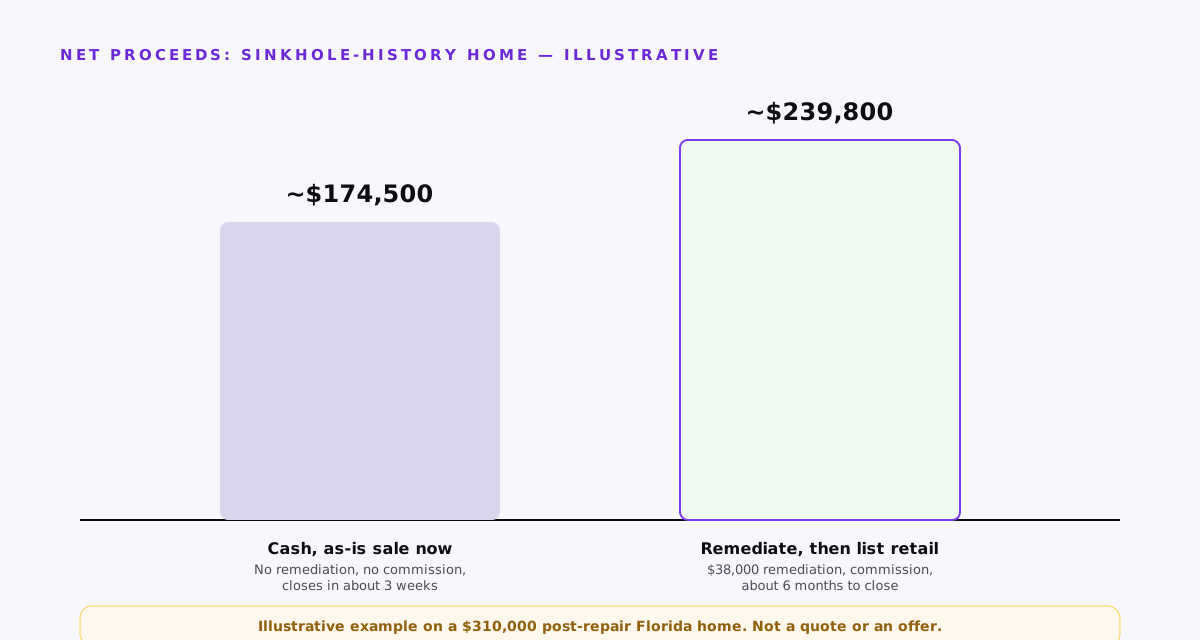
Illustrative example (a $310,000 post-repair Florida home, not a quote or offer). Remediate-then-list-retail path: retail sale price after a certified repair, $310,000, minus compaction grouting and engineer certification $38,000, minus agent commission (~5.5%) $17,050, minus seller closing costs (~1.5%) $4,650, minus holding costs during a 6-month remediation-and-sale timeline $10,500 — net proceeds roughly $239,800. Cash, as-is sale path: an offer reflecting the unrepaired condition and the buyer's own remediation risk, $176,000, no remediation cost, no commission, minimal closing costs, and 3 weeks instead of 6 months — net proceeds roughly $174,500.
The remediate-first path nets about $65,300 more in this example, but it requires fronting $38,000 before you have a buyer, waiting out permitting and grouting work, and carrying the house for months while hoping the certification satisfies the eventual buyer's lender. If you don't have $38,000 to front, can't qualify for a repair loan against an unremediated house, or simply can't carry the property for half a year, the math behind a faster, certain, lower cash sale becomes a lot more reasonable than the sticker-shock gap makes it look at first glance.
Fully remediate, get the engineer's certification, then list retail. Nets the most in the example above, at the cost of a large upfront repair bill and months of permitting, grouting, and re-inspection.
List as-is at a reduced price, disclosed, to a buyer who accepts the remediation risk themselves. Skips the repair bill but usually still requires a buyer willing to either pay cash or find a lender comfortable with the property's condition — often a smaller, slower buyer pool than a fully repaired retail listing.
File the optional Sinkhole Loss claim first, if you carry that coverage and haven't already, and let the insurance proceeds fund some or all of the remediation before you decide how to sell. Whether this makes sense depends on your specific policy, deductible, and claim history — a conversation for your agent or a public adjuster, not something this guide can tell you to do.
A cash sale, as-is, now, before remediation starts. Skips the upfront repair bill and the months of permitting and grouting entirely, at a lower price than a certified, fully remediated retail sale would bring.
There's no universally right way to approach selling a house with sinkhole damage — the right route depends on your claim history, how much you can front for remediation, and how long you can carry the property. For the general math of a retail sale versus a cash sale independent of sinkhole specifics, see our guide on cash offers versus listing net proceeds. Foundation issues from causes other than sinkhole activity are covered separately in our guide on selling a house with foundation problems.
We'll give you a written offer within 24 hours and can buy a house with sinkhole damage or a paid sinkhole claim as-is, no remediation required — and if remediating first and listing nets you more, we'll say so.
All guides · Cash offer vs listing net proceeds · Selling a house with foundation problems · Selling a damaged house
Step 1 of 5
No obligation, no fees, no repairs. We respond the same day.
You’ll talk to Trevor McAmis, Owner & Acquisitions Lead
(313) 710-6129
Takes about two minutes. Or call (313) 710-6129 — we answer.
