Selling a house with severed mineral rights is usually possible — a title exception for separately-owned minerals is common enough that it's routinely disclosed and waived, not a dealbreaker. Fannie Mae's own underwriting guide treats outstanding mineral rights as a minor, typically waivable title impediment, not a reason to deny a loan, as long as they don't materially affect the property's use or value. The real work is confirming who owns the minerals, whether any drilling is planned or active, and disclosing it accurately — not assuming the sale is blocked.

Step 1 of 5
Tell us what the title search turned up. We'll tell you honestly whether it affects our offer and how we'd structure around it.
You’ll talk to Trevor McAmis, Owner & Acquisitions Lead
(313) 710-6129
Takes about two minutes. Or call (313) 710-6129 — we answer.
Educational only. This explains how these situations generally work. It is not legal, tax or financial advice, and the rules differ by state — talk to an attorney or CPA about your own situation before you act on any of it.
Mineral rights get separated from surface ownership one of two ways: a prior owner sold the surface but kept the minerals for themselves (a reservation written into the deed), or someone later sold the mineral rights off separately while keeping the house and land. Either way, you end up with two legally independent property interests stacked on the same parcel — you own the surface and everything built on it, someone else owns whatever oil, gas, coal, or other minerals sit underneath.
The legal default in most states treats the mineral estate as dominant — meaning the mineral owner (or their lessee) generally has an implied right to use the surface as reasonably necessary to get at what they own, without your permission and without paying for ordinary, non-negligent damage, unless a lease or agreement says otherwise. The Texas Railroad Commission's own FAQ states this plainly for Texas; the same basic doctrine applies in most states with a long history of mineral severance.
Severed mineral estates are especially common on older, rural, and formerly-agricultural parcels, and Texas has one of the longest, most well-documented histories of it in the country. Mineral reservations were a routine practice for generations of Texas landowners and land companies, which is why a title search on an older Texas property turns this up more often than buyers expect.
Texas A&M AgriLife Extension's real estate law program confirms this history directly and lays out the practical mechanics that govern it today, including the accommodation doctrine — a three-part test courts use to decide when a mineral owner's surface use has to yield to an existing, incompatible surface use, if the surface owner has no reasonable alternative and the mineral owner does (Texas A&M AgriLife Extension). Texas's Common Courtesy Act, enacted in 2015, requires an operator to give a surface owner 15 days' written notice before drilling or re-entering a well.
This isn't only a Texas issue — it shows up across our other markets too, just less often, typically tied to a specific county's older rural or agricultural deed history rather than a statewide pattern.
Usually not. Severed mineral rights show up on a title search and in a title insurance policy as a standard exception, not an insurability problem — the policy simply excludes the minerals from coverage rather than refusing to insure the rest of the property.
On the lending side, Fannie Mae's Selling Guide (B7-2-05) groups "outstanding oil, water, or mineral rights" with the kind of minor title impediments lenders customarily waive, so long as they don't materially alter the property's contour or impair its value or intended use — it's explicitly in the acceptable category, not the kind of defect that blocks a loan outright.
Where it genuinely matters more: if there's active drilling, a pending lease, or visible surface infrastructure (a well pad, pipeline, access road) already on the property, or a real prospect of it. That's a disclosure issue and, often, a real value and livability consideration — not just a paperwork footnote — and it deserves a straight answer to a buyer's question, not a minimized one.
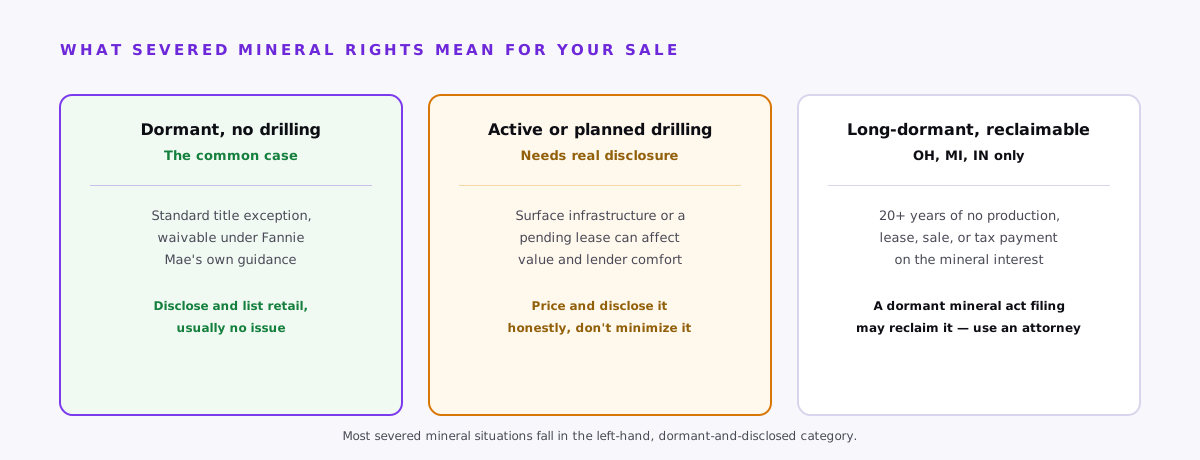
Three of our markets have a real statutory path for a surface owner to reclaim mineral rights that have sat completely unused for a long time: Ohio, Michigan, and Indiana. All three use roughly the same structure — a mineral interest that's gone 20 years with no production, no lease, no recorded transaction, and no tax payment on it is treated as abandoned, and a surface owner can file to have it vest back to them.
Ohio's version (ORC 5301.56) requires serving notice on the mineral holder, who then has 60 days to file a preservation claim showing qualifying use within the prior 20 years; if they don't respond, the surface owner files an affidavit of abandonment. One real wrinkle worth knowing: Ohio's law has gone through two versions, and the Ohio Supreme Court held the original 1989 version wasn't self-executing — surface owners actually had to bring a quiet title action, not just declare abandonment on their own. The current notice-and-affidavit procedure governs claims made since 2006. Michigan's statute (MCL 554.291) uses the same 20-year non-use standard. Indiana's Dormant Mineral Interests Act (IC 32-23-10) does too, and even gives an owner who missed the filing deadline through inadvertence a 60-day window to still preserve their claim once they learn of the lapse.
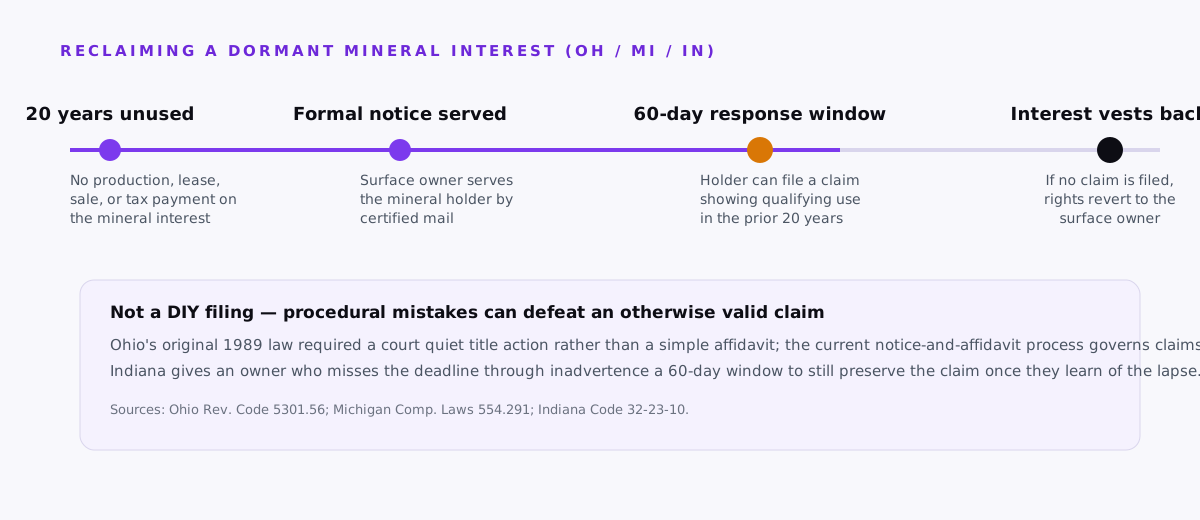
None of this is a quick DIY fix — it requires a full chain-of-title search to confirm 20 years of genuine non-use, certified-mail notice, waiting out response periods, and correctly filed paperwork, so budget for a real estate or oil-and-gas attorney if you want to pursue it rather than just disclose and sell around it.
A dormant, unused mineral reservation with no drilling in sight has a real but usually modest effect on value — it shows up more as a disclosure item and a minor negotiation point than a major price hit, which is exactly why Fannie Mae treats it as a waivable impediment rather than a dealbreaker.
An active or clearly pending extraction situation is a different, bigger conversation, and pricing that honestly — rather than glossing over it to protect a number — is the only way to avoid a deal falling apart at inspection or appraisal.
The honest tradeoff for a seller: listing retail works fine for a typical dormant severed-mineral situation once it's disclosed, since most lenders waive it the same way Fannie Mae's own guide describes. Where a cash sale earns its place is when the situation is messier — active drilling nearby, a lease a buyer's lender balks at, or a seller who simply doesn't want to spend months explaining a title exception to a string of financed buyers who get spooked and walk. A cash offer trades some of that top-end retail number for certainty and speed, same as with any other disclosed title issue — it isn't a reason by itself to expect a dramatically lower price if the mineral situation is genuinely dormant and disclosed clearly.
Disclose it and list retail. In the common, dormant, no-drilling case, most lenders will waive it as a minor title impediment, same as Fannie Mae's own guidance describes.
Try to buy back or consolidate the mineral rights if the current owner is locatable and willing to sell — this can simplify title and remove the issue entirely, though it takes time and negotiation.
Pursue a dormant mineral act reclamation if you're in Ohio, Michigan, or Indiana and can document 20 years of genuine non-use — talk to an attorney before relying on this, since the filing procedure is specific and unforgiving of mistakes.
Negotiate a surface use agreement if there's active or planned extraction, to get notice requirements, restoration terms, and protected areas in writing before a buyer has to weigh in on it.
Sell for cash with the issue disclosed. Skips the retail back-and-forth entirely if you'd rather not manage buyer nerves over a title exception — send us the property here and we'll give you a straight answer on how it affects our number.
This article is general educational information, not legal advice. Mineral rights law, dormant mineral statutes, and lender treatment of title exceptions vary by state and by the specific facts of your title. Talk to a real estate attorney and your title company before deciding how to proceed.
We buy houses with disclosed title exceptions, including severed mineral rights, all the time — no lender in the loop means no underwriter deciding it's a problem. We'll give you a straight answer on how it affects our number.
All guides · Title insurance cost, explained · Selling an inherited house · Seller closing costs
Step 1 of 5
No obligation, no fees, no repairs. We respond the same day.
You’ll talk to Trevor McAmis, Owner & Acquisitions Lead
(313) 710-6129
Takes about two minutes. Or call (313) 710-6129 — we answer.
