Selling a house with PFAS-contaminated water is, for most sellers, not actually a problem you need to solve — the EPA's drinking-water rule binds public water utilities, not homeowners, and there is no federal disclosure duty tied to selling a house on public water. The real exception is narrow: a private well inside a documented contamination plume, which in our markets means parts of Kent County, Michigan or the lower Cape Fear region of North Carolina. Outside those specific areas, there is no confirmed PFAS issue to price into your sale.
Step 1 of 5
Tell us what the test showed and whether it's been treated. We'll give you a straight answer on how it affects our number.
You’ll talk to Trevor McAmis, Owner & Acquisitions Lead
(313) 710-6129
Takes about two minutes. Or call (313) 710-6129 — we answer.
Educational only. This explains how these situations generally work. It is not legal, tax or financial advice, and the rules differ by state — talk to an attorney or CPA about your own situation before you act on any of it.
PFAS (“per- and polyfluoroalkyl substances,” nicknamed “forever chemicals”) are a family of manufactured chemicals used for decades in firefighting foam, nonstick cookware, water-repellent fabric, and industrial processes. They don't break down in the environment, which is how they end up in groundwater near old manufacturing sites, landfills, and military bases that used firefighting foam for training.
In April 2024, the EPA finalized the first-ever national PFAS drinking water rule, setting enforceable limits for six compounds — PFOA and PFOS at 4.0 parts per trillion each, PFHxS, PFNA, and GenX (HFPO-DA) at 10 parts per trillion, plus a combined “Hazard Index” limit for mixtures of several of these chemicals together (EPA: PFAS and the Safe Drinking Water Act). Public water systems had until 2029 to come into compliance.
That timeline is currently moving, not settled. As of this writing, EPA has proposed keeping the PFOA/PFOS limits in place but pushing the compliance deadline out to 2031, while separately proposing to rescind the limits on the other four compounds entirely on procedural grounds. If you're researching this because a home inspection or a neighbor mentioned PFAS, know that the exact regulatory endpoint is still being litigated at the federal level — treat any claim that this is fully finalized and resolved with some skepticism, including on this page, since the rule could look different by the time a system's compliance deadline actually arrives.
None of this applies to you directly if you're on a private well. The EPA is explicit that private wells are not regulated under the Safe Drinking Water Act at all (EPA: Private Drinking Water Wells) — testing and treatment are the well owner's responsibility, not a federal mandate, and there's no federal PFAS testing requirement comparable to lead or radon disclosure rules.
We buy houses in Alabama, Arizona, Florida, Georgia, Indiana, Maryland, Michigan, Missouri, New York, North Carolina, Ohio, and Texas. Two of those states contain some of the country's most documented PFAS groundwater plumes.
Michigan. The state has mapped and responded to PFAS contamination tied to industrial sites, including a well-documented tannery-waste dump area in Kent County near Rockford, and to military bases that used PFAS-containing firefighting foam, including the former Wurtsmith Air Force Base near Oscoda. Affected households in documented plumes have in some cases been moved onto municipal water or given filtration as part of a negotiated response. If your property sits inside one of these mapped areas, a buyer's agent, appraiser, or attorney doing diligence may well turn it up — and Michigan's general Seller Disclosure Act already requires disclosing known environmental hazards and well or water-supply issues on its standard disclosure form, which would reasonably capture a known PFAS problem even though the form doesn't name PFAS specifically.
North Carolina. The Chemours Fayetteville Works facility on the Cape Fear River was identified in 2017 as a source of GenX and related compounds reaching both the river, a drinking water source for several downstream utilities, and private wells near the plant. A 2019 consent order between North Carolina regulators and Chemours required the company to stop discharging, cut air emissions, and provide alternative water — public hookups or home filtration — to households with contaminated wells near the facility (NC DEQ: GenX Investigation). In September 2026, Chemours and its spin-off partners agreed to pay $455 million over 15 years to settle the remaining Fayetteville Works and statewide firefighting-foam claims with the state and affected local governments. If your well falls inside the tested and confirmed contamination zone — Bladen, Cumberland, Robeson, and Sampson counties near the plant, and parts of New Hanover, Brunswick, Columbus, and Pender counties downriver — you may already have documentation of your well's test result and whatever remedy you were offered.
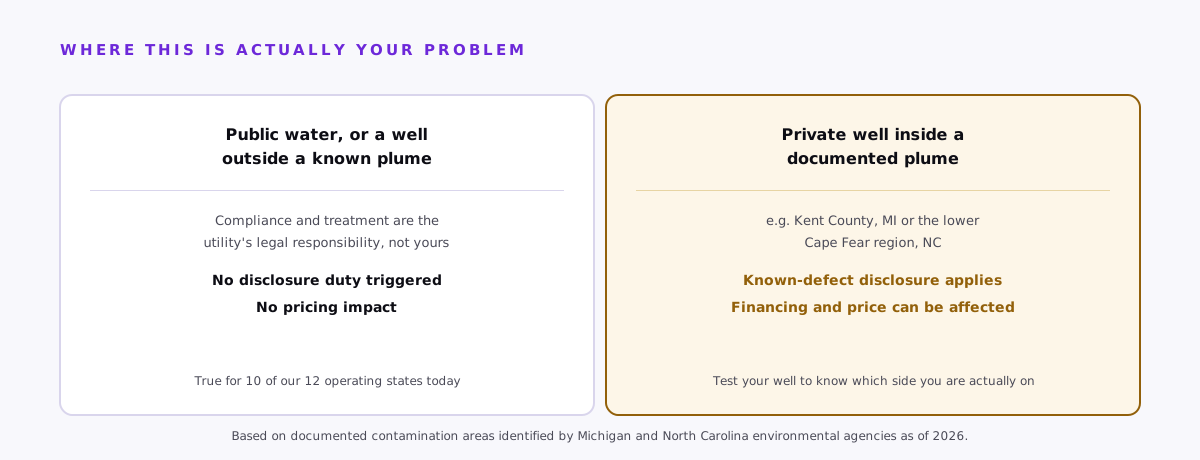
If you're not in one of these two documented situations, or the equivalent in another state, there currently isn't a confirmed PFAS disclosure obligation or financing wrinkle to plan around. We'd rather tell you that plainly than manufacture a worry that doesn't apply to your sale.
Disclosure. None of our twelve states has a PFAS-specific real estate disclosure statute on the books today. What you do have, in every state, is a general duty to disclose known material defects and environmental hazards — and a documented well-test result showing PFAS above a health guideline is about as squarely “known and material” as it gets. Disclose it the same way you'd disclose a known failed septic system or a documented mold problem: in writing, with whatever test results or agency correspondence you have.
Financing. A financed buyer's lender and appraiser may ask about documented water contamination the same way they'd ask about a failed well or septic inspection — it's handled as a property-condition issue, not a unique PFAS underwriting category. If your property is already connected to a remedy (municipal hookup, an installed whole-house filtration system with maintenance records), that generally resolves the concern for underwriting purposes; an untreated, actively contaminated private well is a harder sell to a financed buyer regardless of the chemical involved.
Cost. A private PFAS water test runs roughly $150 to $600 depending on the lab and how many compounds are tested. Whole-house treatment — typically granular activated carbon or reverse osmosis — commonly runs from a couple thousand dollars for a basic point-of-use system up into five figures for whole-house reverse osmosis, plus ongoing filter maintenance. If your property is inside a documented plume with an active consent order or settlement, as in the North Carolina Chemours case, ask directly whether your household already qualifies for employer- or settlement-funded filtration or a water-line hookup before you pay for this yourself — some affected residents already have.
If you're on municipal water with no known contamination, or on a private well outside a documented plume, PFAS realistically isn't a pricing factor in your sale — don't let a vague PFAS headline talk you into discounting a house that has no actual exposure.
If you are in a documented plume with an untreated well, here's the honest math most sellers in that position face. On a $240,000 house, treating the well first with whole-house filtration ($4,000 to $10,000) and then listing retail nets roughly $216,800 after commission and closing costs. Selling as-is for cash, reflecting the unresolved well issue, nets roughly $198,000 to $210,000, closing in about two weeks with no filtration cost up front.
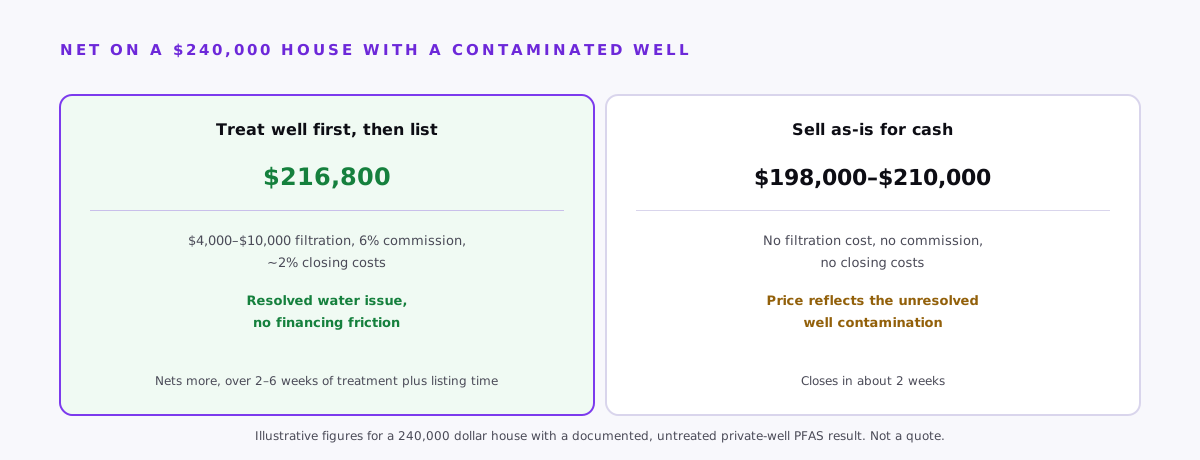
Treating the well first and listing retail nets more in almost every case where you can fund it and the timeline works — that's the honest answer, not a sales pitch. A cash sale earns its place when you can't front the filtration cost, you'd rather not manage remediation and verification yourself, or you need to move before a system could realistically be installed and tested.
1. Test the well yourself first, even if you're not required to. Knowing your actual numbers — not a headline about a plume miles away — is the only way to price this accurately.
2. Check whether you already qualify for a settlement- or program-funded remedy before spending your own money on filtration, especially in North Carolina's Chemours-affected counties or Michigan's documented plume areas.
3. Talk to a real estate attorney before you sign a disclosure form if you have an actual documented result — this page is educational, not legal or environmental advice for your specific property.
4. List it with an agent if the house is otherwise in good shape and you can fund a filtration fix — on these numbers, that route nets more than a cash sale most of the time.
If a cash sale is still the better fit for your timeline or situation, send us the address and we'll give you a straight answer on how we'd price around a documented water issue — no obligation. This page is educational only and is not legal or environmental advice; talk to a real estate attorney about your specific situation.
If you can fund a whole-house filtration system and the timeline works, treat the well first and list retail — on the numbers below, that route nets more almost every time. We'd tell you that on the phone.
Where a cash sale earns its place is narrower: you can't front the filtration cost, you'd rather not manage installation and verification yourself, or you need to move faster than treating the well allows. Send the address and we'll send a written offer within 24 hours that accounts honestly for the water issue. No cost, no obligation.
All guides · Selling a house with a private well · Cash offer vs listing net proceeds · Selling a house with mold
Step 1 of 5
No obligation, no fees, no repairs. We respond the same day.
You’ll talk to Trevor McAmis, Owner & Acquisitions Lead
(313) 710-6129
Takes about two minutes. Or call (313) 710-6129 — we answer.
