<b>A landlocked house with no legal access can still be sold, but most mortgage lenders won't finance it until the access problem is resolved, and title insurers will typically except it from coverage.</b> Your realistic paths are a court or county process to force access (months, often several thousand dollars, no guaranteed outcome), a negotiated and recorded easement with the neighbor who controls the path (cheaper and faster, but still real money), or a sale to a buyer who doesn't need a lender's sign-off to close.
Step 1 of 5
Tell us about the property and we'll send a written cash offer within 24 hours, no legal access required before closing, no repairs, no commissions.
You’ll talk to Trevor McAmis, Owner & Acquisitions Lead
(313) 710-6129
Takes about two minutes. Or call (313) 710-6129 — we answer.
Educational only. This explains how these situations generally work. It is not legal, tax or financial advice, and the rules differ by state — talk to an attorney or CPA about your own situation before you act on any of it.
No legal access means there is no recorded easement, no deeded right-of-way, and no public road frontage connecting your parcel to a public street — whatever path people actually use to reach the house crosses someone else's land with nothing on file at the county recorder's office granting that right. That's different from a house with a shared driveway or an access easement that exists but was never properly documented, where a real right to cross almost certainly exists and the fix is usually paperwork.
Cornell Law School's Legal Information Institute defines a landlocked parcel as one that “lacks direct access to a public roadway and can only be reached by crossing another person's property.” The same entry notes owners generally have two paths: negotiate and purchase an easement from the neighboring landowner, or rely on an easement by necessity if the parcel was created when a larger tract under common ownership was split apart.
Mortgage lenders and title insurers both require a recorded, enforceable right to cross whatever land sits between your parcel and the public road, and a landlocked house with no legal access doesn't have one, so both sides of a financed deal stall at the same point. Title insurers underwrite to marketable title, and a parcel with no recorded access does not have it.
A title search that turns up no recorded easement typically produces a specific exception on the title commitment — something like “lack of right of access to and from the land” — and most title companies will either decline to insure the parcel at all or will insure it while carving out any claim related to access. FHA, VA, and conventional underwriters generally will not close a loan without confirmed, recorded legal access, because an unresolved access problem threatens the collateral itself. That single requirement is why a landlocked house effectively loses most of the financed-buyer pool before a showing ever happens.
Say you have a landlocked house that would be worth roughly $235,000 with normal recorded access. Here's what each path to a sale actually costs in money and time, worked out on that number.
A court or county access petition (an easement-by-necessity or statutory private-road action) typically runs $3,000 to $12,000 or more in attorney, survey, and filing costs for an uncontested case, and $15,000 to $40,000-plus if a neighbor contests it — commonly taking 6 to 18 months, and well past 24 months if contested, with no guaranteed outcome. A voluntary recorded easement with a cooperative neighbor typically runs $1,500 to $4,000 for survey and drafting costs, plus whatever the neighbor wants for granting it, and can often close in 30 to 90 days. Selling as-is to a buyer who doesn't need a lender skips both: no legal spend before closing, typically 1 to 3 weeks, at a lower price that reflects the access problem and the smaller pool of buyers who can purchase it at all.
| Path | Typical cost | Typical timeline | Needs neighbor? |
|---|---|---|---|
| Court/county access petition | $3,000–$12,000+ (up to $40,000+ if contested) | 6–18 months (24+ if contested) | No |
| Voluntary recorded easement | $1,500–$4,000 + neighbor's ask | 30–90 days | Yes |
| Sell as-is for cash | No legal cost before closing | 1–3 weeks | No |
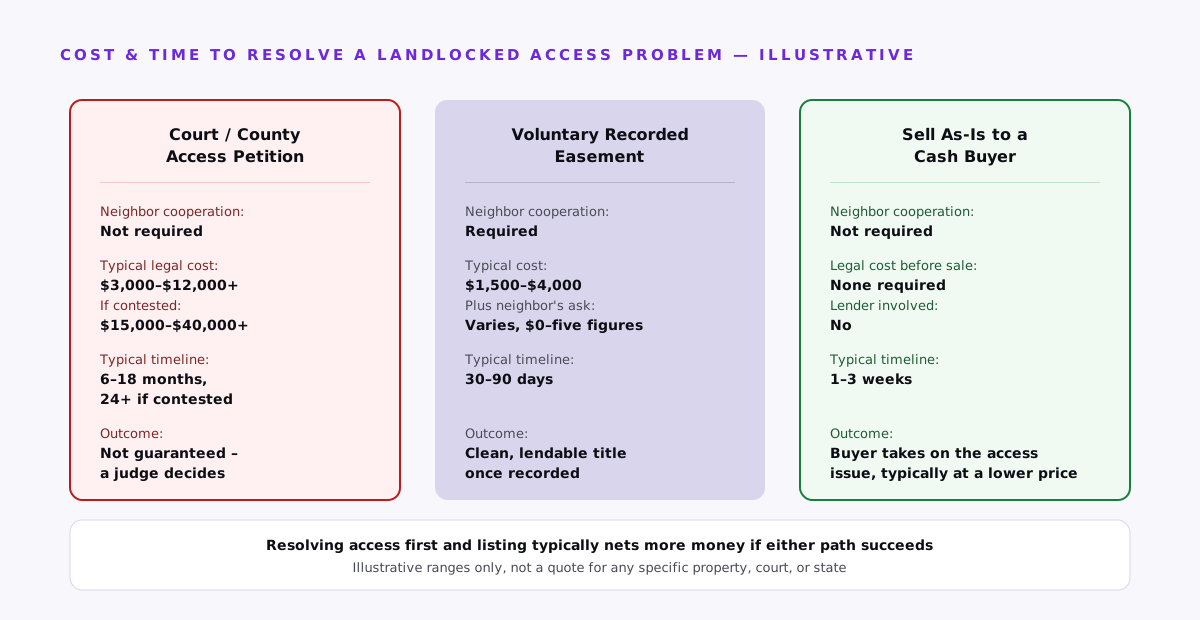
The arithmetic isn't close on net dollars if either legal path succeeds — both typically net more than an as-is cash sale. What the spreadsheet doesn't show is the risk: the court path can take years and still fail, and the negotiated-easement path depends entirely on one neighbor's willingness to deal, today and for as long as it takes to finish the paperwork.
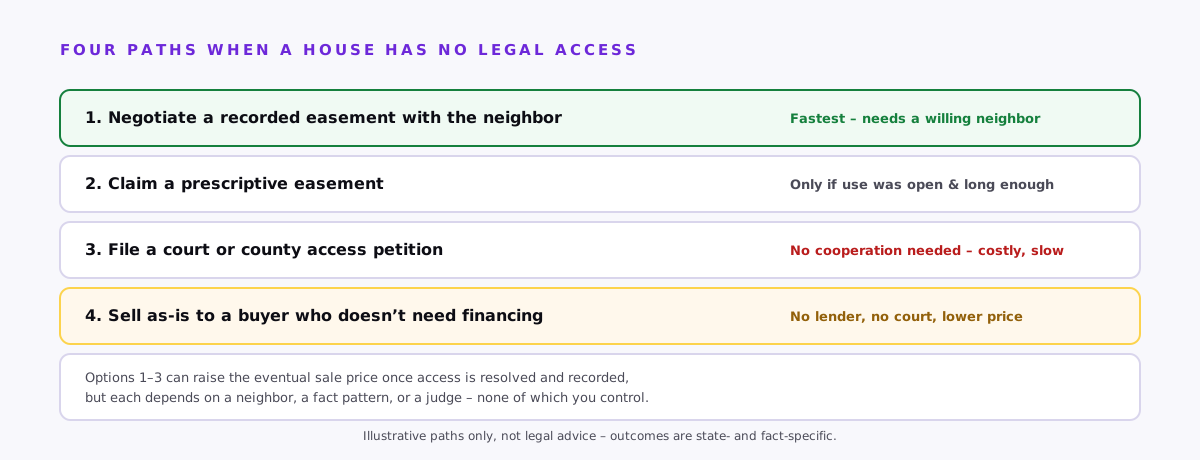
A lawsuit is the most expensive and slowest way to fix a landlocked parcel's access problem, which is exactly why it's usually the last option tried, not the first. Before filing anything, most owners look at three other paths: negotiating directly with the neighbor who controls the path, a prescriptive-easement claim if the access has genuinely been used long enough, and a formal statutory petition if neither of those works.
Negotiate directly with the neighbor who controls the path. Almost always worth trying first, because a recorded agreement is dramatically cheaper than a court case and can close in weeks. Bring a surveyor's sketch of the exact route you're asking for, and expect to pay something — cash, a strip of land, or ongoing maintenance responsibility — for cooperation.
A prescriptive-easement claim, if the path has genuinely been used long enough. If you or a prior owner used the same route openly, continuously, and without the neighbor's permission for your state's statutory period, you may be able to claim a prescriptive easement instead of negotiating one. Cornell LII defines this as an easement “acquired through open and notorious use of an owner's land which is adverse to the owner's rights, for a continuous and uninterrupted period of years,” noting the required number of years is set by state law and varies. This is fact-dependent and not guaranteed — permissive use typically defeats the claim.
A formal court or county petition for access. Most states have a statutory process letting a landlocked owner ask a court, or in some states a county authority, to establish access across a neighbor's land in exchange for paying that neighbor's assessed damages. North Carolina's version, confirmed directly on the state's own code site, is G.S. 136-69, which lets a petitioner ask the court to lay off a “cartway” 18 to 30 feet wide once a jury of view confirms doing so is necessary, reasonable, and just. Georgia and Texas both have comparable statutes, and most other states have something similar under a different name — but confirm the current citation and procedure with a local real estate attorney rather than a secondhand summary.
This is educational only, not legal advice. Resolving an access problem is a real legal process with state-specific rules and evidence requirements — talk to a real estate attorney licensed in your state before filing anything or signing an easement agreement.
A cash offer accounts for the access problem as-is, so you're not stuck choosing between a lawsuit, a neighbor negotiation, or waiting to list until a court case resolves.
You'll get a written offer within 24 hours, no repairs or commissions required, and you pick the closing date. We're a direct buyer, not an attorney, agent, or broker, and this isn't legal advice.
All guides · Selling a house with a shared driveway or access easement · Selling a house with a boundary line dispute · Cash offer vs. listing net proceeds
Step 1 of 5
No obligation, no fees, no repairs. We respond the same day.
You’ll talk to Trevor McAmis, Owner & Acquisitions Lead
(313) 710-6129
Takes about two minutes. Or call (313) 710-6129 — we answer.