Synthetic stucco (EIFS) moisture damage happens when water gets behind the foam panel on the wall and can't drain out, slowly rotting the sheathing and framing underneath. For a seller it matters for three reasons: you can't see it from outside, it's expensive to fix once it's real, and once you know about it you have to disclose it.
Step 1 of 5
Tell us about the property and we'll send a written cash offer within 24 hours that already accounts for the stucco. No repairs, no commissions.
You’ll talk to Trevor McAmis, Owner & Acquisitions Lead
(313) 710-6129
Takes about two minutes. Your address is never shared.
Educational only. This explains how these situations generally work. It is not legal, tax or financial advice, and the rules differ by state. Talk to an attorney or CPA about your own situation before you act on any of it.
EIFS stands for Exterior Insulation and Finish System. Most homeowners know it as synthetic stucco. It's a foam insulation board glued to the house, covered with fiberglass mesh and a thin acrylic finish textured to look like real stucco. The look isn't the problem. Drainage is.
Older “barrier” EIFS, common through the 1990s, was built to seal the wall and keep all water out at the surface. Water gets in anyway: through a hairline crack, a badly flashed window, a deck ledger board, or a roofline without kick-out flashing. Once it's behind barrier EIFS it has nowhere to go. It sits against the sheathing and studs and keeps them wet, sometimes for years, while the outside looks fine.
“Drainable” EIFS became the industry standard after the mid-1990s. It adds a water-resistant barrier and a drainage gap so water that gets in can run back out. It's a much safer system, but a lot of pre-2000 houses still have the older barrier version, including many in the Carolinas, where the problem first got national attention.
Tap it. Traditional cement stucco over wire lath feels hard and sounds solid, close to knocking on concrete. EIFS has foam underneath, so it sounds hollow and gives a little when you press it. Up close, EIFS usually has a more uniform, slightly plastic-looking texture, and it's only about 1/16 to 3/8 inch thick, compared with 3/4 inch or more for real stucco.
If your house was built or re-sided between the early 1980s and mid-2000s and has a stucco-style finish, find out which kind it is before you list or price any repair. A licensed inspector or an EIFS moisture specialist can tell you in minutes.
The damage is almost always worse than what shows, so a walk-around isn't enough once there's a reason to suspect a problem. EIFS-trained inspectors work in layers. They start with a visual check for cracks, failed caulk, missing kick-out flashing, and EIFS that runs into the ground (it should stop at least 6 inches above grade), per InterNACHI guidance on EIFS water damage.
Probe testing comes next. A technician pushes a small moisture probe through the cladding at common trouble spots, leaving a hole about 1/8 inch wide that gets sealed afterward, and reads the actual moisture level in the wall. Infrared imaging scans the wall from outside and shows wet areas as cooler, darker patches, which maps the likely extent of a problem without cutting anything (InterNACHI on infrared moisture inspection). Invasive testing is the last step when the probe or infrared results look bad: a contractor cuts out a section of EIFS and sheathing to see the framing underneath. It's the only way to know for sure how far the rot has gone.
EIFS repair isn't one price. It depends on what's going on behind the wall. Patching a crack or small hole with no water damage runs a few hundred dollars. Once water has gotten into the wall, the cost jumps, because you're paying for whatever is rotting under the surface.
According to HomeAdvisor's stucco cost data, water-damage repairs to stucco and EIFS run $30 to $50 per square foot, compared with $8 to $20 for a plain crack repair. If the EIFS has to come off entirely, removal alone runs $1 to $3 per square foot, and new EIFS runs $8 to $12 per square foot. Add it up and a full removal, structural repair and re-clad on an average one-story house can reach $30,000 to $50,000 or more. If rot has spread across more than one wall, it goes higher. (HomeAdvisor stucco siding cost guide; HomeAdvisor stucco repair cost guide.) Mold remediation, if the moisture has been there long enough to grow it, is extra. HomeAdvisor puts a typical job around $2,200.
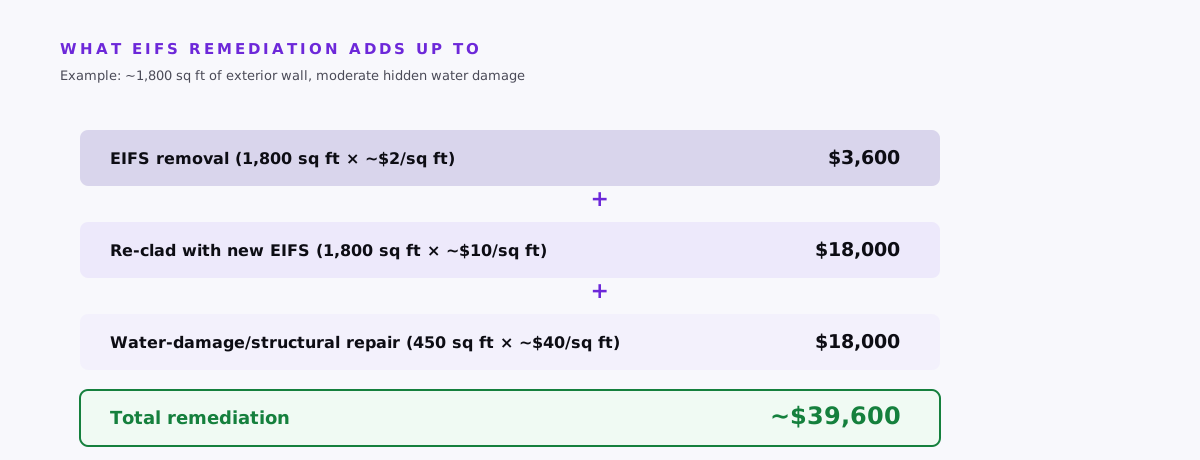
The only way to get your real number is to do the invasive inspection and price the actual scope. If moisture has led to mold, our guide on selling a house with mold covers the health and disclosure side.
Disclosure. In North Carolina, synthetic stucco, current or past, is treated as a material fact you must disclose, whatever box you check on the state form. NC REALTORS guidance on synthetic stucco disclosure points to Question #3 on the North Carolina Residential Property and Owners' Association Disclosure Statement, and notes that even if a seller marks “No Representation,” the agent still has to disclose it if they know.
The law behind it is North Carolina's Residential Property Disclosure Act (N.C. Gen. Stat. Chapter 47E), which requires sellers to disclose known defects by the time a buyer makes an offer. Selling “as-is” doesn't get you out of it. Other states have their own rules, so check yours with a real estate attorney.
Financing. Buyers using a conventional or FHA loan need an appraisal, and appraisers have to note whether the siding is traditional or synthetic stucco and flag visible damage. If moisture problems turn up, lenders often want an inspection or repairs before closing.
Insurance. Some insurers exclude or extra-underwrite EIFS homes with a history of moisture problems, which can make it harder for a buyer to get a policy in time to close.
Here's a worked example: a $280,000 house, typical for our North Carolina and Georgia markets, with about 1,800 square feet of exterior wall and moderate hidden water damage across about a quarter of it.
| Repair, then list | Sell as-is for cash | |
|---|---|---|
| Sale or offer price | $280,000 | $215,000 (example) |
| Remediation cost | −$39,600 | $0 |
| Commission (~6%) | −$16,800 | $0 |
| Holding costs (~3 months) | −$4,500 | ~$0 (fast close) |
| Buyer or appraiser concession | −$4,200 | $0 |
| Closing costs | included above | −$1,200 |
| Net to seller | ~$214,900 | ~$213,800 |
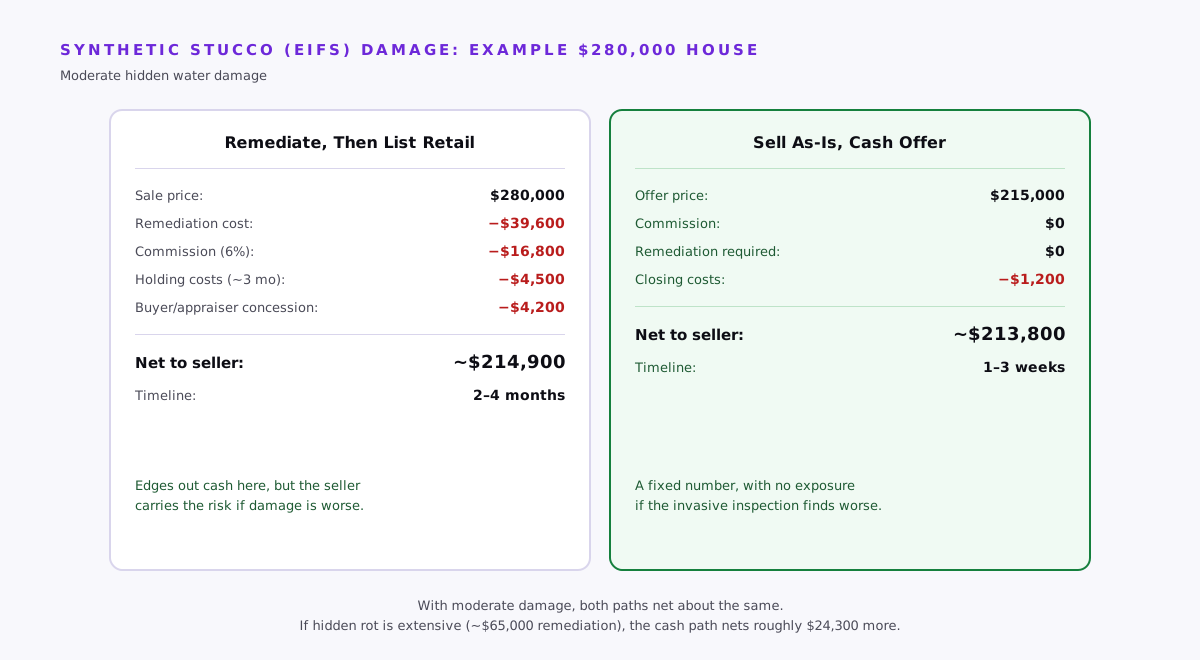
With moderate damage the two paths come out almost even. Listing nets about $1,100 more. That changes fast if the invasive inspection finds worse. If rot has spread through the framing on several walls and remediation runs closer to $65,000, the listing path drops to about $189,500, roughly $24,300 behind the cash sale. When you repair and list, you carry the risk of the repair bill coming in high. With a cash sale the buyer carries it, which is why the offer is lower but the number is fixed. The inspection result is what decides this one.
For more on whether any repair pays off before listing, see should I repair before selling, and for general prep costs, the cost of getting a house market-ready.
You have more choices than paying for everything or taking a cash offer.
List as-is with full disclosure and let the buyer's inspection and lender drive the negotiation. Many buyers will still go ahead and ask for a credit at closing instead of walking.
Get one remediation bid and credit the buyer at closing. The buyer gets a real, documented number, and you don't have to front the money or manage a contractor.
Sell as-is for cash. A lower price, but no repair bill, no commissions, no holding costs, and a closing date you can count on.
If you can wait and don't need to front any money, listing after a proper disclosure often nets more, as the example above shows. A cash sale makes the most sense when the damage is extensive, when you can't pay for repairs out of pocket, or when a fast, certain close matters more to you than the last few thousand dollars.
We buy houses as-is for cash, stucco problems included. Send the address and you'll have a written offer within 24 hours. No repairs, no commissions, and you pick the closing date. If the damage turns out to be minor and listing would net you more, we'll say so.
All guides · Selling a house with mold · Should I repair before selling? · Cost of getting a house market-ready before you list
Step 1 of 5
No obligation, no fees, no repairs. We respond the same day.
You’ll talk to Trevor McAmis, Owner & Acquisitions Lead
(313) 710-6129
Takes about two minutes. Your address is never shared.